
Heat Pump Leaking Water? Normal Runoff vs a Fault, and What to Do
Quick answer: A heat pump leaking water inside the house is a fault, most often a blocked or badly routed condensate drain, a clogged filter or a coil that has iced up, while water from the outdoor unit in winter is normal defrost runoff.
Water running down the wall under a heat pump is one of those problems that looks worse than it usually is, and gets worse the longer it’s left. The cause behind most indoor drips is a small one. The damage it does to gib, skirting, carpet and anything electrical underneath it is not small at all, and every day of dripping adds to the bill.
Free cost calculator
Weighing up a new heat pump instead of a repair?
Answer a few questions and we’ll email you an Auckland price range.
So the first question isn’t who to call. It’s where the water is. Some heat pump water is meant to be there, and some of it means switching the unit off now. The makers’ own manuals draw that line clearly. Forum threads and overseas air-conditioning blogs mostly don’t.
Heat Pump Leaking Water: Normal Runoff or a Fault?
A heat pump moves heat by running refrigerant through two coils, one inside and one outside. Whichever coil is cold at the time pulls moisture out of the air, the same way a cold drink sweats on a summer day. That water has to go somewhere. In a correctly installed system it goes somewhere you never see. When you can see it, its location tells you most of what you need to know.
Water at the outdoor unit in winter
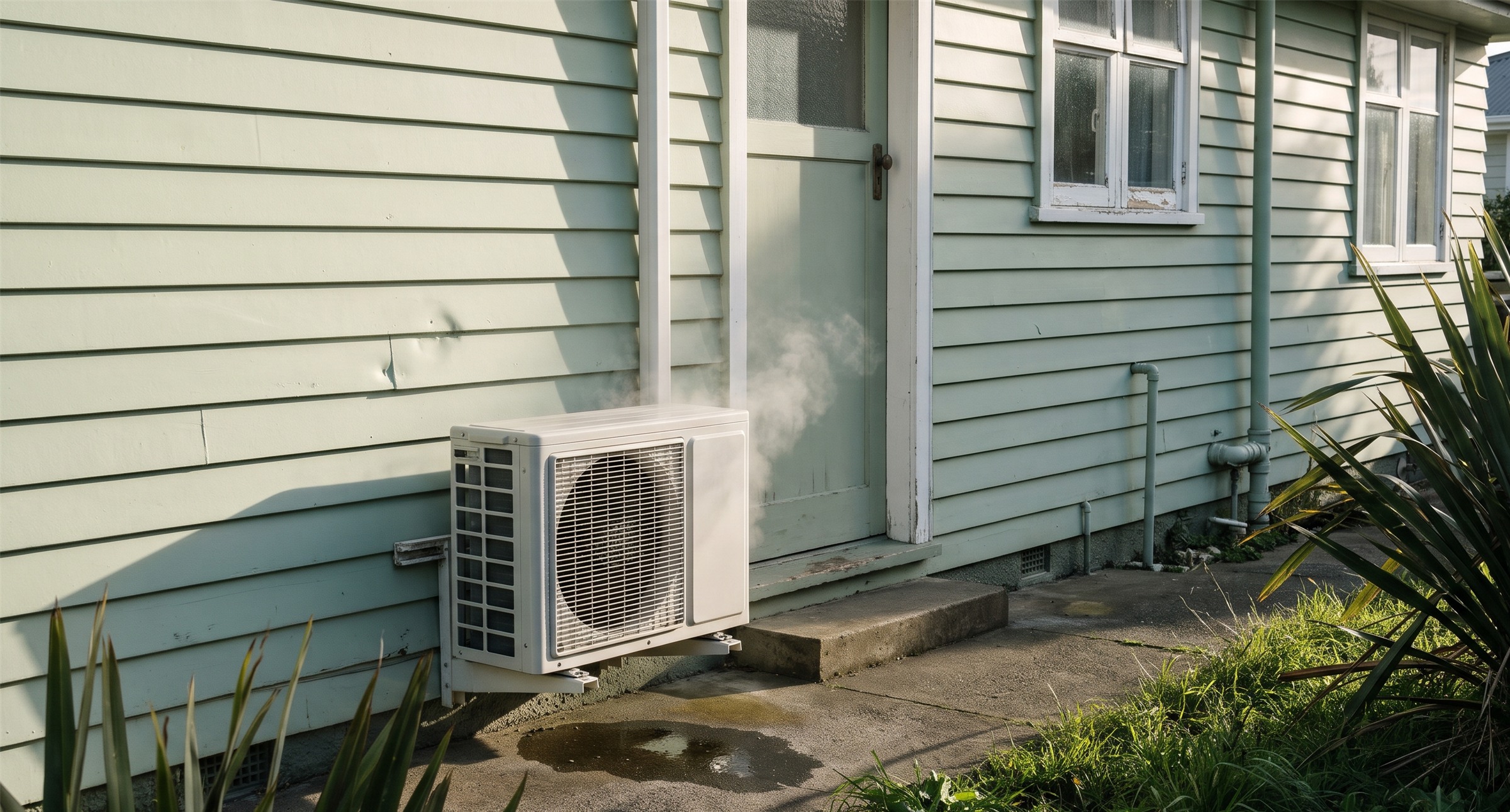
In heating mode the outdoor coil is the cold one, and on a cold, damp Auckland morning it can frost over. The unit deals with that by running a defrost cycle. GENERAL New Zealand’s operating manual for its ASTG09 and ASTG12 wall units explains that when frost forms, the system stops heating briefly and runs its defrost circuit for a maximum of 15 minutes, with an indicator blinking on the indoor unit while it does. It lists two things you’ll see outside during that time: the outdoor unit may emit water generated by the defrost, and steam may rise from it. Mitsubishi Electric New Zealand’s owner guide for its AP Series says the same thing more plainly: every heat pump defrosts from time to time in cold winter conditions, and that is normal.
So a puddle under the outdoor unit after a frosty night, or a cloud of steam rising off it while the lounge goes quiet for ten minutes, is the machine working as designed. Water outside in heating mode is runoff, not a leak. Where it becomes your problem is where it lands: on a path, a deck or a set of steps that ices over, or against a weatherboard wall that never dries out. That’s a placement question for whoever installed it, not a fault in the unit.
Water, mist or dripping at the indoor unit
In cooling or dry mode the indoor coil is the cold one, and it makes a lot more water. That water collects in a drain tray behind the front panel and leaves the house through a drain hose. If any part of that path fails, the water comes out the front or the side of the indoor unit instead. GENERAL’s manual puts “water leaks from the unit” on its short list of events where you stop the heat pump and disconnect the power, alongside a burning smell or smoke. That is the maker telling you an indoor leak is not a wait-and-see problem.
Two indoor effects are normal and easy to mistake for a fault. The manual says a thin mist can come out of the indoor unit in cooling or dry mode, from condensation as the air is cooled suddenly. It also gives an indoor humidity limit of 80 per cent or less, and warns that if the unit runs continuously for many hours above that, water may condense on the outside surface of the unit and drip. Neither is the drain failing. One is a visible puff of cold air, the other is a muggy room.
Reading the signs in one table
| What you see | Mode | Usually means | What to do |
|---|---|---|---|
| Water or steam at the outdoor unit, indoor unit paused | Heating, cold weather | Defrost cycle (up to 15 minutes) | Nothing, unless the runoff lands somewhere unsafe |
| Thin mist from the indoor vents | Cooling or dry | Condensation as air cools quickly | Nothing |
| Beads of water on the outside of the indoor unit | Cooling or dry, long run, humid room | Surface condensation above about 80 per cent humidity | Raise the louvre, ventilate, shorten the run |
| Steady drip or trickle from the front or side of the indoor unit | Any | Drain path blocked, misrouted or overflowing | Stop it, isolate the power, book a technician |
| Ice on the indoor coil, then dripping | Cooling or dry | Coil freezing, often from poor airflow | Stop it, check the filter, book a technician |
| Water on the wall below the unit after heavy rain | Any, including off | Rain getting in around the pipe hole | Book a technician to reseal the penetration |
Sources: GENERAL New Zealand operating manual (defrost, mist, humidity, freezing); Samsung New Zealand support (rain through the pipe hole).
💡 Property tip: Before you decide anything, note the mode the remote is in and whether the water appears only when it runs. Water that turns up with the unit switched off, after rain, is a building problem around the pipe hole, not a heat pump fault.
Why winter leaks surprise people
Most Auckland heat pumps spend the cold months in heating mode, when the indoor coil is warm and makes almost no water. Then a humid spell arrives, someone switches to cooling or dry for an evening, and a drain that has been quietly silting up for a year gets its first real load. That’s why a leak so often seems to appear from nowhere on the first hot, sticky day. The blockage was there all along; the unit just hadn’t asked the drain to do any work.
Dry mode deserves a mention here, because it’s the mode people reach for when a house feels damp. Mitsubishi Electric’s owner guide says its heat pumps offer limited dehumidification in dry mode, that the unit is not heating while it runs, and that a heat pump does not prevent condensation on its own. Dry mode makes water on purpose, which is exactly why it is the setting that exposes a tired drain. If the house has a real moisture problem, the guide points at ventilation and dehumidifiers rather than the heat pump.
Heat Pump Dripping Inside? What to Do in the First Ten Minutes
An indoor leak is a water problem and an electrical problem at the same time, so the order of the first few steps matters. Do them in this order and you protect the house, the unit and the evidence a technician needs.
Stop it and isolate the power
Turn the heat pump off with the remote, then turn off its circuit at the switchboard or isolator. GENERAL’s manual is specific about why the second step matters: for a water leak it says to stop operation and disconnect all power by turning off the breaker or unplugging the unit, and it warns that as long as the unit is connected to the power supply it is not insulated from it, even when switched off. Most fixed heat pumps have a labelled circuit at the switchboard and an isolating switch beside the outdoor unit. If you can’t tell which breaker it is, or the switchboard is wet, damaged or hot, leave it alone and call an electrician.
Two things not to do. Don’t keep running the unit to “see if it stops”: if the drain is blocked, every minute of running adds water to a tray that is already full.
And don’t cycle the breaker on and off to reset it. GENERAL also says not to start or stop the heat pump by switching the breaker or pulling the plug as a matter of course, and a breaker that trips because water has reached something live is a fault reporting itself. If that happens, leave it off and get an electrician to find the fault before anything is reset.
Protect what’s underneath
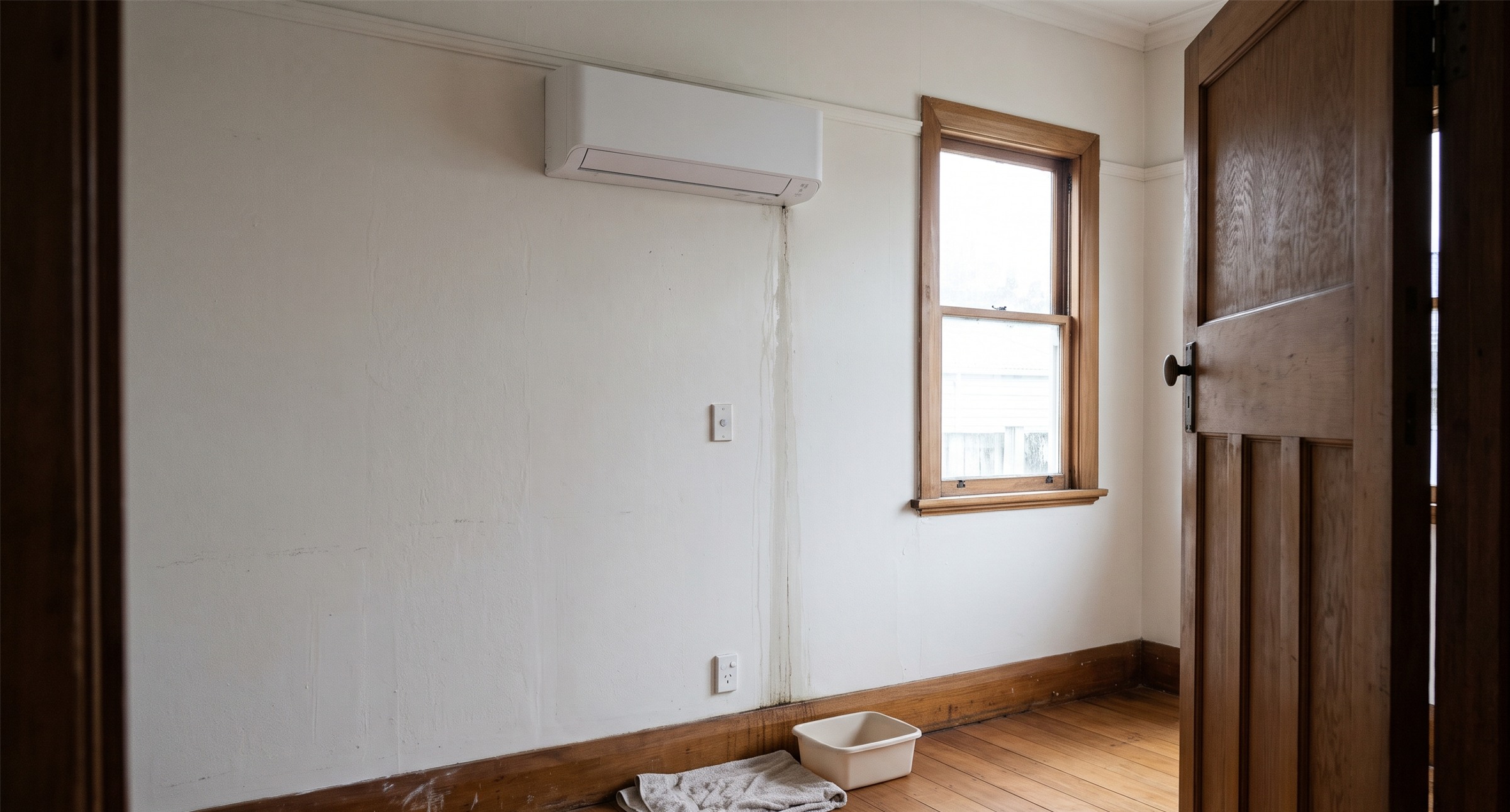
Move anything electrical out from under the indoor unit: televisions, power boards, chargers, a sound bar. GENERAL’s manual already tells owners not to put electrical products or household belongings under the unit, because dripping condensation can wet them and damage them. Put a towel on the floor and a container where the drip lands. Wipe the wall dry so you can see whether fresh water appears once the unit is off.
If water has run down inside the wall rather than over it, you may not see the extent of it. Watch the skirting, the bottom of the gib and the carpet edge over the next day or two. Tenancy Services’ mould and dampness guidance makes the point that hidden dampness left long enough can cause expensive damage, and that a qualified building surveyor may be needed to find it. A wall that stays dark after the unit has been off for a day is worth a second look.
Photograph it before anything moves
Take three photos: the drip itself with the unit’s display in frame, any error code or blinking light on the indoor unit, and the outside end of the drain hose if you can see it safely from the ground. Note the mode and set temperature on the remote. A technician can tell a lot from whether the water came from the front edge, the side, or behind the unit, and the error code disappears once the power has been off. If you have home insurance and the wall or floor is damaged, those photos are also the start of any claim.
The checks you can make yourself
There are two safe, legal jobs for the owner here, and both are on the makers’ own lists. The first is the filter. GENERAL’s manual has you open the intake grille, unclip the air filters, vacuum them or wash them in mild detergent and warm water, and dry them thoroughly in the shade before refitting. It also warns not to touch the aluminium fins of the heat exchanger inside, and to leave filter cleaning to a service technician if it means working at height. Mitsubishi Electric’s guide sets the filter clean at every seasonal change, done with a vacuum and a small brush attachment.
The second is the outside end of the drain hose. Without opening anything, look at where the hose comes out of the wall and where it ends.
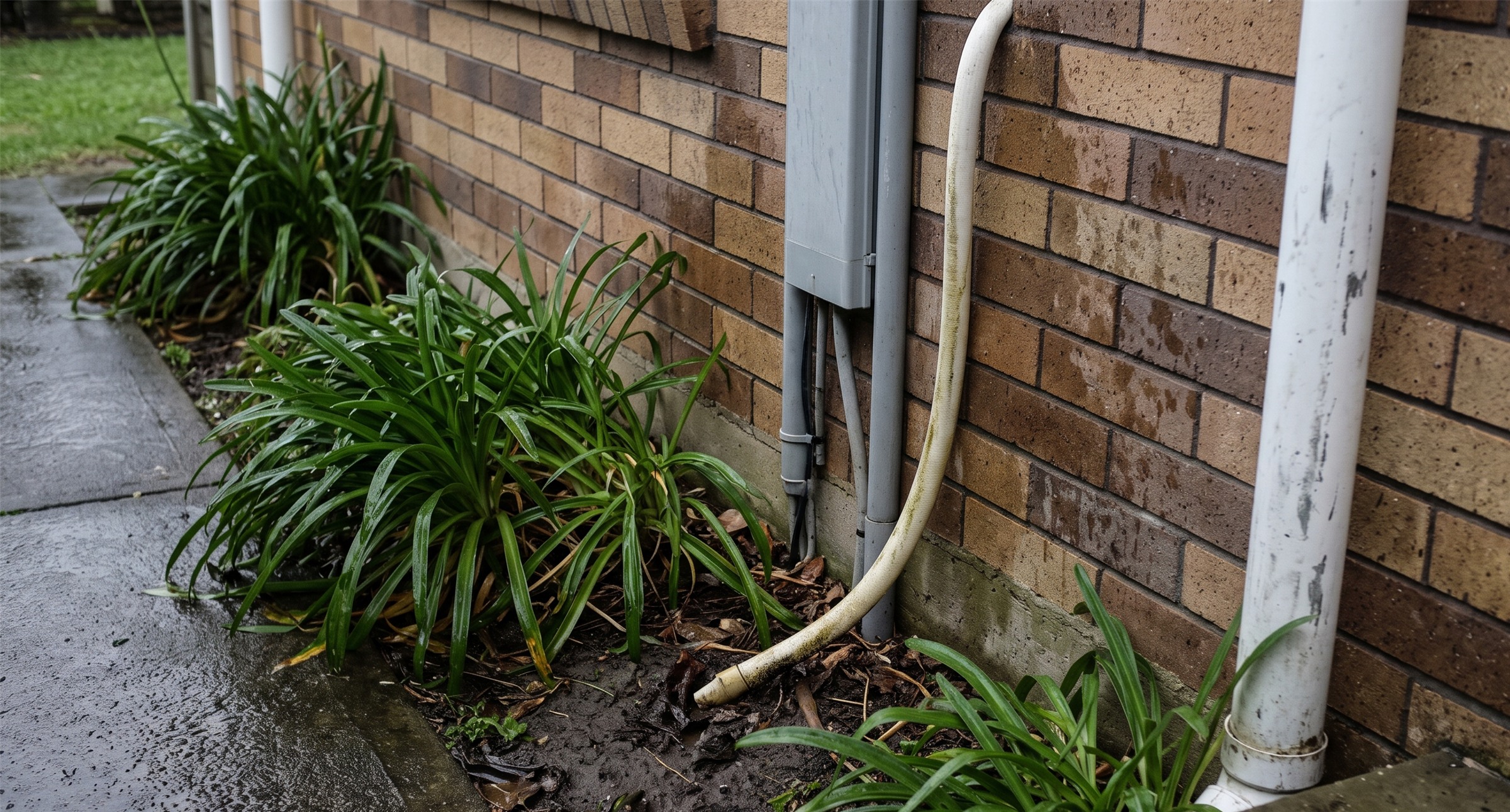
Samsung New Zealand’s support page on indoor water leakage lists the hose faults that send water back into the room: a hose that rises above the indoor unit, a hose that is bent, and a hose whose end sits under water so it flows back. A hose end buried in a garden bed, pushed into a full bucket or flattened behind a downpipe is something you can see from the ground. Freeing the end from mud or standing water is fine. Pulling the hose off the unit, poking wire up it from inside, or taking the front cover off is not, and GENERAL’s manual is blunt that the unit contains no user-serviceable parts.
Compliance note: The fixed wiring, isolator and circuit that supply a heat pump are electrical work for a registered electrician, and the refrigerant side is for qualified service personnel only. WorkSafe’s guide to doing your own electrical work sets out the limited list an owner-occupier may do; if a job isn’t on it, or you’re unsure, use a registered electrician.
What Usually Causes an Indoor Heat Pump Leak, and Who Fixes It
Once the unit is off and the room is safe, the cause narrows to a handful of things. Some are a service job, some are an installation fault, and one involves the refrigerant. Knowing which is which tells you who should come out and roughly what kind of bill to expect.
A blocked drain tray or hose
This is the most common one by a distance. Dust that gets past the filter, slime that grows in a warm, wet tray and insects that crawl up the hose from outside all end up in the same narrow outlet. Samsung’s support page lists a drain hole clogged from not being cleaned for a long time as one of its four causes of indoor leakage. Mitsubishi Electric New Zealand’s maintenance and responsibilities page lists removing salt, dust and contaminants from coils and drain trays, and making sure drains, airflow and filters work properly, among the reasons for regular servicing.
Clearing it properly means taking the front panel off, cleaning the tray, flushing the outlet and the hose through to the outside, and checking the water runs freely. That’s a technician’s job, because the tray sits beside the coil, the fan and the electronics. It’s also the core of what a proper heat pump service covers, which is why a unit that is serviced on schedule rarely leaks this way.
A dirty filter or coil, and a coil that freezes
A clogged filter does two things: it lets fine dust through to the coil and the tray, and it chokes the airflow. GENERAL’s manual says a dirty filter reduces airflow, lowers efficiency and increases noise.
Cut the airflow far enough in cooling or dry mode and the indoor coil can drop below freezing. The manual names this directly: depending on conditions, the heat exchanger may freeze in cooling or dry mode, causing water leakage. When the ice melts, it melts faster than the tray can drain, and the overflow comes out the front.
If you open the grille and see frost or ice on the coil, switch off and let it thaw with towels underneath. Then clean the filter before you run it again. If it ices up a second time with a clean filter, the cause is something a technician needs to measure, such as a fan fault or a refrigerant problem.
A unit that isn’t level, or a hose that doesn’t fall
The drain tray only empties if the water can run downhill from it. Samsung’s support page lists an indoor unit that is not horizontal, so the condensate overflows to one side, and a drain hose that rises above the unit or is bent. Both are installation faults. They often show up on a unit that has leaked from new, or on one that started leaking after something changed: a wall bracket that has dropped, a hose disturbed by a painter or a gardener, or a new deck or garden bed built over the hose outlet.
A leak that comes from one end of the unit only, or a puddle that always forms on the same side, points this way. The fix is relevelling the unit or rerouting the hose so the water can run out freely. On a recently installed system, ring the installer first, because a drain that was never set up to run downhill is their workmanship to put right.
Rain getting in around the pipe hole
Not every drip under a heat pump comes from the heat pump. The pipes, cable and drain hose leave the house through a hole in the wall behind the indoor unit. Samsung’s support page lists rainwater flowing in through that penetration as a cause of water at the indoor unit, and its fix is sealing the hole with putty or silicone. The giveaway is timing: water that appears after wind-driven rain, with the unit switched off, is coming from outside.
On an Auckland weatherboard or brick-veneer home this is more than a nuisance. Water getting into the wall framing at a penetration is the kind of hidden dampness Tenancy Services warns about. Resealing the penetration is a small job; repairing wet framing found behind it is not, and that is a reason not to put it off.
The refrigerant side
When a coil keeps icing with a clean filter, the refrigerant circuit is one of the things a technician will check. It sits in a separate category of risk. Some current wall units run on R32: GENERAL’s manual states its ASTG09 and ASTG12 units contain R32, describes it as a flammable refrigerant, and says that in the event of a refrigerant leak you should keep away from fire and flammables and consult authorised service personnel. It also notes refrigerants may not have an odour.
Anything involving the refrigerant is a technician’s job, not an owner’s. Finding the leak, repairing it and recharging the system need equipment and training, and topping up without fixing the leak only pays for gas that escapes again. If a technician tells you the system is low on refrigerant, ask where the leak is before agreeing to a regas.
💡 Property tip: When you book, say which of these you’ve seen: ice on the coil, water from one end only, water only after rain, or a breaker that tripped. It tells the technician which tools and parts to bring and can save a second visit.
Repair or Replace a Leaking Heat Pump?
Most indoor leaks don’t end a heat pump’s life. A blocked drain, a dirty filter, a sagging hose or an unsealed pipe hole is a repair on any unit of any age. The decision only becomes real when the leak is a symptom of something bigger, such as a failed fan, a corroded coil or a refrigerant leak that needs finding and fixing on an older system.
When a repair is the obvious call
If the cause is in the drain path, the filter or the installation, fix it. Those jobs keep the unit, its pipework and its wiring as they are, and they are what a routine service exists to prevent. The same goes for a leak on a unit still under its maker’s warranty: report it to the installer or the maker first and let them decide who attends. GENERAL’s manual tells owners to consult the dealer or authorised service personnel when water leaks from the unit.
When replacement is worth pricing
The calculation changes when the technician finds the leak is one of several problems on an old unit: a corroded coil, a refrigerant leak in hard-to-reach pipework, or a fan or control fault on top of the drain. Spending heavily on a system near the end of its working life can buy you a year or two, and a new unit at the same outlay buys you a fresh start and current efficiency.
For the replacement side of the sum, our published guide range for a standard wall-mounted heat pump is $1,500 to $4,000 installed, with most Auckland households paying $2,500 to $3,500 for a mid-range hi-wall unit. That comes from our breakdown of what a new hi-wall heat pump costs to supply and fit, which also covers multi-split and ducted systems. We don’t publish a fixed figure for heat pump repairs, because a drain clear and a refrigerant leak repair are different jobs on different units. Every job gets a fixed quote before any work starts, so you can put the repair and the replacement side by side before you choose.
What to ask before you decide
Ask the technician four things: what the cause is, in one sentence; whether it’s a one-off or a sign of wear; what else they saw while the cover was off; and how old the unit is, from its label. A clear answer to those questions is worth more than a headline price. If a refrigerant leak is involved, ask whether the leak was found and repaired, not just whether the system was topped up.
Stopping the next leak before it starts
Prevention here is cheap and mostly on the calendar. Clean the filters at every change of season, as Mitsubishi Electric’s guide recommends. Keep the outdoor unit clear: the same guide recommends cleaning it every six months, clearing rubbish, plants and debris from around it, washing the unit and coil with car wash liquid rather than dishwashing liquid and hosing it down, and keeping furniture, plants and ornaments off and away from it. Check the drain hose outlet each spring, before the first humid spell puts it to work.
Then book the inside clean. A technician cleaning the coil, fan and drain tray on a regular cycle is the single step that takes a blocked drain off the list of things that can go wrong. In the cooling months, keep the louvre angled where the maker recommends. GENERAL’s manual advises louvre positions 1 to 3 in cooling or dry mode to stop condensation drips, and says the unit moves itself to position 3 if left in positions 4 to 6 for 30 minutes or more.
Superior Property Services handles heat pump leaks across Auckland from our Rosedale office on the North Shore, on wall units and on ducted systems, where the same drain fault shows up as a stain on the ceiling instead of a drip down the wall. If the leak turns out to be one item on a longer list, it usually makes sense to fix the rest in the same visit. Call 0800 199 888, or ask our heat pump team to trace the leak and quote the fix. If the fault is on the electrical side, a registered electrician from our team can check the circuit and isolator in the same booking.
For Landlords: A Leaking Heat Pump in a Rental
In a rental the leak is the same fault, but there are three parties instead of one, and the law gives each of them a job. Getting the order right protects the property, keeps the tenancy on good terms and keeps the heating side of the property where it needs to be.
The tenant reports, the landlord repairs
Tenancy Services’ damage and repairs page says tenants must tell the landlord straight away when they know something needs repairing, however it happened. If a tenant doesn’t report damage as soon as possible and it gets worse, the landlord may be able to claim some of the cost from them. A heat pump dripping down a wall is exactly the kind of fault where a week’s delay turns a drain clear into a gib and carpet repair, so a clear reporting route matters.
The same page covers who pays. Tenants aren’t responsible for fair wear and tear. If a tenant or their guests carelessly damage the property, they’re liable for the cost up to four weeks’ rent or the landlord’s insurance excess, whichever is lower. A drain that silted up over years of normal use reads as wear, not carelessness, and the landlord should expect to pay for it. If the parties can’t agree, either can apply to the Tenancy Tribunal.
Who cleans the filter, and who services the unit
Tenancy Services’ heating and ventilation page splits the work. Landlords are responsible for maintaining heaters. Where it is accessible and easy to do, a tenant must clean a device and its filters to a reasonable standard and keep gardens or lawns clear of external units. Where technical knowledge or specific tools are needed, or the filters are not easy to reach, the landlord is generally required to maintain the device, including cleaning, under the obligation to keep heaters in good working order.
Read against the causes above, that split is useful. A tenant can clean the filter and keep the outdoor unit and the hose outlet clear of garden. Clearing the drain tray, relevelling the unit, resealing the pipe hole and anything refrigerant or electrical is the landlord’s. The page also suggests landlords show tenants how to clean the filters at the first inspection, which is the cheapest leak prevention a rental can have.
When it counts as urgent
Tenancy Services says that where disrepair is likely to cause injury to people or property, a tenant can have the repair done and ask the landlord to pay, and the landlord must reimburse them as long as the tenant made reasonable attempts to tell the landlord first. Water running near a powered appliance, or into a wall, can fall into that category. The practical answer is to make the landlord easy to reach and to act within days, not weeks. If a landlord doesn’t fix something they’re required to, the tenant can issue a 14-day notice to remedy.
There is one thing a landlord must not do personally. Tenancy Services’ page on using licensed practitioners says landlords are prohibited from doing any fixed wiring work on properties they rent out. Isolating the unit at its breaker is fine; repairing the isolator, the circuit or the unit’s connection is a job for a licensed electrician.
Heating while the unit is out of action
In many Auckland rentals the heat pump is the heater that meets the heating standard, so a leaking unit switched off for a week matters. Tenancy Services’ heating standard page requires one or more fixed heaters that can directly heat the main living room, each at least 1.5 kW, together meeting the room’s required capacity, and a heat pump or electric heater must have a thermostat. Prioritise the repair on that basis, and keep the paperwork: the call log, the technician’s report and the invoice.
Healthy Homes compliance note: Whether a rental’s heating meets the standard is a question for the landlord and Tenancy Services, not for a repair technician. See the Tenancy Services heating standard for the requirements; we do the physical repair and servicing work only.
We look after maintenance for Auckland rental properties during and between tenancies, from a single heat pump repair to a full list after a routine inspection. One quote and one invoice per job, and a reply to every enquiry within one working day.
Stop the Drip, Then Fix the Cause
A leaking heat pump is rarely a dying heat pump. Turn it off at the remote and the breaker, protect what’s underneath, photograph it, clean the filter and check the hose outlet. If water is still coming from the indoor unit after that, the drain, the coil or the installation needs a technician, and the sooner it’s done the smaller the repair to the wall around it.
➡ Request a free no-obligation quote from Superior Property Services
➡ Book a heat pump technician to find and fix the leak
➡ Make an enquiry — we respond within 1 working day
Why is my heat pump leaking water inside?
An indoor leak usually means the condensate is not leaving through the drain. The common causes are a blocked drain tray or hose, a dirty filter that lets the coil ice up and then melt, an indoor unit that is not level, a drain hose that rises, kinks or sits in water, or rain getting in around the pipe hole. Turn the unit off, isolate the power and book a technician.
Is it normal for a heat pump to drip water outside?
Yes, in heating mode in cold weather. The outdoor unit runs a defrost cycle to clear frost from its coil, and GENERAL New Zealand's manual says this lasts up to 15 minutes, during which the outdoor unit may release water and steam. Water outside in that situation is runoff, not a fault. Check only that it does not pool on a path or step.
Is a leaking heat pump dangerous?
It can be, because water and electricity are close together inside the indoor unit. GENERAL's manual tells owners to stop the unit and disconnect all power at the breaker or plug if water leaks from it, and notes the unit is not isolated from the supply while it remains connected, even when switched off. Move electrical items from under it and call a technician.
Can I fix a leaking heat pump myself?
You can clean the air filters and check that the outside end of the drain hose is not buried, bent or sitting in water. Taking covers off, clearing the drain tray, relevelling the unit and anything electrical or refrigerant is for a technician or registered electrician. GENERAL's manual states the unit contains no user-serviceable parts.
Why does my heat pump leak water in cooling mode but not heating?
In cooling and dry mode the indoor coil is cold and pulls a lot of water out of the room air, which has to drain away. In heating mode the indoor coil is warm and makes almost none. A drain that has been slowly blocking can go unnoticed all winter and only overflow the first time the unit is asked to cool or dry a humid room.
Can a heat pump coil freeze and then leak?
Yes. GENERAL's operating manual says the heat exchanger may freeze in cooling or dry mode depending on conditions, causing water leakage. Poor airflow from a clogged filter is a common contributor. When the ice melts it can overwhelm the drain tray. Switch off, let it thaw with towels underneath, clean the filter, and book a technician if it freezes again.
How much does it cost to fix a heat pump that is leaking water?
We do not publish a single repair figure, because clearing a drain and finding a refrigerant leak are very different jobs. Every job gets a fixed quote before work starts. If replacement is on the table, our published guide range for a standard wall-mounted heat pump is $1,500 to $4,000 installed, with most Auckland households paying $2,500 to $3,500.
How do I stop my heat pump leaking water again?
Clean the filters at every change of season, keep the outdoor unit and the drain hose outlet clear of debris and garden, and have the indoor coil, fan and drain tray cleaned by a technician on a regular cycle. In cooling or dry mode, keep the louvre in the positions the maker recommends; GENERAL advises positions 1 to 3 to prevent condensation drips.
Who pays to fix a leaking heat pump in a rental?
Landlords are responsible for maintaining heaters, and a drain that blocks through normal use is generally fair wear and tear for the landlord to fix. Tenants must report the problem straight away and keep accessible filters clean. If a tenant carelessly damages the unit, Tenancy Services caps their liability at four weeks' rent or the insurance excess, whichever is lower.
Should I turn off my heat pump if it is dripping water?
Yes, if the water is coming from the indoor unit. Switch it off at the remote, then turn off its circuit at the switchboard or its isolating switch, as GENERAL's manual directs for a water leak. Leave it off until a technician has found the cause. Water from the outdoor unit during a winter defrost cycle does not need the unit switched off.
Related guides
- Which repairs fall to the landlord, and how fast they need doing
- Dealing with mould and damp in an Auckland rental
- How the heating standard is calculated for a rental living room
References
- GENERAL New Zealand, Operating manual ASTG09/12KMTC (wall-mounted heat pump)
- Mitsubishi Electric New Zealand, A quick-start guide to your AP Series heat pump
- Mitsubishi Electric New Zealand, Maintenance and Responsibilities
- Samsung New Zealand, What to do when water drops fall from my air conditioner
- Tenancy Services, Damage and repairs
- Tenancy Services, Heating and ventilating your rental home
- Tenancy Services, Using licensed practitioners for your property
- Tenancy Services, Mould and dampness
- Tenancy Services, Heating standard
- WorkSafe New Zealand, Doing your own electrical work