
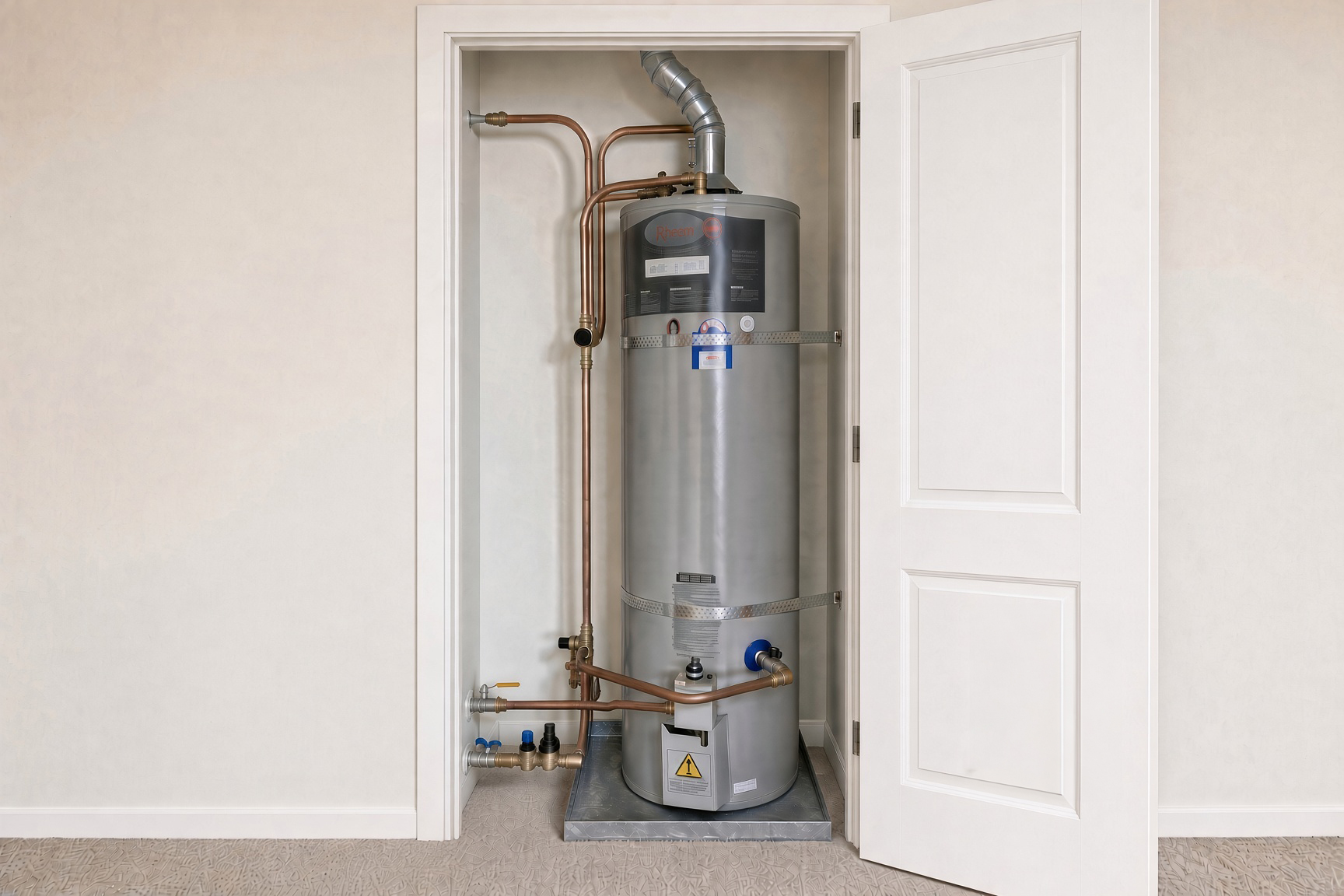
Heat Pump Hot Water Cylinder: Cost, Payback and Consent Rules in Auckland
Quick answer: A heat pump hot water cylinder heats water by pulling warmth out of the outside air, using around 60 to 75 per cent less electricity than a standard electric cylinder. EECA puts the installed price at around $7,000 to $7,500, so it pays back fastest in busy households that use a lot of hot water.
Water heating makes up around a third of a typical New Zealand household’s energy bill, according to EECA. That makes the hot water cylinder the single biggest appliance most Auckland homes run, and the one people think about least, right up until it fails on a Sunday night.
Free cost calculator
Pricing up a new hot water cylinder?
Answer a few questions and we’ll email you an Auckland price range.
That failure is usually the moment the heat pump question comes up. You need a new cylinder anyway, the plumber mentions a heat pump unit, and the price is roughly double. Is the extra money worth it, or is it a nice idea that suits someone else’s house?
It comes down to three things you can check before you sign anything. How much hot water your household actually uses. Whether there’s a sensible place outside for the unit, away from your neighbour’s bedroom window. And whether the job you’re planning is one that needs a building consent, which is less clear-cut than most installers make it sound.
This guide works through each of those in order, using EECA’s published figures and the Building Act itself rather than brochure claims. We run the payback arithmetic for a busy household and for an average one, because the two answers are very different. We cover the consent rules, including a point where two pieces of official government guidance disagree with each other. We cover Auckland’s night-time noise limit, which matters more than people expect for a unit that often runs overnight.
The last section is for landlords. In a rental the person who pays for the cylinder and the person who pays the power bill are usually different people, and that changes the maths completely.
We write this from the installation side. Superior Property Services sends registered plumbers and licensed electricians to hot water jobs across Auckland, from straight cylinder swaps to full system changes, Papatoetoe to Howick. A heat pump cylinder is a good product in the right house and an expensive mistake in the wrong one. Here’s how to tell which one you have.
How a Heat Pump Hot Water Cylinder Works, and Why Auckland Suits It
A heat pump hot water cylinder works on the same principle as the heat pump on your living room wall. It doesn’t make heat with an element. It moves heat that’s already in the outside air into your water.
EECA describes the cycle in four steps. A refrigerant absorbs heat from the air and turns from a liquid into a gas. A compressor squeezes that gas, which raises its temperature above the temperature you want in the tank. The hot gas passes through a condenser coil, gives its heat to the water and turns back into a liquid. Then it flows back round to do it again.
The only electricity used goes to the compressor and the fan. That’s where the saving comes from: a standard electric cylinder turns one unit of electricity into one unit of heat, while a heat pump moves several units of heat for each unit it uses.
What COP means, and why your postcode changes it
The measure is the coefficient of performance, or COP. It’s the amount of useful heat you get out divided by the electricity you put in. EECA says hot water heat pumps typically run at a COP of around 2 to 4, against just under 1 for a conventional electric cylinder. MBIE’s building guidance uses the round example of three kilowatts of heat moved into the water for every one kilowatt supplied to the compressor.
EECA states that the same heat pump model will have a higher COP in Auckland than in Christchurch, because the average air temperature is higher, so the unit doesn’t have to work as hard. Mild winters are about as good a climate as New Zealand offers for this technology.
It isn’t magic in July, though. EECA also notes that efficiency drops when the outside air is cooler, and that some models drop further than others. Ask for the manufacturer’s performance figures at low outdoor temperatures, not just the headline COP, and compare those between quotes.
💡 Property tip: When you compare quotes, ask each installer for the same thing in writing: the model number, the tank size, the refrigerant, and the rated performance at a cold outdoor temperature. Without the model number you can’t check any of it.
Integrated or split: the two types
There are two main designs, and the choice is mostly about where things can physically go at your place.
An integrated unit has the heat pump and the cylinder in one box, usually with the heat pump sitting on top. EECA says the whole unit must be sited outside. It’s simpler to install when the outside wall nearest your bathroom and kitchen has room for it.
A split system has an outdoor unit containing the refrigerant circuit and a separate cylinder that can go inside or outside. The two are joined by water or refrigerant pipework. That flexibility means the cylinder can stay close to where you use the water, which cuts the wait for hot water at the tap. EECA also notes it’s possible to retrofit the outdoor unit to an existing hot water cylinder. Hold that thought, because it’s where the consent question gets complicated (more on that below).
| Question | Integrated unit | Split system |
|---|---|---|
| Where does the cylinder go? | Outside, as part of the single unit | Inside or outside |
| Where does the heat pump go? | On the same unit, outside | Separate outdoor unit |
| Frees up the hot water cupboard? | Yes | Only if the cylinder also goes outside |
| Can it use your existing cylinder? | No | EECA says retrofitting is possible (consent position below) |
| Usually suits | Homes with clear outside wall space near the wet areas | Homes where the cylinder needs to stay central, or space outside is tight |
What it can’t do
A heat pump cylinder is still a storage system. EECA is clear that it can’t offer endless hot water the way a gas continuous-flow heater can, although its modelling found that with the right size of unit, running out is rarely, if ever, a problem. Sizing is the installer’s job, and it’s the first thing to question if your household is large or the showers are long.
It’s also more mechanically complex. A compressor and a fan are moving parts that a plain electric cylinder doesn’t have. EECA puts the lifespan of a properly maintained hot water heat pump at 8 to 15 years, against 10 to 15 years for a standard electric cylinder. That gap feeds straight into the payback sums in the next section.
Temperature rules stay the same whatever heats the water. EECA advises that stored hot water should be at least 60°C at the cylinder, to prevent the growth of legionella bacteria, and no more than 55°C at the tap so nobody gets burnt. A heat pump unit that can’t reliably hold the tank at 60°C isn’t the right unit. Ask how it does that in winter, and whether it uses a backup element to get there.
“The heat pump part is the easy bit to sell. The questions that decide whether it works are boring ones: is the tank big enough for the people in the house, and is there somewhere outside the unit can sit without annoying the neighbours at 2am.”
— Superior Property Services Team
Heat Pump Hot Water Cylinder Cost Against the Savings: Who It Actually Pays For
Every brochure says a heat pump cylinder pays for itself. Whether it does in your house comes down to one number: how much hot water you use. EECA publishes enough figures to run the sums properly, so that’s what we’ll do.
What EECA says it costs to buy and run
EECA has published two sets of figures, on two different pages, and they don’t quite match. Its current consumer page puts a hot water heat pump at around $7,000 including purchase and installation, and says it could save the average household around $284 a year. Its November 2023 technical insight puts the average at around $7,500 to buy and install, with higher costs for the most efficient models or larger systems.
The 2023 insight then compares running costs for a four-person household with average hot water use:
| System (EECA, four-person household) | Purchase and install | Energy cost per year |
|---|---|---|
| Hot water heat pump | Around $7,500 | $333 |
| Electric hot water cylinder | Around $3,000 | $1,176 |
| Gas continuous flow | Around $3,000 | $1,071, plus a yearly gas connection fee |
Over ten years, EECA works out the total cost of owning the heat pump at 27 per cent less than an electric cylinder and 21 per cent less than gas continuous flow, for that four-person household. Those are EECA’s own modelled figures, built on its stated assumptions, not ours.
Running the payback both ways
EECA doesn’t print the payback, but its own numbers are enough to work it out. The fair comparison when your old cylinder has died is the extra cost of the heat pump over a like-for-like replacement, not its full price, because you were paying for a new cylinder either way.
| Our working on EECA figures | Busy household (four people) | Average household |
|---|---|---|
| Heat pump installed | $7,500 (2023 insight) | $7,000 (consumer page) |
| Electric cylinder installed | $3,000 | $3,000 |
| Extra upfront cost | $4,500 | $4,000 |
| Saving per year | $843 ($1,176 less $333) | $284 |
| Simple payback | About 5.3 years | About 14 years |
Put that next to EECA’s 8 to 15 year lifespan and the picture is plain. For a busy household, the extra cost comes back roughly halfway through the unit’s life and everything after that is saving. For an average household, the payback lands close to the end of the unit’s expected life, and a unit that fails early never pays back at all.
Two caveats on the right-hand column. EECA’s consumer page doesn’t state what the $284 saving is measured against, so treat that column as a rough guide rather than a precise result. And the payback ignores power price rises, which would shorten both columns.
EECA’s own view of who it suits matches the arithmetic. It says hot water heat pumps suit homes with higher occupancy or high hot water use, standalone homes, and homes with underfloor heating or radiators, because some systems can run those too. A couple in a two-bedroom unit in Mt Albert is a much weaker case than a family of five in a standalone house in Pakuranga.
Three things that move the numbers in your favour
Solar panels. EECA notes that savings are even greater if the heat pump can run on solar power from your own roof. A heat pump cylinder with a timer set to heat during the middle of the day soaks up surplus solar that would otherwise be exported for a low buy-back rate.
A failed gas system. If you’re on gas and the heater has died, the comparison also includes the yearly gas connection fee, which EECA leaves out of the $1,071. Dropping gas entirely removes that fee, but only if nothing else in the house uses gas.
Timing. The weakest case is replacing a perfectly good cylinder that has years left in it. The strongest is when the old cylinder has already failed, or is leaking, and you’re paying for a replacement regardless. Our hot water cylinder replacement cost guide covers the like-for-like prices and the repair-or-replace call. If you’re not sure the cylinder is actually finished, our troubleshooting guide for a cylinder that’s stopped working walks through the checks first.
💡 Property tip: EECA runs a free home energy savings calculator that lets you put in your own household. Run it before you get quotes, so you know roughly what saving you’re paying for.
One more thing on money. EECA’s Warmer Kiwi Homes grants cover insulation, space heaters, LED downlights and some access work, not hot water systems. If a quote suggests a government grant will pay for most of a heat pump cylinder, ask exactly which scheme, and check it on EECA’s own page before you rely on it.
Consent, Placement and Noise Rules for a Heat Pump Hot Water Cylinder in Auckland
This is the part most quotes skate over. Installing a hot water system is building work under the Building Act 2004. Whether you need a building consent depends on what the job is, not on what kind of unit you’re buying.
When no consent is needed
Schedule 1 of the Building Act lists work that doesn’t need a consent. Clause 38 covers the replacement of any water heater, including repositioning an existing one, if the new water heater is connected to or incorporates a controlled heat source. MBIE’s exemption guidance defines a controlled heat source as one with controls or devices that keep the water in the storage tank at no more than 90°C.
MBIE’s exemption guidance then lists heat pump examples that fall inside clause 38:
- Replacing a water storage heater with a heat pump water storage heater.
- Replacing and repositioning an internal water storage heater with an external heat pump water storage heater.
- Replacing an external water storage heater with an external heat pump water storage heater.
The exemption sits in Part 2 of Schedule 1, which only applies to work carried out by a person authorised under the Plumbers, Gasfitters, and Drainlayers Act 2006. MBIE names the legally required professional as an authorised plumber. A handyman install isn’t exempt, whatever the unit. The exemption doesn’t excuse the Building Code either: MBIE stresses the installation must still comply.
When consent is needed
MBIE’s heat pump water heater article, updated 1 November 2024, is just as direct about the other side. A building consent is required for a new or additional heat pump water heater, and it gives three examples: a new house with a heat pump water heater, adding a second heat pump system when the house already has a hot water system, and adding an ensuite with its own separate heat pump system.
So a straight swap is usually exempt. A second system for a new ensuite or a minor dwelling isn’t. If the hot water change is part of a bigger bathroom or laundry rebuild, that’s renovation territory, and our sister company Superior Renovations handles laundry renovations where the cylinder moves as part of the job.
The grey area: adding a split unit to your existing cylinder
This is where the official guidance contradicts itself, and it’s worth knowing before an installer tells you it’s fine.
MBIE’s heat pump water heater article says a building consent is not required when a registered certifying plumber adds a separate (split) heat pump to an existing storage water heater. MBIE’s exemption guidance for clause 38 says the opposite. It lists “the owner wants to add a split heat pump (not a replacement split heat pump) to an existing water storage heater” under work that needs consent, because clause 38 only covers replacing or repositioning a water heater.
Both pages sit on building.govt.nz. The heat pump article even opens by saying installers don’t get consistent answers from building consent authorities. Our reading: the clause 38 wording covers replacement and repositioning, and a retrofit onto a tank you’re keeping is neither. We’re a maintenance company, not a consent authority, so treat that as a reason to check rather than a ruling.
The practical fix is simple. If your quote is a split retrofit onto the existing cylinder, ask the plumber to confirm the consent position with Auckland Council in writing before work starts. MBIE’s exemption guidance also points out that a council can grant a discretionary exemption for work that falls outside the listed exemptions, if you ask it first. Work that should have had a consent and didn’t can show up years later when you sell.
There’s a separate engineering question with a retrofit too. You’re pairing a new heat pump with an older tank. MBIE’s guidance sets a minimum durability of five years for a heat pump water heater and fifteen years for a storage water heater, so a ten-year-old tank may not have much life left to match its new partner.
💡 Property tip: You can check that your plumber is registered and authorised on the Plumbers, Gasfitters and Drainlayers Board’s public register in about a minute. Do it before you pay a deposit.
The Building Code clauses that still apply
Consent or not, MBIE lists the Building Code clauses every heat pump water heater installation in a house has to meet:
| Code clause | What MBIE says it means for a heat pump water heater |
|---|---|
| B1 Structure | The unit must be restrained against earthquake forces |
| B2 Durability | Minimum 5 years for the heat pump water heater, 15 years for a storage water heater, with normal maintenance |
| E2 External Moisture | Any penetration through the wall or cladding must be weathertight |
| G9 Electricity | The electrical installation must be safe, covered by a certificate from the electrician |
| G12 Water Supplies | Safe supply, storage, reticulation and delivery of hot water |
| H1 Energy Efficiency | Hot water systems serving sanitary fixtures must be energy efficient |
That electrical line matters. A heat pump cylinder is a plumbing job and an electrical job, and you should get paperwork from both trades. Our licensed electricians wire the supply and leave the certificate with you. MBIE also notes it’s preferable to run the refrigerant and water pipes under a suspended floor or through the eaves, so the wall cladding isn’t penetrated at all. On older weatherboard houses in Grey Lynn or Devonport, that’s worth insisting on.
Auckland’s night-time noise limit
EECA is upfront that hot water heat pumps can be louder than other water heaters, because they run a fan and a compressor. That’s why the noisy part lives outside. Outside is exactly where the Auckland Unitary Plan applies.
Auckland Unitary Plan Standard E25.6.2 sets the maximum noise from any activity in Auckland’s main residential zones, measured within the boundary of the neighbouring site:
| Time | Limit (Table E25.6.2.1) |
|---|---|
| Monday to Saturday 7am to 10pm, Sunday 9am to 6pm | 50 dB LAeq |
| All other times | 40 dB LAeq, and 75 dB LAFmax |
That limit applies across the Single House, Mixed Housing Suburban, Mixed Housing Urban and Terrace Housing and Apartment Buildings zones. The night limit is 10 decibels lower than the day limit, and plenty of hot water systems are set to heat overnight.
Imagine a new townhouse in Flat Bush or Hobsonville with the side yard barely wider than the unit, and the neighbour’s bedroom window on the other side of the fence. A unit timed to run at 3am is the worst combination for that site. Ask the installer for the unit’s published sound level, where they intend to put it, and how far that is from the boundary, and consider setting the timer to heat during the day, which also lines up with solar.
We’re not giving you a decibel figure for any particular model, because that depends on the unit and the site. The point is that placement is a planning question as much as a plumbing one, and it’s far cheaper to get right before the concrete pad goes down.
Refrigerant and end-of-life
EECA lists the refrigerants these units use: R134a, which it says is being phased out in New Zealand because of its high global warming potential; R32, a lower-impact option common in newer units; R744, which is carbon dioxide; and R290, propane, which it describes as emerging for homes. When the unit is replaced, EECA says it should be removed by a suitably qualified company that recovers the refrigerant, and there’s normally a fee. Ask for that to be in the quote for the old unit, not left as a surprise.
For Landlords: Is a Heat Pump Hot Water Cylinder Worth It in a Rental?
Everything above still applies to a rental. What changes is who pays for what, and that changes the answer.
What you’re required to provide
Tenancy Services states plainly that the landlord must make sure the property has a way to heat water and cook food. The Residential Tenancies Act 1986, section 45(1)(b), requires the landlord to provide and maintain the premises in a reasonable state of repair, and section 45(1)(c) requires compliance with all building, health and safety requirements under any enactment that apply to the premises.
So a failed cylinder is the landlord’s problem, and it’s an urgent one. Tenancy Services says tenants must tell the landlord straight away when something needs repairing. Section 45(1)(d) also requires the landlord to compensate a tenant for reasonable repair costs where the disrepair is serious and urgent and the tenant has given notice or tried to. No hot water is not a job to leave until the next routine inspection.
Healthy Homes compliance note: The healthy homes standards cover heating, insulation, ventilation, moisture ingress and drainage, and draught stopping. Hot water isn’t one of the five. A hot water heat pump heats water, not the main living room, so it does nothing towards the heating standard, and the living room heater is a separate obligation. Your hot water obligations come from the Residential Tenancies Act instead.
The split incentive
Tenancy Services says that costs which arise from living in the house are the tenant’s to pay. On that test, the power used to heat the water is normally the tenant’s bill. The landlord pays the extra $4,000 to $4,500 up front, and the tenant collects the $284 to $843 a year in lower power bills.
On pure cash, then, a heat pump cylinder rarely pays back to the landlord directly. The case for it in a rental is different, and it’s narrower:
- Larger households. A four-bedroom house in Manurewa or Papakura let to a family uses far more hot water than a one-bedroom flat. That’s the tenant EECA’s figures say saves the most, and lower running costs are a genuine point in a listing.
- Space. An integrated unit outside frees up the hot water cupboard inside. In a small unit that can mean usable storage, or a laundry space that wasn’t there before.
- Long hold. If you’re keeping the property for well over a decade and will replace the system at least once anyway, the higher-efficiency option is a reasonable default.
The case against is just as practical. More moving parts means more that can go wrong mid-tenancy, and a compressor fault is a less routine call-out than a failed element. If your tenant base turns over every year and the house is small, a like-for-like electric cylinder is often the sensible call.
Placement and access in a rental
An outdoor unit needs to stay clear of rubbish bins, firewood and garden growth so air can move through it. Make that part of the move-in conversation and note it on the inspection report. Put the unit where a tradie can reach it without going through the tenant’s bedroom, because every repair visit is an entry you need to arrange with proper notice.
Noise matters more in a rental, not less. A complaint from next door lands with your tenant first and with you second. If the property is a duplex or terrace in Mt Wellington or Glen Innes, take the night-time noise limit seriously when choosing the spot.
Use licensed trades for all of it. Tenancy Services’ guidance on using licensed practitioners for your property sets out who can do which work. We can keep the hot water side of a rental sorted across tenancies, so a failed cylinder becomes one call rather than a weekend of phoning around.
💡 Property tip: Note the cylinder’s install date and model on your maintenance register. A tank in its second decade is a planned replacement waiting to happen, and planned is always cheaper than an emergency call-out with tenants in the house.
Before You Sign a Heat Pump Hot Water Quote: A Checklist
Most problems with heat pump cylinders come down to things that could have been asked at the quote stage. We’d want these answered in writing before you pay a deposit.
The unit
- Model number and type. Integrated or split, and which brand. Without the model, nothing else on the quote can be checked.
- Tank size against your household. How many people, how many bathrooms, and whether anyone takes long showers. Ask how they sized it.
- Cold-weather performance. The rated output at a low outdoor temperature, not just the best-case COP.
- Holding 60°C. How the unit keeps the tank at the 60°C EECA recommends, and whether it uses a backup element in winter.
- Refrigerant. Which one, given EECA notes R134a is being phased out.
- Warranty. What’s covered, for how long, and who you call. Get the terms from the manufacturer’s own documents rather than the quote.
The installation
- Consent. Is this a replacement under clause 38, or new or additional work that needs a consent? If it’s a split retrofit onto your existing tank, ask for the council’s position in writing.
- Who does what. An authorised plumber for the water side, a licensed electrician for the supply, and a certificate from each.
- Location and noise. Where the unit goes, how far from the boundary, and when the timer will run it.
- Seismic restraint and pipe route. How the unit is restrained, and whether pipes go under the floor or through the eaves instead of through the cladding.
- Old unit removal. Disposal of the old cylinder, and refrigerant recovery if it’s an old heat pump unit.
When the old system isn’t finished yet
If your existing cylinder is working, don’t rush. The best time to switch is when you’d be paying for a new cylinder anyway. That’s when the extra cost is only the difference, and the payback table above is at its most favourable. Get the old tank checked, note its age, and plan the change rather than having it forced on you.
If you already have a heat pump for space heating, its servicing is a separate job with its own schedule. Our guide to heat pump servicing costs and common faults covers that side.
Whichever system you choose, the job is a single maintenance-scale visit: water, power, a pad or bracket, and the old unit out. We can swap a failed cylinder for a heat pump unit in the same spot, or for a like-for-like electric one if the numbers don’t stack up for your house. We’ll tell you which, and why.
The Short Version
A heat pump hot water cylinder is the cheapest way to heat water over its life if your household uses enough hot water to earn back the extra cost before the unit wears out. On EECA’s figures, a busy four-person household gets there in around five years. An average household may barely get there at all.
Check the consent position for your specific job, especially for a split retrofit. Put the outdoor unit somewhere the neighbours won’t hear it at night. Get certificates from both the plumber and the electrician. If you’re a landlord, remember the savings go to whoever pays the power bill. Do those four things and the technology does the rest.
Not sure which way to go? Call Superior Property Services on 0800 199 888. We respond within one working day, anywhere in Auckland.
➡ Request a free no-obligation quote from Superior Property Services
➡ Learn more about our hot water cylinder replacement in Auckland
➡ Make an enquiry — we respond within 1 working day
How much does a heat pump hot water cylinder cost in NZ?
EECA puts a hot water heat pump at around $7,000 including purchase and installation on its consumer page, and around $7,500 on average in its November 2023 technical insight, with higher costs for the most efficient or larger systems. A standard electric cylinder is around $3,000 installed on the same EECA figures. If your old cylinder has failed, the real extra cost of choosing a heat pump is the difference between the two, roughly $4,000 to $4,500.
How much can a heat pump hot water cylinder save?
EECA says a hot water heat pump could save the average household around $284 a year. For a four-person household with average hot water use, its 2023 modelling puts the energy cost at $333 a year for a heat pump against $1,176 for an electric cylinder, a difference of $843. Over ten years it calculates the total cost of ownership at 27 per cent less than an electric cylinder and 21 per cent less than gas continuous flow.
How long does a heat pump hot water system take to pay for itself?
On EECA's own figures, a four-person household paying about $4,500 more than an electric cylinder and saving $843 a year pays back in roughly five years. An average household paying about $4,000 more and saving $284 a year takes roughly 14 years. EECA puts the lifespan of a hot water heat pump at 8 to 15 years, so the case is strong for busy households and weak for small ones.
Do I need a building consent for a heat pump hot water cylinder?
Not usually, if you are replacing an existing water heater. Building Act Schedule 1 clause 38 exempts replacing or repositioning a water heater that has a controlled heat source, when an authorised plumber does the work. MBIE says a consent is required for a new or additional heat pump water heater, such as one for a new ensuite. Adding a split heat pump to a cylinder you are keeping is a grey area, so get the council's position in writing first.
What is the difference between an integrated and a split heat pump water heater?
EECA describes two types. An integrated unit combines the heat pump and the cylinder in one box, which must be sited outside. A split system has a separate outdoor heat pump connected by pipework to a cylinder that can be inside or outside. Split systems give more flexibility on where the cylinder goes, and EECA notes the outdoor unit can sometimes be retrofitted to an existing cylinder.
Do heat pump hot water cylinders work in winter?
Yes, but less efficiently. EECA says hot water heat pumps lose some efficiency when the outside air is cooler, and some models lose more than others, so check the manufacturer's cold-weather figures before buying. Auckland helps: EECA states the same model will have a higher coefficient of performance in Auckland than in Christchurch because the average air temperature is higher.
Are heat pump hot water systems noisy?
EECA says they can be louder than other water heaters because they run a fan and a compressor, which is why those parts sit outside. In Auckland's main residential zones, the Unitary Plan limits noise measured within the neighbouring site to 50 dB LAeq during the day and 40 dB LAeq at night. If the unit runs overnight, place it well away from the neighbour's bedrooms or set the timer to heat during the day.
What temperature should a heat pump hot water cylinder be set to?
The same as any cylinder. EECA advises that hot water should be at least 60°C at the cylinder to prevent legionella bacteria growing, and no more than 55°C at the tap so nobody gets burnt. Ask your installer how the unit holds 60°C in the tank during winter, and whether it uses a backup element to do so.
Can I get a government grant for a heat pump hot water cylinder?
Not through Warmer Kiwi Homes. EECA's Warmer Kiwi Homes programme covers insulation, space heaters, LED downlights and some access work, and does not list hot water systems. If a quote suggests a grant will cover the cost, ask which scheme it is and check the details on the scheme's own website before relying on it.
Does a landlord have to replace a broken hot water cylinder?
Yes. Tenancy Services says the landlord must make sure a rental has a way to heat water and cook food, and section 45 of the Residential Tenancies Act requires the landlord to keep the premises in a reasonable state of repair. No hot water should be treated as an urgent repair. The landlord can choose a like-for-like cylinder or a heat pump unit; hot water is not one of the five healthy homes standards.
References
- EECA — Hot water heat pumps for your home
- EECA — Hot water heat pumps in the home (EECA Insights, November 2023)
- EECA — Heat water efficiently
- EECA — Home energy savings calculator
- EECA — Warmer Kiwi Homes programme information
- MBIE Building Performance — Heat pump water heaters (2nd edition, updated 1 November 2024)
- MBIE Building Performance — 4.5 Replacement or repositioning of water heater connected to controlled heat source
- Building Act 2004 — Schedule 1, Part 2, clauses 32, 36 and 38 (legislation.govt.nz)
- Auckland Unitary Plan — E25 Noise and vibration, Standard E25.6.2 (PDF)
- Tenancy Services — Healthy homes
- Tenancy Services — Utilities and other payments
- Tenancy Services — Damage and repairs
- Tenancy Services — Using licensed practitioners for your property
- Residential Tenancies Act 1986 — section 45 (legislation.govt.nz)
- Plumbers, Gasfitters and Drainlayers Board — Search the register