
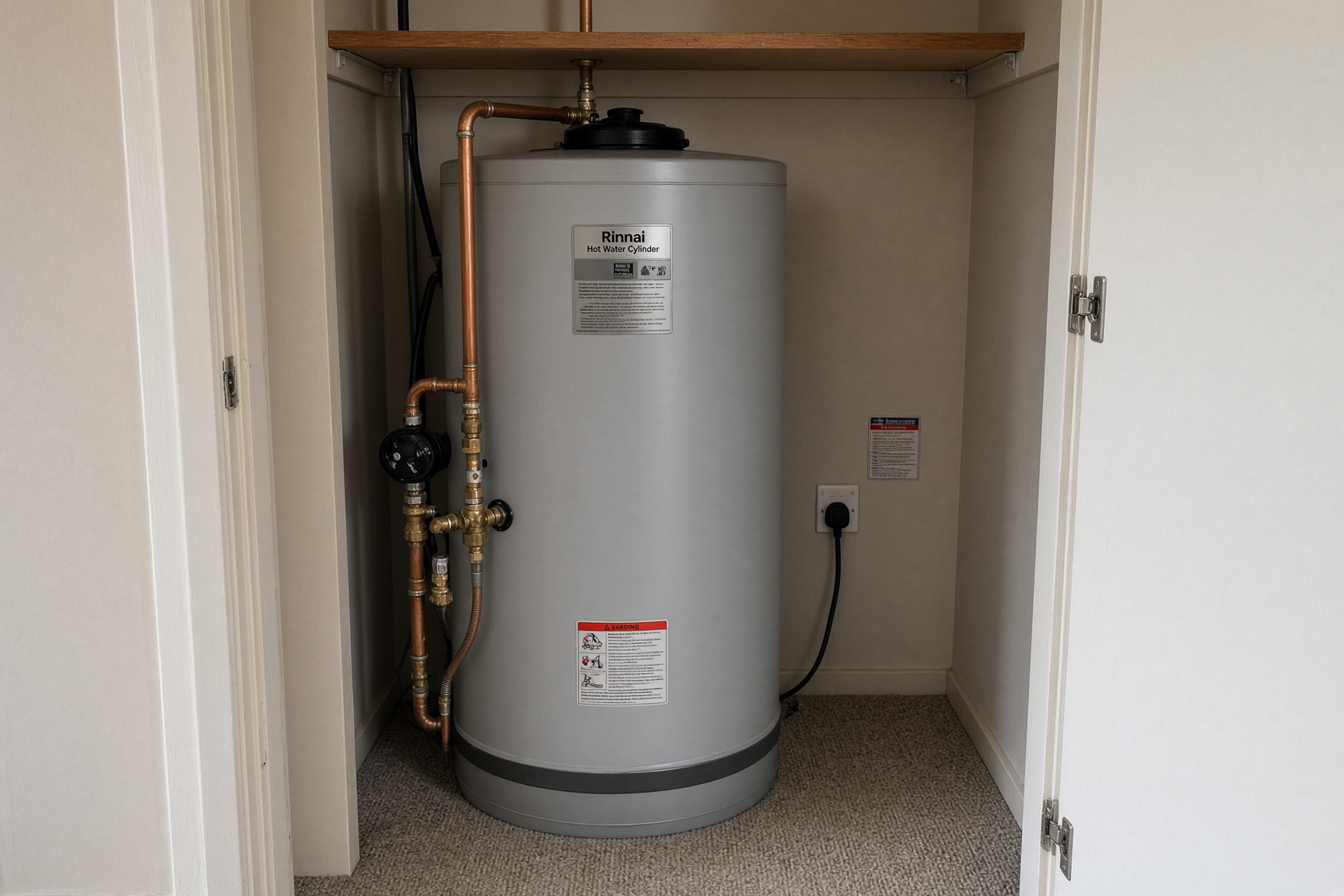
Hot Water Cylinder Not Working? An Auckland Troubleshooting Guide
Last updated:
Quick answer: If your hot water cylinder has stopped working, check the switchboard first — a tripped breaker or RCD is the most common cause, and any wiring or gas fault needs a registered electrician or gasfitter.
You turn the shower on, wait for the steam, and it never comes. Just cold. Then you remember last night’s dishes were lukewarm too. A dead hot water system always seems to pick the worst morning to quit, and the first instinct is to assume the cylinder is finished and start pricing a new one. Most of the time it isn’t finished at all. The fault is smaller, cheaper, and often sitting right there on your switchboard.
Free cost calculator
Replacing a hot water cylinder?
Get an instant Auckland price range for your project — no details required to see it.
This guide walks you through it the way a tradesperson would on the phone. We start with the checks you can safely do yourself in two minutes, then work through what actually goes wrong inside an electric cylinder, what a gas system does when it stops, and how to tell a quick repair from a full replacement. A hot water cylinder not working falls into a handful of common patterns, and knowing which one you’re looking at tells you whether you need a reset button or a registered tradesperson.
One rule up front, because it matters. You can check breakers, taps and pilot lights. You cannot open the cylinder’s wiring or touch the element or the gas train. Fixed electrical work and gasfitting are legally restricted to registered people, and hot water gear runs hot and stays live. We flag exactly where the DIY line stops. Everything before that line, you can do in your dressing gown before the coffee’s even made.
First checks when you have no hot water in Auckland
Before you assume the worst, run three quick checks. They cost nothing and they rule out the faults that a tradesperson would charge you a call-out fee to find.
Check the switchboard first. The single most common reason an electric cylinder goes cold is a tripped breaker or a tripped RCD (the safety switch) at the board. Open the switchboard and look for a switch that has flicked to the middle or off position while its neighbours are all up. If you find one, switch it fully off and back on. If it holds, you’ve fixed it for free. If it trips again the moment you reset it, stop — that repeated trip is the cylinder telling you something inside it has failed, usually a leaking element, and that is a job for a registered electrician, not a switch you keep flicking. We cover when electrical certification comes into it in our guide on when you need an electrician and a Certificate of Compliance.
Is it every tap, or just one? If only the kitchen runs cold but the shower is fine, your cylinder is working and the problem is a tap or a mixer. If every hot tap in the house is cold, the cylinder or its power supply is the suspect. This one test tells you whether you’re chasing a plumbing fitting or a heating fault.
Know which system you have. Walk to the cylinder or the gas unit. A tall insulated tank in a cupboard is an electric storage cylinder. A slim box mounted on an outside wall that only fires when you open a tap is gas continuous-flow. This matters because the fixes are completely different, and so is the tradesperson you call.
We had a call-out in Papakura where the owner was ready to sign off on a whole new cylinder. The actual fault was a tripped RCD that a faulty toaster had knocked out earlier that day. Two minutes at the board and the hot water was back. Not every job ends that cheaply, but plenty start there.
| Symptom | Likely cause | Who fixes it |
|---|---|---|
| No hot water at any tap, electric cylinder | Tripped breaker or RCD, failed thermostat or element | You (reset only) or registered electrician |
| Breaker trips again the instant you reset it | Leaking or burnt-out element earthing out | Registered electrician |
| Water warm then quickly cold | Failing thermostat, one dead element, or overdrawn tank | Registered electrician |
| No hot water, gas continuous-flow unit | Pilot out, ignition fault, or gas supply cut | Registered gasfitter |
| Only one tap cold, rest fine | Tap or mixer fault, not the cylinder | Plumber |
💡 Property tip: Before you touch anything, note down what you see at the switchboard — which switch is tripped and whether it resets. If you do end up calling a tradesperson, that one sentence often shaves time and money off the visit.
Electric cylinder faults and how hot water recovery works
If you’ve reset the board and still have no hot water, the fault is inside the electric cylinder. There are only a few things that commonly go, and it helps to know the shortlist even though the repair itself is an electrician’s job.
The thermostat. This is the part that senses tank temperature and switches the element on and off. When it fails, it usually fails off, so the element never fires and the tank slowly goes cold. A dead thermostat is one of the more common causes of a hot water cylinder not heating, and it’s often the cheaper of the two main faults to sort.
The element. This is the metal heater sitting in the water, and it burns out the same way a kettle element eventually does. A failed element can go two ways. Sometimes it simply stops heating. Other times it splits and starts earthing to the tank, which is the fault that keeps tripping your RCD every time you reset it. If your safety switch will not stay in, a failing element is the prime suspect.
The reset or overheat cut-out. Some cylinders have a manual reset (a small button, often red, near the thermostat cover) that trips if the water gets too hot. On cylinders that have one, it can occasionally be reset, but a cut-out that has tripped has done so for a reason, and if it trips again you need it looked at rather than repeatedly pushed back in.
“Nine times out of ten a dead electric cylinder is one of three things — the breaker, the thermostat, or the element. The trick is reading which, not guessing and swapping parts.”
— Superior Property Services Team
Now the recovery question, because it trips a lot of people up. An electric cylinder does not reheat instantly. It heats a full tank of cold water gradually, and how long that takes depends on two things: the wattage of the element and the volume of the tank. A bigger tank holds more water to heat. A smaller or lower-wattage element pushes less heat in per minute. Put those together and a large cylinder with a modest element takes noticeably longer to bring a cold tank back to temperature than a small cylinder with a strong element does. This is why, after a power cut or a reset, you can have power restored and still get a cold shower — the water simply hasn’t caught up yet. Give it time before you decide the repair didn’t work.
It also explains the classic “warm then cold” complaint we hear from bigger households in places like Manurewa. If four people shower back to back, a cylinder that’s slightly undersized or has a weak element runs out of stored hot water faster than it can reheat. That’s not always a fault. Sometimes it’s a tank that’s too small for the house, which is a sizing conversation rather than a repair.
💡 Property tip: After any reset or power outage, wait before judging the fix. If hot water starts coming through and slowly builds, the system is doing its job. If it stays stone cold well after power is back, that points to a thermostat or element, not recovery time.
Gas hot water not working — pilot, ignition and supply
Gas systems fail differently. There’s no tank of stored water quietly going cold; instead the burner simply doesn’t fire when you open the tap. If your gas hot water not working problem started suddenly, the cause is usually one of three things, and the first two are worth a safe look before you call anyone.
The pilot light or ignition. Older gas units run a standing pilot flame. If a draught or a knock puts it out, the unit can’t light the main burner and you get cold water. Many units have printed relighting instructions on a panel. Newer continuous-flow units use electronic ignition instead, and if you can hear it clicking but not catching, or nothing happens at all, that’s an ignition fault for a gasfitter. Do not start pulling the unit apart to chase it.
The gas supply. Sounds obvious, but check the bottle or the supply first. If you’re on LPG, a bottle can simply run empty, or the changeover valve on a twin-bottle setup can fail to swing across to the full one. If you’re on reticulated natural gas, check whether your gas cooktop still lights — if the hob’s dead too, the supply is the problem, not the water heater.
Continuous-flow versus gas storage. It’s worth knowing which you’ve got. Continuous-flow (also called instantaneous or califont) heats water on demand as it passes through, so it never runs out but it does stop dead if the ignition or water flow fails. Gas storage keeps a heated tank like an electric cylinder does, so it can run lukewarm if the burner is struggling. The symptoms read differently: a continuous-flow unit tends to be all-or-nothing, while a storage unit fades.
A Henderson landlord rang us last winter certain the califont had died. The tenant had no hot water for a day. It turned out the LPG bottle had run empty and the twin-bottle changeover hadn’t swapped over. A five-minute check, but the tenant had been cold overnight — which, as we’ll get to, is the kind of thing a landlord needs to move on fast.
Everything past the supply check on a gas unit belongs to a registered gasfitter. Gas is not a category where a confident homeowner should be poking around inside the burner or the gas train. Relight the pilot per the printed instructions if your unit has them, check the bottle, and if that doesn’t bring it back, make the call.
💡 Property tip: If you smell gas at any point (that rotten-egg odour), stop, turn the supply off at the bottle or meter if you can safely reach it, don’t touch switches, and ventilate. Then phone a gasfitter. A cold shower is an inconvenience; a gas leak isn’t.
Repair or replace, and who you legally need to call
So you’ve narrowed it down. The next question is whether this cylinder is worth fixing or whether you’re better off replacing it. There’s no single rule, but a few things push the decision.
Age is the big one. A cylinder that’s leaking from the tank itself, not a fitting but the actual body, is done — no repair brings it back. If an old cylinder has failed and it’s already well into its service life, spending on a new element and thermostat can be throwing good money after old steel. A newer cylinder with a single failed part is almost always worth repairing. The honest read usually comes from whoever opens it up.
We won’t quote a replacement figure here, because it swings hard on the cylinder type, the size, mains-pressure versus low-pressure, and how your existing gear is plumbed and wired. For a realistic Auckland range, run the calculator box above, and for the full breakdown of what drives the price read our hot water cylinder replacement cost guide. For your specific setup, the only accurate number is a quote after someone has looked at it.
Who you legally need. This part isn’t optional. The wiring, element and thermostat on an electric cylinder are fixed electrical work, and that means a registered electrician — not a handyman, not you. Anything on a gas system is a registered gasfitter’s work. This isn’t red tape for its own sake; it’s live power and pressurised hot water, and the certification exists so the job is signed off as safe. If you want the detail on electrical certification and when a Certificate of Compliance is issued, our electrical certification guide lays it out.
“The cheapest cylinder repair is the one done once, properly, by the right trade. We see far more money wasted on part-swapping than on getting it diagnosed right the first time.”
— Superior Property Services Team
Where it helps to deal with a property maintenance company rather than a single trade is when the fault crosses over. A Takapuna owner called us for no hot water and it turned out to be a corroded isolating valve feeding a tired cylinder — part plumbing, part electrical, part replace. Having plumbers and electricians under one roof means the whole job gets handled without you chasing three different vans. That’s the core of our property maintenance service across Auckland.
💡 Property tip: If you’re replacing anyway, ask about upsizing or switching type while the old unit is out. Doing it in one visit, rather than replacing like-for-like now and regretting the size later, is far cheaper than a second job down the track.
Landlords: a tenant with no hot water is an urgent repair
This section is for landlords and property managers, and it’s the one worth reading twice. If you’re a homeowner, the checks above are your path. If you rent a property out, no hot water carries a legal clock, and it’s a short one.
You have to provide a way to heat water. Under the Residential Tenancies Act, a landlord must make sure the rental has a way to heat water and to cook food. If gas is the main method of heating water, the landlord is responsible for providing the gas supply, the cylinder and the piping. So when the hot water dies, it isn’t the tenant’s problem to solve out of their own pocket — it’s yours to fix.
And it’s treated as urgent. No hot water is an urgent repair. Landlords must complete urgent repairs as soon as reasonably possible. Here’s the part that catches landlords out: if a tenant makes reasonable attempts to contact you and can’t reach you, they’re entitled to arrange the repair themselves and seek reimbursement from you. Being slow or unreachable doesn’t pause the obligation — it just moves the repair out of your control and leaves you with the bill anyway.
One point to clear up, because it gets muddled a lot. Hot water is not one of the five Healthy Homes standards — those cover heating, insulation, ventilation, moisture and drainage, and draught-stopping. The hot water obligation is separate. It sits under the RTA duty to provide a way to heat water, plus the urgent-repair duty. Don’t wait to bundle it into a Healthy Homes assessment; it stands on its own and it moves faster.
For a Mt Roskill rental we manage, a tenant reported no hot water on a Saturday. Because the reporting line went straight to us rather than an owner who might’ve been away for the weekend, an electrician was there and the cylinder was back the same day. That’s the standard the Act is pointing at — reasonable speed, not “we’ll sort it Monday”. If you’d rather that clock never becomes your problem, our landlord property services keep urgent repairs moving so a cold tenant doesn’t turn into a Tenancy Tribunal claim.
💡 Property tip: Give tenants a clear after-hours maintenance contact and keep it current. Most reimbursement disputes over urgent repairs come down to a tenant who genuinely couldn’t reach anyone — a working contact line is the cheapest protection you have.
➡ Request a free no-obligation quote from Superior Property Services ➡ Learn more about our property maintenance in Auckland ➡ Make an enquiry — we respond within 1 working day
Why is my hot water cylinder not heating?
The usual causes are a tripped breaker or RCD at the switchboard, a failed thermostat that stops switching the element on, or a burnt-out element. Check the switchboard first and reset any tripped switch. If it holds, you're sorted. If it trips straight back or the switchboard is fine but the water stays cold, the fault is inside the cylinder and needs a registered electrician. Don't open the wiring yourself.
Why do I have no hot water but the power is on?
Power to the house doesn't mean power to the cylinder. A cylinder can be on its own breaker or RCD that has tripped while the rest of the house runs fine. Check the switchboard for a single switch sitting in the off or middle position. Also consider a failed thermostat or element, which leaves the cylinder powered but not heating. If it's a gas unit, check the pilot light and the gas supply instead.
How long does a hot water cylinder take to reheat?
There's no single figure, because it depends on the element wattage and the tank volume. A larger tank holds more water to heat, and a smaller or lower-wattage element adds heat more slowly, so a big cylinder with a modest element takes longer to bring a cold tank back to temperature than a small cylinder with a strong element. After a power cut or reset, expect hot water to build gradually rather than arrive instantly.
Who do I call for no hot water in Auckland?
It depends on the system. Fixed electrical work on an electric cylinder (the element, thermostat or wiring) must be done by a registered electrician. Anything on a gas system must be done by a registered gasfitter. If the fault crosses plumbing and electrical, a property maintenance company with both trades can handle the whole job in one visit. Superior Property Services covers hot water faults across Auckland.
Why does my hot water go warm then quickly cold?
Warm-then-cold usually means one of three things: a failing thermostat, a single dead element in a twin-element cylinder, or a tank that's too small or overdrawn for the household. If several people shower back to back and the last one gets cold, the cylinder may simply be running out of stored hot water faster than it can reheat. An electrician can tell you whether it's a fault or a sizing issue.
My RCD keeps tripping when I reset it — what does that mean?
An RCD that trips again the moment you reset it is doing its job. It's detecting a fault, most often an element that has split and is earthing to the tank. Don't keep flicking it back on. Repeated resets on a genuine fault are unsafe. Leave it off and call a registered electrician to test and replace the element. This is one of the more common causes of a dead electric cylinder.
My gas hot water isn't working — what should I check first?
Check the gas supply and the pilot first. On LPG, the bottle may be empty or a twin-bottle changeover may have failed to swap to the full one. On natural gas, see if your cooktop still lights — if not, the supply is the problem. Older units have a standing pilot you can relight using the printed instructions. If the supply is fine and it still won't fire, it's an ignition fault for a registered gasfitter.
Is hot water a Healthy Homes requirement?
No. The five Healthy Homes standards are heating, insulation, ventilation, moisture and drainage, and draught-stopping. Hot water isn't one of them. A landlord's hot water obligation comes from the Residential Tenancies Act, which requires the property to have a way to heat water, and from the urgent-repair duty. So it's a real legal obligation, just not a Healthy Homes one, and it's treated as urgent rather than part of a Healthy Homes assessment.
Can I fix a hot water cylinder myself?
You can safely reset a tripped breaker or RCD, check whether it's one tap or all of them, relight a gas pilot using the printed instructions, and check the gas bottle or supply. You cannot legally do the fixed electrical work (element, thermostat, wiring) or any gas work. Those are restricted to a registered electrician or gasfitter. Trying it yourself is unsafe and can void insurance, so stop at the reset.
Should I repair or replace my hot water cylinder?
If the tank body itself is leaking, replace it — that can't be repaired. If it's an old cylinder well into its service life with a failed part, replacing is often the smarter spend. A newer cylinder with a single failed thermostat or element is usually worth repairing. The honest call comes from a tradesperson who opens it up. For a replacement price range, use our hot water cylinder cost calculator or read the replacement cost guide.
References
- Tenancy Services — Utilities and other payments (landlord must provide a way to heat water)
- Tenancy Services — Damage and repairs (urgent repairs)