
Electrical CoC NZ: What It Is & When You Need One
Last updated:
Quick answer: An electrical CoC (Certificate of Compliance) is the legal document a licensed electrician must give you, no later than 20 days after finishing, for most fixed wiring work in NZ, confirming the job meets the Electricity (Safety) Regulations 2010.
Most people hear the term “electrical CoC” for the first time at the worst possible moment. The lawyer handling your property sale asks for certificates you’ve never seen, or your insurer wants proof that the switchboard work from three years ago was done legally — and you’ve got nothing.
Sound familiar?
Here’s the uncomfortable bit: the certificate system isn’t new, and it isn’t optional. Under the Electricity (Safety) Regulations 2010, your electrician is legally required to certify most fixed wiring work — and you’re the one who should be holding the paperwork. Yet almost everything written about CoCs in New Zealand is written for electricians, not for the property owners who actually need to file them. Templates, compliance apps, EWRB form downloads. Useful if you’re on the tools. Useless if you’re a landlord in Mt Albert trying to work out whether the heat pump install on your rental was ever signed off.
This guide is for the other side of the transaction. We’ll cover what an electrical CoC is, how it differs from the alphabet soup of other certificates (ESC, RoI, COV, EWoF), which jobs legally require one (including the exemption that half the articles ranking on Google get wrong) and the part nobody else covers: what you should actually keep on file as an Auckland property owner or landlord, and what to do when work was never certified.
At Superior Property Services, our electrical work across Auckland is carried out by EWRB-registered electricians through the Superior Construction Group trade network, and a CoC is issued as standard on every job that requires one. We see the paperwork side of this often, including the mess left behind when a previous owner’s “mate who’s handy with wiring” did the kitchen.
What an Electrical Certificate of Compliance Is — and Why It Exists
Free cost calculator
How much will your project cost?
Get an instant Auckland price range for your project — no details required to see it.
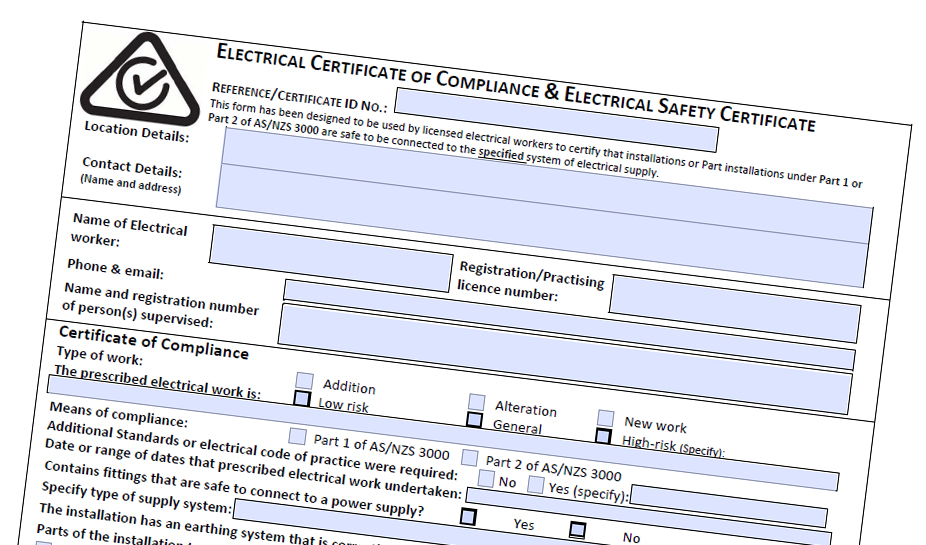
A Certificate of Compliance is a legal declaration, signed by a licensed electrical worker, that the prescribed electrical work they’ve just completed was done lawfully and safely. It’s not a receipt. It’s not a warranty. It’s the document that connects a specific piece of electrical work to a specific licensed person who is legally accountable for it.
The legal framework behind the certificate
Three pieces of law sit behind every CoC issued in New Zealand:
The Electricity Act 1992 establishes who is allowed to do electrical work at all. The Electricity (Safety) Regulations 2010 set out when certification is required and what the certificate must contain. And AS/NZS 3000 (the Wiring Rules, published through Standards New Zealand) defines the technical standard the work itself must meet. When an electrician signs a CoC, they’re certifying against all three.
The system is administered by WorkSafe New Zealand, with licensing handled by the Electrical Workers Registration Board (EWRB). Only a registered electrical worker holding a current practising licence can issue and sign a CoC. An apprentice can help fill in the form, but the signature (and the legal liability) belongs to the licensed person. According to WorkSafe’s guidance on getting electrical work done, you’re entitled to ask to see that practising licence before any work starts, and you can verify it against the EWRB’s public register.
💡 Property tip: Practising licences must be current at the time the work is done, so check the date, not just that a card exists. The quickest way is the EWRB’s public register: search by name or registration number and it shows whether the licence is current.
What’s actually on the certificate
A valid CoC identifies the electrician (name, registration number, signature), describes the work done, records the date and address, and declares that the work complies with the regulations and has been tested. If any of those details are missing, the certificate may not stand up when an insurer, buyer’s solicitor, or the Tenancy Tribunal asks for it. Regulation 74E lets the electrician keep their copy in hard copy or electronically, and a PDF emailed with the invoice is a normal way to receive yours. What matters is that every required detail is on it and you can produce it when asked.
The three risk tiers of prescribed electrical work
The regulations split prescribed electrical work (PEW) into three tiers, and the tier determines the paperwork:
Low-risk work: regulation 6A(1) of the Electricity (Safety) Regulations 2010 defines this as the maintenance or replacement of a fitting in an existing installation, and it expressly includes relocating or extending a conductor to facilitate replacing a fitting. General work: the bulk of residential jobs, covering new circuits, additional power points, rewiring, switchboard alterations, fixed appliance installation. High-risk work: mains work and similar, which requires independent inspection on top of certification. Regulation 6A(4) provides that work done in reliance on the homeowner exemption in section 79 of the Electricity Act 1992 is not categorised as low-risk, high-risk or general prescribed electrical work at all, unless regulation 57 requires that work to be certified. The three tiers above do not govern homeowner-exemption work.
A CoC is mandatory for general and high-risk prescribed electrical work. For low-risk work, it’s voluntary — which is exactly where most of the confusion (and most of the wrong information online) lives. We’ll deal with that properly in the section on when you need one.
— Superior Property Services Team
Healthy Homes compliance note: Electrical certification isn’t itself a Healthy Homes standard, but it intersects with one constantly: fixed heating. If a heat pump was installed to meet the heating standard in your rental, the electrical connection work should have generated a CoC. Tenancy Services’ Healthy Homes guidance expects landlords to hold records demonstrating compliance — the CoC belongs in that file.
So that’s one certificate. The problem is, it’s not the only one — and mixing them up is where property owners come unstuck.
CoC vs ESC vs RoI vs COV: Decoding NZ’s Electrical Certificates
New Zealand’s electrical certification system uses at least five acronyms, and they get used interchangeably in conversation — including, frustratingly, by some tradies. They are not interchangeable. Each certificate does a different job, and knowing which one you should be holding matters when someone official comes asking.
The five certificates at a glance
| Certificate | What it certifies | When you’d receive it |
|---|---|---|
| CoC — Certificate of Compliance | The work itself was done lawfully, safely, and to standard | After general or high-risk prescribed electrical work: new circuits, power points, rewiring, switchboard changes, fixed appliances |
| ESC — Electrical Safety Certificate | The installation is safe to connect to power and use | After prescribed electrical work, once it is connected to supply. Issued alongside the CoC for general work, and the only certificate for low-risk work |
| RoI — Record of Inspection | An independent licensed inspector has checked high-risk work | After high-risk work like mains alterations — attached to the related CoC |
| COV — Certificate of Verification | An existing installation has been verified as safe | Reconnecting a property disconnected for more than 6 months, or verification under AS/NZS 3019 |
| EWoF — Electrical Warrant of Fitness | A connectable installation is safe to plug into supply | Caravans, tiny homes on wheels, and other connectable installations — not standard houses |
The pairing that matters: CoC + ESC
For most residential jobs, the CoC and ESC travel together — the EWRB even publishes them as a combined form. The CoC says “the work was done correctly.” The ESC says “this installation is safe to switch on and use.” Per the EWRB’s certification guidance for prescribed electrical work, the combined certificate covers installations certified under AS/NZS 3000.
Where it gets interesting is low-risk work. Replacing a broken socket like-for-like doesn’t require a CoC, but regulation 74A still requires the electrician to issue an ESC once they are satisfied the installation is safe to use. So if your sparky hands you an ESC and no CoC after a small job, that’s not a corner being cut. It’s exactly right.
What an electrical safety certificate actually says
An electrical safety certificate is narrower than its name suggests. Under regulation 74A, the person who completed the work must issue one once they are satisfied the installation, or the part they worked on, is electrically safe and complies with the regulations, and, where they altered or added to an existing installation, that the work has not adversely affected any other part of it. The certificate must:
State that the installation is connected to a power supply and safe to use. Say whether it covers the whole installation or only specified parts. Identify the location, give the date of connection, and be signed and dated by the person who connected it, with their name and registration number.
Regulation 74A(5) also gives it weight outside the electrical file: for section 19(1)(e) of the Building Act 2004, an ESC is a certificate confirming that the prescribed electrical work complies with the Building Code. Regulation 74C sets the deadline: as soon as practicable after connection, and no later than 20 working days after it.
What an ESC is not: a whole-house safety check. An ESC covers the installation or part installation the electrician worked on. If what you actually want is assurance that an older house is electrically safe, the EWRB’s advice to consumers is to have it checked by a licensed electrical inspector.
EWRB and your CoC: what an owner needs to know
The Electrical Workers Registration Board registers and licenses electrical workers and publishes the certification guidance they work to. For a property owner, its consumer guidance boils down to four points:
Copies come to you. Your electrical worker must give certification documents to whoever contracted or authorised the work, or to the owner or occupier if that person isn’t available. For a non-consented small stand-alone dwelling such as a granny flat, copies go to both.
There is a deadline. Certification must be issued as soon as possible after the work is finished, and no later than 20 days after completing it.
Some work must be inspected. Work on the main switchboard, the main cable and the main earth needs inspection by a licensed electrical inspector, and arranging that is your electrical worker’s job, not yours. Keep the inspection report with the CoC.
You can check who did the work. The EWRB register shows whether a worker’s licence is current, which is worth doing before the job rather than after.
The two you’ll meet at the edges
The RoI appears when work is high-risk — mains work being the classic case. The work must be independently checked by a licensed electrical inspector, who attaches the CoC to their Record of Inspection and logs the details on WorkSafe’s high-risk database. If you’ve had a mains upgrade as part of a rewire and there’s no RoI in your paperwork, ask the question.
The COV matters to landlords more than most realise. If an installation has been disconnected for more than six months, regulation 74 requires whoever reconnects it to first give or sight a certificate issued under section 3 of AS/NZS 3019. That certificate must have been issued no earlier than six months before reconnection, must certify that the installation is suitable for continued use, and must come from a person authorised to certify mains work. The rule covers installations where no general or high-risk work has been done since the disconnection, which is exactly the situation with a deceased estate or a long vacancy, and it is easy to miss until the reconnection is booked.
💡 Property tip: Buying a rental that’s been vacant a while? Ask the agent how long the power has been off. More than six months means a COV before reconnection — price the delay into your settlement-to-tenancy timeline.
Healthy Homes compliance note: A vacant property being brought back into service is also the trigger point for a full Healthy Homes check — heating, insulation, ventilation, moisture and draught-stopping standards all apply from the start of the new tenancy. See tenancy.govt.nz for the standards. Bundling the electrical verification and the Healthy Homes work into one visit saves a second call-out.
Knowing the certificates apart is half the job. The other half is knowing which jobs actually trigger them — because this is where the internet gets it wrong.
When You Need an Electrical CoC — and the Exemption Everyone Gets Wrong
Search this topic and you’ll find ranking articles claiming every electrical repair needs a certificate, and others implying small jobs need nothing at all. Both are wrong. The dividing line is whether the job is prescribed electrical work that alters or adds to the fixed wiring — not how big the invoice is.
Jobs that require a CoC
WorkSafe is explicit: electricians must issue a CoC for any fixed wiring work, including fitting new power points. In practice, for Auckland properties that means:
New power points or light circuits. Switchboard replacements and upgrades. Full or partial rewiring. Hardwired heat pump, oven, hob, or hot water cylinder connections. Outdoor power to a sleepout or spa. Bathroom extractor fan installations on new wiring. If new cable went into the wall, expect a CoC.
Jobs that don’t — the maintenance exemption
Here’s the part at least one page currently ranking on Google gets flatly wrong by claiming repairs and maintenance need certification. WorkSafe states that CoCs are not issued for maintenance work — replacing sockets and light fittings like-for-like, or repairing appliances. That’s low-risk work. No CoC is required, but the electrician must still issue an ESC under regulation 74A once satisfied the installation is safe to use.
Why does the distinction matter to you? Because it cuts both ways. Don’t panic because there’s no CoC for the tap-for-tap socket swap in your Remuera villa — none was required. Do worry if a switchboard was replaced and there’s no certificate anywhere. One of those gaps is normal. The other is a red flag.
The DIY trap for homeowners
NZ law allows homeowners to do a limited amount of electrical work on their own home — it’s one of the quirks of the Electricity Act. But the exemption is narrower than the DIY guides suggest, and it does not mean the work goes uncertified. A homeowner cannot test or certify their own work, because only a registered electrical worker holding a current practising licence may certify prescribed electrical work. That is not the same as the work being uncertifiable.
Who the exemption reaches. Section 79(1) of the Electricity Act 1992 applies to the owner of premises that are occupied, or intended to be occupied, by that person as a residence for that person or that person and members of their family. WorkSafe states that you must own and live in the property, and that there must be no payment or reward. Section 79(3) defines owner for this purpose.
What the regulations permit. Regulation 57 of the Electricity (Safety) Regulations 2010 sets the limits: the work must be carried out and tested in accordance with NZECP 51:2004, on a domestic installation with a maximum demand at or below 80 amperes per phase single-phase, or 50 amperes per phase multi-phase. Within those limits, regulation 57(3) lists the permitted work — removing and replacing fuse links; connecting and disconnecting fixed-wired appliances; relocating existing switches, socket-outlets and lighting outlets supplied by tough plastic-sheathed cables; removing and replacing listed fittings such as switches, socket-outlets, light fittings, permanent connection units, ceiling roses, cord-grip lampholders, batten holders, water heater switches, thermostats and elements; and installing, extending and altering subcircuits, including submains.
Two limits inside that list do the most work. Replacing those fittings is permitted under regulation 57(3)(d) only if the work does not involve work on a switchboard, and WorkSafe states never to do any work on a switchboard apart from replacing fuse wire or fuse cartridges. Installing, extending or altering a subcircuit is permitted under regulation 57(3)(e) only if the person does not enter any enclosure where live conductors are likely to be present, and the work is tested and certified in accordance with Part 2 of AS/NZS 3000, before being connected to a power supply, by a person authorised to inspect mains work. Section 79(1)(d) to (f) carries the same conditions: no part of the work is connected to a power supply while it is being carried out, and the work is tested, certified and then connected by that registered person.
So the subcircuit case ends in a certificate, not in a gap. WorkSafe states that the finished job must be checked and tested by a licensed electrical inspector, and that if it complies with safety requirements the inspector will connect it, test it, and issue you with a Certificate of Compliance. Where a previous owner added a subcircuit and skipped that step, the gap is not that certification was impossible. It is that the step which makes the exemption lawful never happened, and a buyer’s solicitor is entitled to ask about it.
The exemption does not reach a landlord, a tenant, or a paid third party. WorkSafe states that employers, employees, landlords, tenants and school staff, including caretakers, cannot carry out electrical work in their workplace or any rented property unless they are registered electrical workers holding current practising licences. Section 79 reaches the owner-occupier only, so it does not reach a handyman engaged to do the work, and WorkSafe’s no-payment-or-reward condition excludes the paid case regardless. On the question homeowners ask most often, the two halves have opposite answers: a light fitting swap sits inside regulation 57(3)(d) for an unpaid owner-occupier who meets its conditions, while anything on the switchboard is prescribed electrical work that only a licensed electrical worker may carry out.
For any specific job, the position is set by WorkSafe‘s own homeowner guidance and by the licensed electrical worker doing the work, and a worker’s current practising licence can be checked against the Electrical Workers Registration Board public register.
💡 Property tip: The deadlines are written into the Electricity (Safety) Regulations 2010. Regulation 65 requires a certificate of compliance for all general and high-risk prescribed electrical work, and says general work can’t be treated as complete until it is issued. Regulation 74E requires a copy to reach the person who contracted for the work within 20 days of completing it, and regulation 74C requires the electrical safety certificate no later than 20 working days after connection. If a job finished a month ago and you’re holding nothing, chase it now, not at sale time.
Rentals: where certification stops being optional housekeeping
For owner-occupiers, missing certificates are an inconvenience. For landlords, they’re an exposure. Under section 45 of the Residential Tenancies Act, you’re required to provide and maintain the premises in a reasonable state of repair and comply with all building and health and safety requirements — Tenancy Services sets this out plainly. If an electrical fault injures a tenant and the relevant work was never certified, you’re defending your maintenance record at the Tribunal with an empty folder.
Insurers take the same line. Landlord policies routinely require that work on the property was carried out by licensed trades — an uncertified switchboard is the kind of detail that turns a fire claim into a dispute.
Healthy Homes compliance note: Heating is the standard that generates the most electrical work in rentals — fixed heaters and heat pump installations to meet the minimum heating capacity for the main living room. Use the Tenancy Services heating standard guidance to confirm requirements, and file the installation CoC with your Healthy Homes compliance statement for an Auckland rental. Same folder, same job.
Which brings us to the part of this topic nobody ranking on page one actually covers: the filing system.
The Property Owner’s Side: What to Keep on File and What to Do About Uncertified Work
Every other guide to electrical CoCs ends where the electrician’s job ends. Yours starts there — because the certificate only has value if you can produce it when it’s asked for. And it will be asked for, at predictable moments: selling, insuring, claiming, and (for landlords) any time the Tribunal looks at your maintenance record.
The property compliance file every owner should run
Keep one folder (digital is fine) per property, holding: every CoC and ESC, any RoI or COV, your Healthy Homes compliance statement, smoke alarm records for the rental, and insurance documents. Keep electrical certificates for as long as the installation exists. Storage costs you nothing; a missing certificate at settlement can cost you a price renegotiation.
Lost one? Regulation 74E requires the electrician, or the employer licence holder they worked under, to keep a copy of every certificate of compliance for at least seven years, and to give a copy to the owner or occupier within 10 working days of being asked. For recent work, a lost certificate is usually one email away.
For landlords running several rentals, the discipline is per-property, per-job. When the invoice arrives, the certificate should arrive with it. Make paying the invoice conditional on receiving the certificate and the problem solves itself.
— Superior Property Services Team
Discovering uncertified work: the playbook
Maybe a builder’s report flagged amateur wiring. Maybe you’ve bought a do-up and the switchboard tells a story. You can’t certify old work retrospectively (a CoC belongs to the person who did the work) but you can have the installation independently assessed. A licensed electrical inspector can examine the uncertified installation, test it, and provide certification confirming it’s safe and compliant as it stands. That document does the practical job the missing CoC would have done: it gives buyers, insurers, and your own conscience something signed to rely on.
If the assessment finds problems, you’re better off knowing. Remediation on your schedule beats remediation discovered mid-settlement, with a buyer using every defect as a bargaining chip.
Selling: get ahead of the request
The EWRB tells consumers to keep their CoC as a record of the work, because it may be needed for insurance claims or when selling. Buyers’ solicitors and building inspectors commonly ask for it alongside the LIM and any building consents.
If you’ve had a rewire, switchboard upgrade, or major alteration done, have those certificates in the vendor file before listing. The Superior Renovations 2026 renovation cost guide puts a full rewire of a standard three-bedroom Auckland home at $8,000–$15,000. That’s a five-figure asset sitting in your walls that’s only provable on paper. The certificate is what converts the spend into sale-day value. Our own guide to house rewiring costs in Auckland covers what that job involves end to end.
Where Superior Property Services fits
Electrical work through SPS (fault-finding such as an RCD that keeps tripping, replacements, heat pump connections, switchboard upgrades, between-tenancy fixes) is done by EWRB-registered electricians from the SCG trade network, and every job our electricians sign off comes with the right certificate. One call covers the trade work and the paperwork, and we respond within 1 working day. For landlords, that certification feeds straight into the compliance records our landlord maintenance service is built around; for one-off jobs, our Auckland property maintenance team handles it.
Not sure whether the work on your property was ever certified? That’s a fixable problem — but only if you start before sale day starts it for you.
Sort the Paperwork Before Someone Asks For It
An electrical CoC is a small document with a long reach: it’s the difference between electrical work that adds value to your property and electrical work you’ll one day have to explain. Know which certificate each job should generate, demand it with the invoice, file it against the property, and deal with uncertified work on your own timeline rather than a buyer’s. The rules haven’t changed in over a decade — what changes is whether you’re holding the paper when it counts.
➡ Request a free no-obligation quote from Superior Property Services
➡ Learn more about our landlord maintenance services in Auckland
➡ Make an enquiry — we respond within 1 working day
Electrical CoC NZ: Frequently Asked Questions
What is an electrical CoC in NZ?
An electrical Certificate of Compliance (CoC) is a legal document issued by a licensed electrical worker after completing prescribed electrical work. It certifies the work was done lawfully, safely, and in line with the Electricity (Safety) Regulations 2010 and AS/NZS 3000. It records the electrician's name, registration number, the work done, the date, and confirmation the work was tested. Only EWRB-registered electricians with a current practising licence can issue one.
Do I need a CoC for every electrical job?
No. A CoC is mandatory for general and high-risk prescribed electrical work — new circuits, power points, rewiring, switchboard changes, and hardwired appliance connections. Low-risk work such as replacing a socket or light fitting like-for-like doesn't require a CoC, but the electrician must still issue an Electrical Safety Certificate (ESC) under regulation 74A. WorkSafe confirms CoCs are not issued for maintenance work of that kind.
What is the difference between a CoC and an ESC?
A CoC certifies the electrical work itself was done lawfully and to standard. An ESC (Electrical Safety Certificate) certifies the installation is safe to connect to power and use. For most residential jobs they're issued together — the EWRB publishes them as a combined form. For low-risk jobs, the ESC is the only certificate you receive, and that's correct.
Who can issue an electrical certificate of compliance in NZ?
Only a registered electrical worker holding a current practising licence issued by the Electrical Workers Registration Board (EWRB). An apprentice can help complete the form, but the signature and legal responsibility sit with the licensed person. You can ask to see the practising licence before work starts and verify it on the EWRB public register.
How long should I keep electrical certificates for my property?
Keep them for as long as the installation exists. Certificates are requested during property sales, insurance claims and tenancy disputes, sometimes long after the work was done. The electrician must keep their own copy of a certificate of compliance for at least seven years under regulation 74E and give the owner or occupier a copy within 10 working days of a request, but don't rely on that: file each certificate against the property the day it arrives, alongside Healthy Homes compliance statements and smoke alarm records.
What if my electrician never gave me a CoC?
Chase it immediately — the Electricity (Safety) Regulations 2010 require a certificate of compliance for all general and high-risk prescribed electrical work (regulation 65), and the electrical safety certificate must be issued no later than 20 working days after connection (regulation 74C). If the electrician can't be found or has stopped trading, a licensed electrical inspector can assess and test the installation and provide certification that it's safe and compliant as it stands.
Do landlords need electrical certificates for rental properties?
Yes, in practice. Section 45 of the Residential Tenancies Act requires landlords to maintain the premises and comply with health and safety requirements, and certificates are your evidence of that. Insurers also commonly require licensed trade work. CoCs for heat pump installations should be filed with your Healthy Homes compliance records, since fixed heating is a Healthy Homes standard.
Does replacing a light fitting need a CoC?
Not if it's a like-for-like replacement without altering the wiring — that's low-risk prescribed electrical work, and WorkSafe confirms CoCs are not issued for maintenance of that kind. The electrician must still issue an ESC under regulation 74A to confirm the installation is safe to use. If the replacement involves new wiring or a new circuit, it becomes general work and a CoC is required.
What is high-risk prescribed electrical work?
High-risk prescribed electrical work includes mains work — alterations to the mains supply into a property. On top of the CoC, high-risk work must be independently checked by a licensed electrical inspector, who issues a Record of Inspection (RoI), attaches the CoC to it, and logs the details on WorkSafe's high-risk database. If you've had mains work done, an RoI should exist.
Can I do my own electrical work in NZ and certify it myself?
A homeowner cannot test or certify their own work, because only a registered electrical worker holding a current practising licence may certify prescribed electrical work. That does not make the work uncertifiable. Section 79 of the Electricity Act 1992 lets an owner who lives in the property do a limited range of wiring work, unpaid, within the limits set by regulation 57 of the Electricity (Safety) Regulations 2010. For installing, extending or altering a subcircuit including submains, regulation 57(3)(e) requires the work to be tested and certified before connection by a person authorised to inspect mains work, who then connects it. WorkSafe states that inspector will connect it, test it, and issue you with a Certificate of Compliance. Work on a switchboard is excluded, and WorkSafe states landlords and tenants cannot carry out electrical work in a rented property unless they are registered electrical workers holding current practising licences.
What is an electrical safety certificate (ESC) in NZ?
An electrical safety certificate confirms that an installation, or the part of it an electrician worked on, is connected to a power supply and safe to use. Under regulation 74A of the Electricity (Safety) Regulations 2010 it must say whether it covers the whole installation or only specified parts, identify the location, give the connection date, and carry the name, registration number and signature of the person who connected it. It must be issued no later than 20 working days after connection (regulation 74C). It is not a whole-house safety inspection: for that, the EWRB advises having the house checked by a licensed electrical inspector.
What does the EWRB have to do with my electrical CoC?
The Electrical Workers Registration Board registers and licenses electrical workers, and only a worker with a current practising licence can certify prescribed electrical work. The EWRB's consumer guidance says your electrical worker must give you the certification documents no later than 20 days after completing the work, that work on the main switchboard, main cable and main earth must be inspected by a licensed electrical inspector arranged by the worker, and that you should keep the CoC for insurance claims and selling. You can check a worker's licence on the EWRB public register.
References
- WorkSafe New Zealand — Getting electrical work done
- WorkSafe New Zealand — Electrical certification and record of inspection templates
- WorkSafe New Zealand — Electricity (Safety) Regulations 2010
- New Zealand Legislation — Electricity (Safety) Regulations 2010, regulations 65, 74, 74A, 74C and 74E (certificates of compliance, reconnection, electrical safety certificates, record-keeping)
- Electrical Workers Registration Board — Documentation from your electrical worker
- Electrical Workers Registration Board — Certification of Prescribed Electrical Work
- Electrical Workers Registration Board — Certification documentation for PEW
- Tenancy Services — Maintenance and inspections
- Tenancy Services — Healthy Homes heating standard
- Standards New Zealand — AS/NZS 3000 Wiring Rules
Current as at 01 Oct 2026. Sources are linked throughout.