
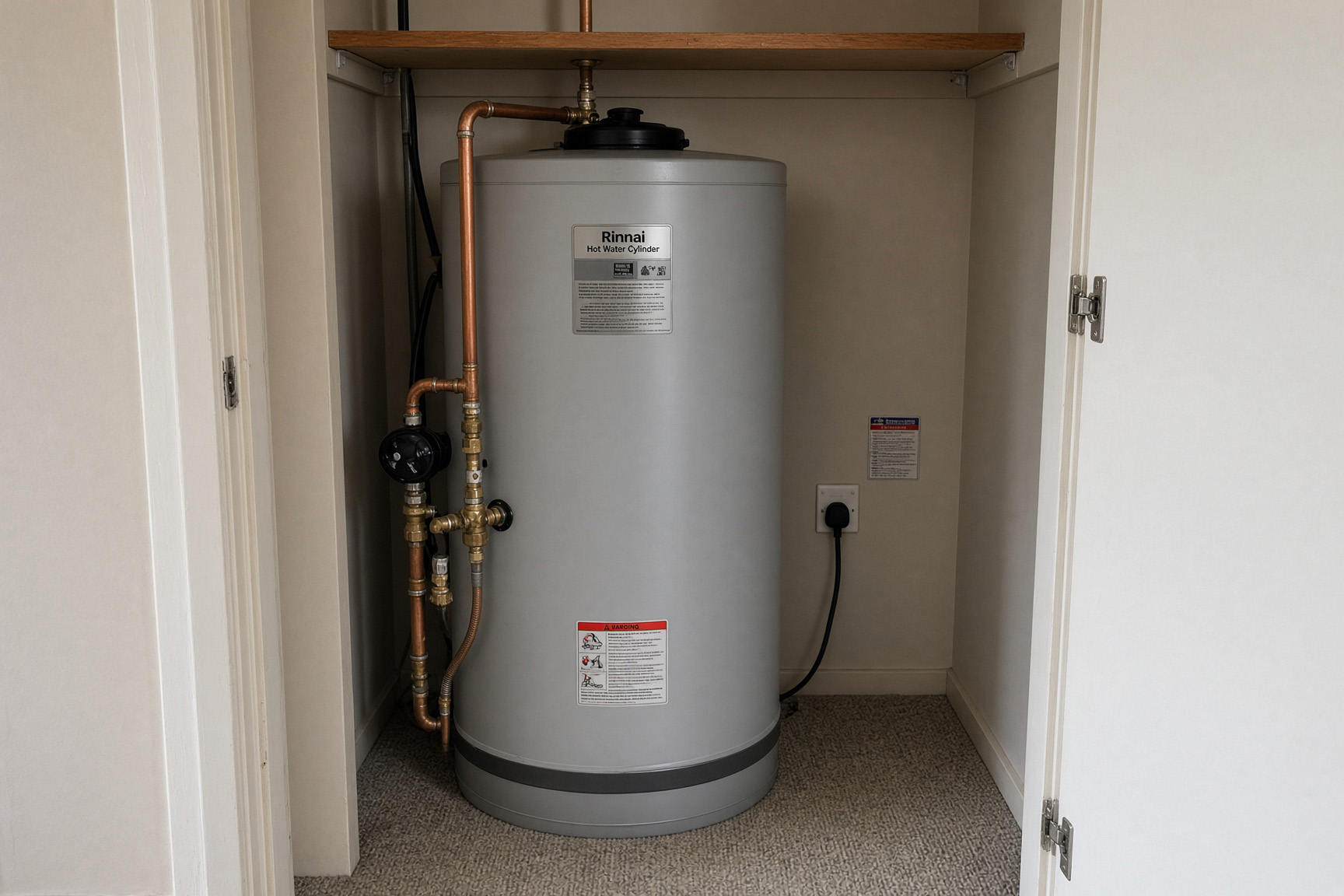
Tempering Valve: What It Does, the 50°C Rule and Who Can Adjust It
Quick answer: A tempering valve blends hot water from your cylinder with cold, so the bathroom taps deliver no hotter than 50°C while the cylinder still stores water at 60°C or more to stop legionella growing.
Two numbers decide whether the hot water in your house is safe, and they pull in opposite directions. The cylinder has to run hot enough to kill bacteria. The shower has to run cool enough not to burn a child. The small brass valve on the pipe beside your cylinder is the part that reconciles them, and it’s easy to forget it’s there until the shower turns lukewarm or a basin tap comes out hotter than it should.
Free cost calculator
Pricing up hot water work at your place?
Answer a few questions and we’ll email you an Auckland price range.
The rule the valve works to also changed recently. The Building Code’s acceptable solution used to allow 55°C at bathroom taps. It now says 50°C for most homes, and a lot of what’s written online, including some product sheets, still quotes the old number. Below we set out what the valve does, what the 50°C rule actually covers (it isn’t retrospective), the signs a valve is failing, who is allowed to adjust it, and what a landlord needs to check in a rental.
What a Tempering Valve Does on Your Hot Water Cylinder
A tempering valve has three connections: hot water in from the cylinder, cold water in from the mains or header tank, and mixed water out to the taps it serves. It blends the two inlets to a set temperature, so the water reaching your basin, bath and shower is cooler than the water sitting in the cylinder.
Two temperatures, one cylinder
The reason for the valve is that the Building Code asks for two different things at once. Clause G12 says hot water delivered to fixtures used for personal hygiene must come out “at a temperature that avoids the likelihood of scalding”. The same clause says a hot water system must be capable of being controlled to prevent the growth of legionella bacteria.
The acceptable solution that puts numbers on those requirements, G12/AS1, does it in two lines. Paragraph 6.14.3 says the storage water heater’s thermostat “shall be set at a temperature of not less than 60°C” to prevent legionella growing, whether or not a delivery temperature control device is fitted. Paragraph 6.14.1 says the water delivered at the outlet of a personal hygiene fixture must not exceed 50°C in most buildings. Store at 60°C or more, deliver at 50°C or less: you can’t do both with a cylinder thermostat alone, which is why the valve exists.
The cold side of the mix matters too. A comment in G12/AS1 warns that cold water pipes run through a hot roof space in summer can exceed 45°C, which raises both the scalding risk and the legionella risk. A valve blending 60°C water with cold water that has been sitting in a roof cavity all afternoon has less cooling to work with. The acceptable solution suggests avoiding long pipe runs exposed to solar heat and laying ceiling pipework under the insulation.
MBIE’s guidance on preventing scalding sums up the trade-off in two sentences. Water that’s too hot scalds; water that isn’t hot enough lets legionella grow in the storage cylinder. Its answer is the same pair of numbers, with a delivery temperature control device as one way of achieving it.
What’s inside the valve
A domestic tempering valve is a small brass body with a cap on top and an adjusting screw underneath; Apex Valves, for example, makes 20 mm and 25 mm versions. Apex’s sheet for its 25 mm valve shows the parts: a temperature-sensing wax element in the middle, and a non-return valve built into both the hot and cold inlets. Those non-returns aren’t optional extras. G12/AS1 Table 8B requires every tempering valve to have a non-return valve on the hot and cold supply, fitted separately or built in.
The same sheet sets out conditions for the valve to work properly. The stored water must be at least 10°C above the valve’s setting and over 60°C. The valve must be protected by a line strainer, a small filter that catches grit before it reaches the mechanism. Its outlet temperature is adjustable from 35°C to 60°C, which is why a valve can be set too hot as easily as too cool.
The first condition is the one households undo without realising. If someone turns the cylinder thermostat down to save power, the valve has less hot water to work with. The bathroom runs cooler than it should, and the cylinder drops below the 60°C storage temperature the Code asks for. A low thermostat isn’t a saving. It’s two problems.
Where you’ll find it
On most Auckland cylinders the valve sits on the hot pipe a short distance from the top or side of the cylinder, often inside the cylinder cupboard. It isn’t screwed straight onto the cylinder. Note 2 to Figure 16 in G12/AS1 requires at least 1.0 m of copper pipe between a storage water heater and the temperature control device, and Apex’s sheet repeats it in capitals: “Do NOT install valve directly into outlet of cylinder”. For the lowest-pressure systems, a footnote in the acceptable solution’s pipe-sizing table sets a 2 m maximum run from the water heater outlet to the valve.
If your house has an older low-pressure system fed from a header tank in the ceiling, the valve has to suit it. Apex markets its 25 mm valve for low-pressure systems, header tanks and open-vented systems because of its high flow rate, and G12/AS1’s pipe-sizing table calls for a minimum 25 mm valve on the lowest-pressure header-tank supplies. A plumber sizes the valve to the system, not the other way round.
💡 Property tip: Open the cylinder cupboard and follow the hot pipe from the top of the cylinder. A brass fitting with three pipes and a round or hexagonal cap, about a metre along, is almost certainly the tempering valve. Take a photo of it before you call a plumber.
No cylinder? Continuous-flow gas and the same 50°C limit
Not every house stores hot water. Many Auckland homes run a gas continuous-flow (instantaneous) water heater instead, and there’s no cylinder for a tempering valve to sit beside. The acceptable solution handles these separately. G12/AS1 Table 8B lists an instantaneous temperature limited water heater, one built to AS 3498 that limits its own outlet temperature, as an acceptable way of meeting the 50°C limit without a separate valve.
There’s a catch in the same table. Where a continuous-flow heater is adjusted to deliver water hotter than 50°C, G12/AS1 says additional temperature control devices must be fitted so the personal hygiene fixtures still don’t exceed 50°C. If someone has turned the unit’s controller up to fill a bath faster, the bathroom has lost its protection, and a tempering valve or a reset of the heater is the fix.
Tempering valve or thermostatic mixing valve?
The two look alike and do a similar job, but they’re not interchangeable. MBIE describes a thermostatic mixing valve (TMV) as reacting quickly to changes in temperature and pressure, and shutting off the hot water if the cold supply fails. A tempering valve works on the same mixing principle but is simpler.
That difference is written into G12/AS1. Table 8A lists the devices acceptable where the delivery limit is 45°C, and a tempering valve isn’t one of them: only a TMV or a thermostatically controlled tap will do. Table 8B, for the 50°C limit that covers ordinary homes, adds the tempering valve. In a house, a tempering valve is the normal choice. In a school, rest home or hospital, it isn’t enough on its own.
The 50°C Rule for Tempering Valves: What Changed and Who It Applies To
If you’ve read that bathroom hot water “must be 55°C”, that was the rule for a long time. It changed in two steps, and the second step has a date that decides whether it applies to your house at all.
From 55°C to 50°C
Amendment 12 to G12/AS1 set the limit at 45°C for early childhood centres, schools, old people’s homes, institutions for people with disabilities and hospitals, and 55°C for all other buildings. Amendment 13 kept the 45°C figure and lowered the second limit to 50°C. Building Performance’s version list shows amendment 13 took effect on 2 November 2023, with amendment 12 still usable until 1 November 2024. Amendment 14, the current version, took effect on 2 November 2024 and keeps the 50°C limit.
For homes, then, there was a year of overlap. A plumber could still work to the 55°C limit until 1 November 2024. MBIE’s guidance gives 2 November 2024 as the date the lower limit applies from.
| Where the tap is | Maximum delivered temperature | Source |
|---|---|---|
| Basins, baths, showers and bidets in a house (new fixtures from 2 November 2024) | 50°C | G12/AS1 6.14.1(b) |
| The same fixtures under the previous version (amendment 12) | 55°C | G12/AS1 amendment 12, 6.14.1(b) |
| Schools, early childhood centres, rest homes, hospitals, disability institutions | 45°C | G12/AS1 6.14.1(a) |
| Taps children can reach in early childhood centres (licensing) | 40°C | Ministry of Education, via MBIE guidance |
| Water stored in the cylinder | At least 60°C | G12/AS1 6.14.3 |
It isn’t retrospective
This is the part most explainers skip. MBIE states the reduction “is not retrospective”. It applies to hot water delivered to new personal hygiene fixtures installed on or after 2 November 2024 when the acceptable solutions are used to comply. For existing buildings, MBIE says, the maximum delivery temperature applies to the installation of new fixtures, and “this requirement is not extended to existing fixtures or appliances within a building.”
So a 2015 bathroom whose valve was set to 55°C under the old rule isn’t suddenly in breach. A new vanity, bath or shower installed after 2 November 2024 is a different matter. Imagine you’re redoing the ensuite in a Botany townhouse next year: the new shower is a new personal hygiene fixture, so the acceptable solution’s 50°C limit applies to it. If you’re planning that sort of job, our sister company Superior Renovations handles full bathroom rebuilds, from the strip-out to the new fixtures, and the plumbing in it will be set to the current figure.
Not retrospective doesn’t mean 55°C is a good setting. It means nobody is forcing you to change it.
Which taps the rule covers
The limits apply to sanitary fixtures used for personal hygiene. G12/AS1 lists them in a comment: showers, baths, hand basins and bidets. MBIE adds that the limits don’t apply to kitchen sinks and laundry tubs, which aren’t fixtures used primarily for personal hygiene. Hotter water can go to the kitchen and laundry, and 50°C there is optional. MBIE notes that 50°C at a domestic kitchen sink is usually adequate for hand-washing dishes, and suggests plumbers and owners agree the pipe layout before installation so nobody is surprised.
That’s why some houses have a tempering valve on one branch of pipe only. The bathroom side is tempered; the kitchen side runs straight from the cylinder.
There’s one exception that goes the other way. If the cylinder is connected to an uncontrolled heat source, such as a wetback on a log burner or a solar water heater, G12/AS1 and MBIE both say untempered hot water must not be supplied to any fixture or appliance from it. With a wetback, the stored temperature depends on how hard the fire is burning, so everything gets tempered.
Why 5 degrees matters
MBIE’s guidance includes a table of how long it takes hot water to cause a burn, taken from a 2009 Danish standard. The gap between 50°C and 55°C is bigger than the numbers suggest.
| Water temperature | Child: 2nd-degree burn | Child: full thickness (3rd-degree) | Adult: full thickness (3rd-degree) |
|---|---|---|---|
| 50°C | 45 seconds | 105 seconds | 300 seconds |
| 55°C | 3.2 seconds | 8 seconds | 28 seconds |
| 60°C | 0.7 seconds | 1.5 seconds | 5.4 seconds |
Read across the middle row. At 55°C a child can suffer a second-degree burn in about three seconds. At 50°C it takes 45 seconds, long enough for someone to hear and reach them. G12/AS1 names children, the elderly and people with physical or intellectual disabilities as most at risk, and MBIE gives the kind of case the rule is aimed at: a child left in a bath with the hot tap running while a parent is distracted, or an older person who falls in the shower and knocks the mixer to full hot.
None of these numbers is a bath temperature. MBIE points out that maximum delivery temperatures are not bathing temperatures, and that you should still mix cold with hot for baths and showers. It gives 37°C to 38°C as the maximum bathing temperature recommended for young children, and three habits that cut the risk: a delivery temperature control device, running the cold water first, and never leaving a child alone in the bathroom. A valve set to 50°C buys time. It doesn’t make a hot bath safe.
One source still says 55°C. EECA’s page on heating water efficiently tells readers hot water should be “no more than 55°C at the tap so you don’t get burnt”. That’s a consumer energy page, not the Building Code. For new bathroom fixtures, G12/AS1 and MBIE’s guidance set 50°C, and if your household includes young children or an older relative, the burn table is a good argument for 50°C whatever the age of the bathroom.
Signs Your Tempering Valve Needs Attention
A tempering valve doesn’t fail dramatically. It drifts, sticks or weeps, and the household adjusts to it without noticing. G12/AS1 is clear that these devices aren’t fit-and-forget: Table 8B’s notes say delivery temperature control devices “require routine maintenance and performance testing”, and point to the Australian standard that sets out how.
Start with a thermometer, not a guess
The simplest check is one you can do yourself. Run the hot tap at the bathroom basin furthest from the cylinder for a minute or two until the temperature settles, then hold a kitchen or digital thermometer in the stream. You’re looking for a reading close to the valve’s setting. For a valve set to the current rule, that’s no more than 50°C.
Do the same at the kitchen sink. If the kitchen tap is much hotter than the basin, the bathroom side is probably tempered and the kitchen isn’t, which is allowed. If both read the same high number, there may be no tempering valve at all, or it may be serving every tap and set too high.
Write the readings down with the date. A number you took in March is the best evidence you’ll have in September that something has changed.
What the common symptoms can point to
Is it the valve, or the cylinder? The table below lists what you might notice and the more likely explanations. A symptom points to a group of causes, not a single fault, and several of them sit upstream of the valve. A cylinder that isn’t heating properly will make a healthy valve look faulty, which is why our troubleshooting steps for a cylinder that’s stopped heating are worth running first if the water is cold everywhere.
| What you notice | What it can point to | First step |
|---|---|---|
| Bathroom water hotter than 50°C | Valve set high, set to the old 55°C rule, worn, or no valve on that branch | Plumber to test and adjust or replace |
| Bathroom lukewarm, kitchen hot | Valve set low or sticking, or a blocked strainer or non-return on the hot side | Plumber to service the valve |
| Lukewarm everywhere | Cylinder thermostat turned down, element or thermostat fault, power supply | Check the cylinder first |
| Temperature swings when another tap or the toilet is used | Hot and cold pressures outside what the valve is designed for (one maker’s 25 mm valve copes with cold-to-hot pressure up to 5:1), or a valve not suited to the system | Plumber to check pressures and valve type |
| Water dripping from the valve or its fittings | Leaking joint or seal | Plumber; put a container under it meanwhile |
| Weak flow at the shower only on a header-tank system | Valve too small for low pressure, or a partly blocked strainer | Plumber to check valve size against the system |
Note the third row. When water is lukewarm everywhere, the valve is rarely the first suspect, because the kitchen tap usually isn’t tempered. The Apex sheet’s rule that stored water must sit at least 10°C above the valve setting explains the knock-on: a cylinder running cool gives a tempered tap even less to work with.
💡 Property tip: Never “fix” lukewarm bathroom water by turning the cylinder thermostat up past where the plumber set it, or by asking for the valve to be wound up to compensate. Get the cause found. A valve wound hot to mask a cylinder fault is how a 60°C shower happens.
Older homes may not have one at all
MBIE notes that hot water systems installed before 1992 are unlikely to have temperature control devices fitted. Plenty of Auckland houses still run cylinders and pipework from that era, from Henderson weatherboards to 1980s brick-and-tile homes on the North Shore, sometimes with a replacement cylinder connected to the original pipes.
If your thermometer reads close to 60°C at the bathroom basin, that’s the likely story: the bathroom is getting the cylinder’s storage temperature directly. Nothing in the 50°C rule makes you change an existing installation. Everything in the burn table says you should think about it, especially with small children or older people in the house. MBIE’s own advice for these systems is to talk to a licensed plumber about fitting a temperature control device.
Adjusting, Repairing or Replacing a Tempering Valve
Once you know the valve needs attention, the questions are who can work on it, whether it can be serviced or must be swapped, and what the paperwork looks like.
Why the adjusting screw isn’t a DIY job
The screw under the cap is right there, and online videos make adjusting it look like a thirty-second job. MBIE is explicit: tempering valves and the other temperature control devices “must only be installed or adjusted by a licenced plumber”.
The Plumbers, Gasfitters and Drainlayers Board (PGDB) draws the homeowner line in the same place. Its advice for consumers says you can install appliances such as dishwashers and washing machines and replace or repair taps, ball cocks and plugs. You cannot do any work that involves fixing or unfixing a pipe, plumbing fixture or appliance, or any pipe that supplies water. A tempering valve is plumbed into the hot water supply, so changing one is sanitary plumbing for a licensed plumber.
There’s a practical reason too. The valve is a safety device set to a measured number, and the setting depends on the cylinder temperature, the pressure on each side and where the tap is. A valve adjusted by feel, without a thermometer at the furthest outlet, is a guess on a device whose job is to prevent burns.
Cartridge or whole valve
Some valves can be serviced and some can’t. Apex Valves’ cartridge sheet for its 20 mm valve explains how to tell: take off the cap and look at the black plastic part underneath. If it’s round, the valve has no replaceable cartridge, and if it’s faulty the whole valve must be replaced. If it’s hexagonal, the internals can be swapped for a new cartridge. The sheet gives the replacement cartridge a 5-year warranty and says it’s factory set at 50°C, adjustable from 35°C to 60°C.
The sheet’s steps finish with the part that matters most: after fitting the new cartridge, run the hot water from an outlet and check the temperature “according to regulations”, adjusting in small increments and letting the temperature settle between each one. That final check is the job. A new cartridge set to a factory figure still has to be proved at the tap.
One more detail from Apex’s 25 mm valve sheet shows why it pays to check the date on any instructions. Its temperature note still says the maximum at personal hygiene fixtures “shall not exceed 55°C”, the pre-amendment figure. A plumber working to the current acceptable solution will set to 50°C, whatever an older sheet says.
What a service visit involves
Apex’s cartridge instructions give a clear picture of what a plumber does on a serviceable valve. The water supply to the valve is turned off first. The cap comes off, the old cartridge is unscrewed, and the spring and cap are kept to reuse. The inside of the valve body is checked for debris or contamination and cleaned if needed. The new cartridge’s O-rings are checked and greased, the cartridge is screwed in, and the water goes back on so the joints can be checked for leaks.
Then comes the temperature work: hot water run from an outlet, the reading checked, and the screw turned in small steps, clockwise for colder and anticlockwise for hotter, with time for the temperature to settle after each turn. On a valve with no replaceable cartridge, the plumber isolates the supply and swaps the whole body instead, keeping that 1 m of copper back to the cylinder. Either way, ask for the final temperature reading at the tap and keep it with your house records.
Does it need a building consent?
Usually not, but the reason is specific. Part 2 of Schedule 1 of the Building Act 2004 lists sanitary plumbing work that doesn’t need a building consent when it’s carried out by a person authorised under the Plumbers, Gasfitters, and Drainlayers Act 2006. Clause 32 covers the repair, maintenance and replacement of sanitary plumbing using comparable products, but excludes repair or replacement of a water heater unless clauses 36 to 38 allow it. Clause 36 covers the repair or maintenance of an existing water heater using comparable building products.
Read together, a like-for-like valve swap by a licensed plumber normally sits inside those exemptions. The exemption is tied to who does the work: the same job done by someone who isn’t authorised doesn’t get the benefit of Part 2. Work outside those clauses, such as moving or changing the type of water heater, has its own rules, and our hot water cylinder pricing and consent guide covers the replacement side.
Compliance note: Work on a tempering valve, cylinder or the pipes between them is restricted sanitary plumbing. Use a plumber licensed with the Plumbers, Gasfitters and Drainlayers Board, and ask them, or Auckland Council, whether your particular job needs a building consent. We don’t give consent advice; the plumber and the council make that call.
What it costs
We don’t publish a price for a tempering valve on its own, and we’re not going to invent one. What a job costs depends on whether it’s a cartridge swap or a whole valve, the valve size, access in the cupboard, and whether the visit turns up something else, such as a cylinder thermostat fault or a failing relief valve. Our licensed plumbers for repairs across Auckland give a fixed quote before any work starts, which is the honest answer to “how much”.
When the valve is one symptom of an old cylinder, the bigger number is the cylinder. Our published guide range for replacing a hot water cylinder is $1,500 to $5,500, with most Auckland homes paying $2,500 to $4,500 for a standard like-for-like replacement or a mains pressure upgrade. A cylinder replacement is the natural time to have the tempering valve tested or replaced in the same visit, so you aren’t paying for two call-outs. If that’s where you’re heading, see how we handle a full cylinder changeover, valves and all.
For Auckland Landlords: Hot Water Temperature in a Rental
Hot water isn’t one of the five Healthy Homes standards, so it doesn’t appear on a compliance statement. It’s still part of a landlord’s obligations, and a scald in a rental is the sort of event nobody wants to explain afterwards.
Where the duty comes from
Section 45 of the Residential Tenancies Act 1986 requires a landlord to provide and maintain the premises in a reasonable state of repair, having regard to their age and character, and to comply with all requirements in respect of buildings, health and safety under any enactment so far as they apply to the premises. A hot water system that works, delivers water at a safe temperature and has had its safety devices maintained sits within both.
Whether a particular rental meets those requirements is a legal question, and we don’t answer it. What we can do is the physical part: test the temperature, service or replace the valve, and leave you with a written reading.
When it’s urgent
Tenancy Services says that if the state of disrepair is likely to cause injury to people or property, a tenant can have repair work done and ask the landlord to pay them back, as long as the tenant made reasonable attempts to let the landlord know first. It also expects repairs to be completed as soon as reasonably possible when the problem is urgent and likely to cause injury.
A tenant reporting scalding water at the bathroom basin fits that description. So does a valve leaking onto the cupboard floor. Treat either as a same-week job, not something for the next routine inspection.
Tenants and DIY
Tenancy Services’ page on licensed practitioners says sanitary plumbing, gasfitting and drainlaying work is restricted and can only be done by tradespeople who are registered and licensed for it, and that using unlicensed tradespeople can affect your insurance. That covers a tenant who decides to wind the valve up because the shower feels cool, and a landlord tempted to do the same on a Saturday. Ask your tenants to report temperature changes rather than adjust anything, and say so in your welcome pack.
A turnover check worth adding
Between tenancies is the cheapest time to look at hot water, because nobody’s waiting for a shower. A short check covers most of it:
- Take a thermometer reading at the bathroom basin furthest from the cylinder, and at the kitchen sink, and record both with the date.
- Look in the cylinder cupboard for water on the floor, a damp safety tray or weeping fittings around the valve.
- Confirm a tempering valve exists on the bathroom branch. If the basin reads close to 60°C, there probably isn’t one.
- If the property has a wetback or solar water heating, confirm every outlet is tempered, as G12/AS1 requires for those systems.
- Keep the plumber’s invoice and any paperwork they leave with the property records.
On a portfolio of older rentals, say a Papatoetoe unit block or a row of 1970s units in Glen Innes, the readings across properties tell you quickly which ones have no temperature control at all. That’s a useful list to work through before a tenant finds it for you.
Compliance note: Hot water isn’t a Healthy Homes standard, but your repair and safety obligations still apply under section 45 of the Residential Tenancies Act 1986. For questions about your legal position as a landlord, contact Tenancy Services. Plumbing work on the valve or cylinder must be done by a licensed plumber.
The Valve Worth Five Minutes of Your Attention
A tempering valve is a small part next to the cylinder it sits beside, and it decides whether the hottest water in your house ever reaches skin. Take a reading at the bathroom tap this week. If it’s well over 50°C, under it, or swinging about, get a licensed plumber to test and set it properly rather than turning the screw yourself. If the cylinder itself is near the end of its life, sort the two together.
➡ Request a free no-obligation quote from Superior Property Services
➡ Talk to us about your hot water system and its tempering valve
➡ Make an enquiry — we respond within 1 working day
What does a tempering valve do?
A tempering valve mixes hot water from your cylinder with cold water so the taps it serves deliver water at a set, safer temperature. It lets the cylinder store water at 60 degrees Celsius or more to stop legionella bacteria growing, while basins, baths and showers receive water no hotter than 50 degrees Celsius under the current Building Code acceptable solution.
What temperature should a tempering valve be set to in NZ?
For basins, baths, showers and bidets in a house, the current acceptable solution G12/AS1 sets a maximum of 50 degrees Celsius. Schools, early childhood centres, rest homes and hospitals have a 45 degree limit, which needs a thermostatic mixing valve rather than a tempering valve. The cylinder itself must store water at not less than 60 degrees.
Is the 50 degree hot water rule retrospective?
No. MBIE says the reduction from 55 to 50 degrees Celsius is not retrospective. It applies to new personal hygiene fixtures installed on or after 2 November 2024 when the acceptable solutions are used. Existing fixtures are not caught by it, although a lower setting is still safer if children or older people live in the house.
Can I adjust my own tempering valve?
No. MBIE says tempering valves and other temperature control devices must only be installed or adjusted by a licensed plumber, and the PGDB limits homeowner plumbing to jobs like replacing taps, ball cocks and plugs and connecting dishwashers or washing machines. You can safely check the temperature at a tap with a thermometer and report what you find.
How do I know if my tempering valve is faulty?
Signs include bathroom water hotter than 50 degrees, a lukewarm shower while the kitchen tap runs hot, temperatures that swing when another tap is used, and water dripping from the valve. Check the temperature at the furthest basin with a thermometer. Lukewarm water everywhere usually points to the cylinder rather than the valve, so check that first.
Do kitchen taps need a tempering valve?
No. MBIE says the maximum delivery temperatures do not apply to kitchen sinks and laundry tubs, because they are not fixtures used primarily for personal hygiene. Supplying 50 degree water to them is optional, and MBIE notes it is usually adequate for washing dishes by hand. The exception is a cylinder heated by a wetback or solar, where every outlet must be tempered.
Where is the tempering valve on a hot water cylinder?
It is usually on the hot pipe in the cylinder cupboard, a short way from the cylinder, with three pipe connections and a cap on top. G12/AS1 requires at least 1 metre of copper pipe between the storage water heater and the valve, so it is never screwed directly onto the cylinder outlet. A photo helps a plumber identify the type.
Can a tempering valve be repaired or does it need replacing?
It depends on the valve. On one maker's 20 mm valve you remove the cap: a round black part underneath means no replaceable cartridge, so a faulty valve is replaced whole, while a hexagonal part means the cartridge can be swapped. Either way a licensed plumber should do it and then check the temperature at the tap.
Do I need building consent to replace a tempering valve?
Usually not. Schedule 1 Part 2 of the Building Act 2004 exempts repair and replacement of sanitary plumbing with comparable products, and repair or maintenance of an existing water heater, when the work is done by a person authorised under the Plumbers, Gasfitters, and Drainlayers Act. Confirm your specific job with your plumber or Auckland Council.
Does a landlord have to fit a tempering valve in a rental?
The 50 degree rule applies to new bathroom fixtures, not existing ones, so it is not a blanket requirement for every rental. Landlords must keep the property in a reasonable state of repair and meet building, health and safety requirements under section 45 of the Residential Tenancies Act. For your legal position, ask Tenancy Services; a licensed plumber can test and fit one.
Related guides
- Whether a heat pump water heater pays back in an Auckland home
- What to check first when the hot water runs out or goes cold
- Finding a hidden leak before it shows up on the water bill
References
- Building Performance (MBIE), Acceptable Solutions and Verification Methods for Clause G12 Water Supplies, 3rd edition amendment 14
- Building Performance (MBIE), G12 Water supplies: acceptable solutions and verification methods (version history)
- Building Performance (MBIE), Preventing scalding from tap water
- Building Act 2004, Schedule 1 Part 2, clauses 32 and 36
- Plumbers, Gasfitters and Drainlayers Board, Advice for consumers
- Apex Valves, Tempering Valve 25mm product sheet
- Apex Valves, Tempering Valve Cartridge (TV 20) product sheet
- EECA, Heat water efficiently at home
- Residential Tenancies Act 1986, section 45
- Tenancy Services, Damage and repairs
- Tenancy Services, Using licensed practitioners for your property