
Gully Trap Overflowing or Smelly? What It Does and Who to Call in Auckland
Quick answer: A gully trap is the grated, water-filled basin outside your kitchen, bathroom or laundry that catches waste water before it reaches the sewer. If yours overflows in Auckland, Watercare asks you to ring them on 09 442 2222 before you call a plumber.
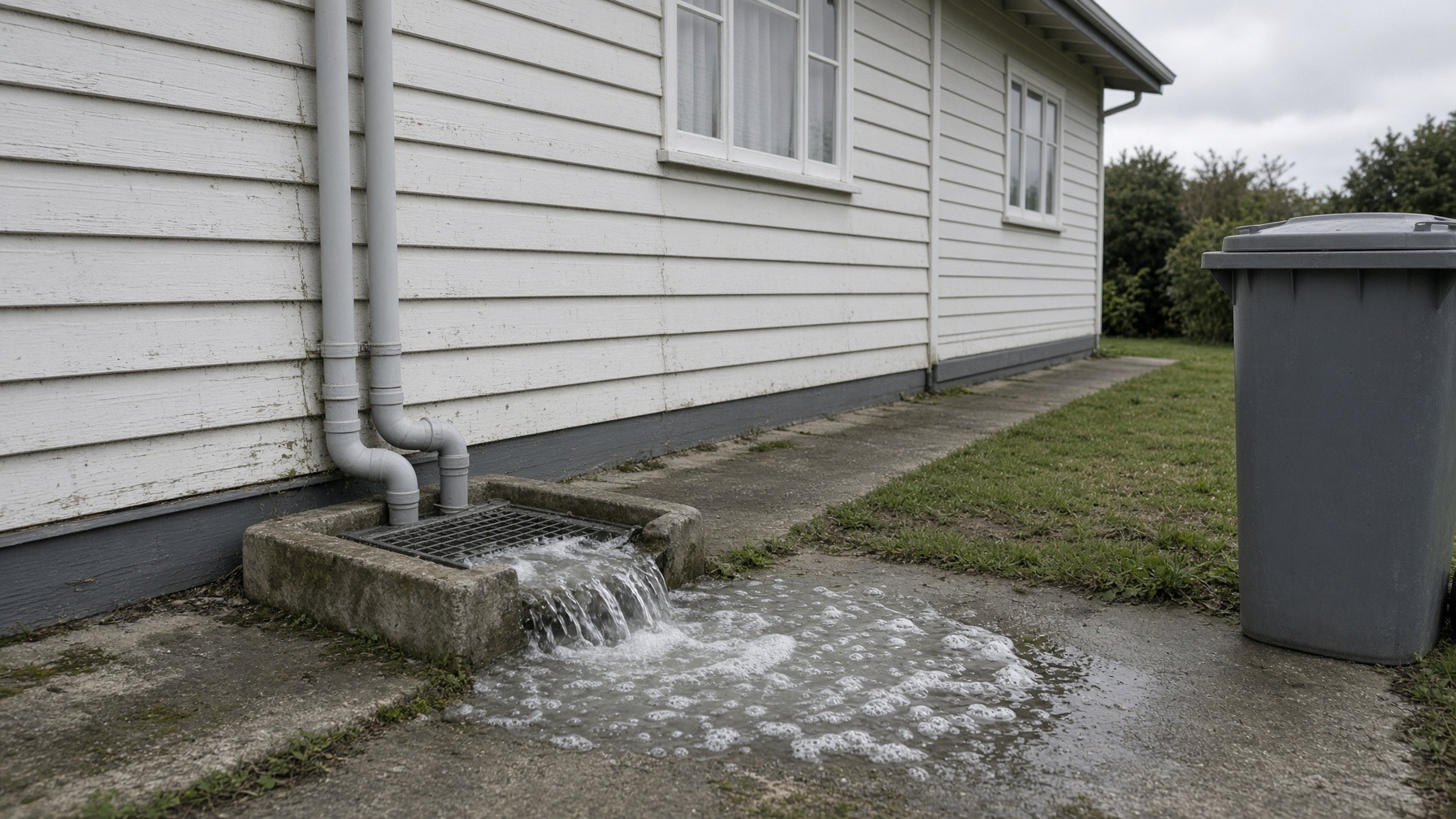
Most people only learn where their gully trap is on the day it starts misbehaving. Grey water is pooling on the path outside the laundry, there’s a sour smell by the back door every time the wind drops, or the grate disappears under a puddle whenever it rains hard. The first instinct is to ring a plumber and pay whatever the call-out costs. In Auckland, that isn’t always the right first call, and it can mean paying for work on a blockage that was never yours to fix.
Free cost calculator
Pricing other jobs around the property?
Answer a few questions and we’ll email you an Auckland price range.
What happens next depends on three things: is the problem on your side of the network or Watercare’s, is the gully itself built the way the Building Code expects, and is the fix something you can do or something that legally needs a registered drainlayer? The answers sit with Watercare, the Ministry of Business, Innovation and Employment (MBIE), the Building Act and the law that licenses drainlayers, and they’re more useful than any amount of plunging.
What a Gully Trap Does, and the Building Code Rules It’s Built To
A gully trap is the open end of your house’s waste water system. The pipes from the kitchen sink, the shower, the bath, the basins and the laundry tub run outside and discharge into it, and from there the water drops into the underground drain that carries it to the public sewer. Toilets are the exception: they don’t discharge through the gully.
How it works
According to BRANZ’s guidance on gully traps, a gully receives discharge from kitchen, bathroom (apart from toilet pans) and laundry fixtures before it enters the sewer. It sits outside on purpose: if the drain blocks, the waste water overflows outside instead of inside the building. Below the grate is a bowl that always holds water. That water is the “trap”, and it stops sewer gases coming back up through the grate.
That gives a gully trap two jobs that matter to an owner. It keeps the smell of the sewer out of the backyard, and it acts as the pressure-release point for the whole drain. When something goes wrong further down the line, you want it to be the gully that overflows, not the shower.
Every house has at least one. Tauranga City Council’s gully trap factsheet says it’s usually found outside the toilet, laundry or kitchen. On an older Auckland villa it might be a concrete dish against the weatherboards near the back door. On a newer townhouse it may be a round plastic grate set into the paving, sometimes hidden under a pot plant or a deck.
💡 Property tip: Find your gully trap on a dry day and take a photo of it with the grate in place. When it overflows in the dark during a storm, you’ll know where to look and what “normal” looked like.
What the Building Code expects of one
The Building Code clause for waste water is G13 Foul water. MBIE’s Acceptable Solution G13/AS2 (Second Edition, Amendment 10, November 2023) is one of the documents a drain can be built to, and its paragraph 3.3 sets out the gully trap in detail. It must be built to keep out surface water and anything likely to cause a blockage, sit inside the legal boundary of the property, and meet the dimensions below.
| G13/AS2 requirement (paragraph 3.3.1) | What it means on your section |
|---|---|
| Overflow level of the gully dish at least 25 mm above paved surfaces | The rim should sit proud of concrete or pavers, so rain runs past it, not into it |
| At least 75 mm above unpaved surfaces | More clearance where it sits in lawn, bark or a garden bed |
| A grating that will allow surcharge | The grate must let water escape upwards when the drain backs up |
| Outlet pipe at least 100 mm in diameter | The pipe leaving the gully is the drain proper |
| Water seal at least 65 mm deep | Enough standing water to block sewer gases |
| At least one discharge pipe running into it, to avoid water seal evaporation | Regular use keeps the seal topped up |
| Waste pipe outlets at least 20 mm above the water seal and 20 mm below the grating | Pipes discharge above the water but under the grate |
| Top of the water seal no more than 600 mm below the top of the dish | So the trap can be cleaned by hand |
| At least 600 mm clear access space above the dish | Nothing built tight over the top, including a deck |
Two of those lines explain most of the problems owners see. The rim heights exist to keep rainwater out of the sewer. The water seal exists to keep the smell in. When a gully floods in the rain or smells in a dry spell, one of those two has usually stopped doing its job.
The overflow relief gully: the one that protects your floors
Paragraph 3.3.2 adds a rule that matters more than any dimension above. Every house must have at least one gully trap that provides overflow relief for the drainage system, and it must be positioned so that the top of the gully dish is no less than 150 mm below the overflow level of the lowest sanitary fixture served by the drain. It must have a grating that allows surcharge, sit in a visible position, and be installed so that surcharge cannot enter into or under the building.
When the drain backs up, waste water rises until it finds the lowest way out. The Code wants that lowest way out to be a grate in the yard, at least 150 mm lower than your shower tray, floor waste or laundry tub. If someone raises the paving, builds a deck or lays a patio until the gully ends up higher than that, the overflow can come up inside instead. It’s the reason a “tidy-up” of the backyard can quietly change what happens in the next blockage.
Why some guides give different heights
Read around and you’ll find more than one figure for unpaved ground. Tauranga City Council’s factsheet tells owners the dish should be at least 100 mm above unpaved surfaces, while the current G13/AS2 text and the BRANZ article both say 75 mm. All three agree on 25 mm for paving.
G13/AS2 is one way of showing a drain meets the Code, not the only one, so a gully a little higher than 75 mm above the lawn does no harm. A gully lower than 25 mm above paving is the one to look at, because that’s where rain starts to run in.
The other thing these sources agree on is ownership. The gully trap, the pipes that run into it and the drain that leaves it are private plumbing on your property. Who is responsible changes further down the line, and that’s where the “who do I call” question starts.
Gully Trap Overflowing? Whose Problem It Is and Who to Call First
An overflowing gully trap is the drain telling you that waste water can’t get away downstream. The blockage might be a metre from the gully, under your lawn, or in a public pipe two properties away. You can’t see which from the backyard, and that’s why Auckland’s water utility wants to hear about it first.
Why Watercare comes before the plumber
Watercare’s faults and outages FAQs are direct about it. If you have a blocked drain on your property, Watercare asks you to contact it before you contact a plumber, on 09 442 2222, press 1.
There’s a money reason as well as a practical one. The same FAQs say Watercare’s contractors can’t repair the private network because of liability, and that Watercare generally does not reimburse work done by a private plumber, with any exception decided case by case after its engineers have looked at it. If a plumber clears what turns out to be a blockage in Watercare’s pipe, that invoice is likely to stay with you. One phone call to Watercare before anyone lifts a rod can decide who pays for the whole job.
Where your drain ends and Watercare’s begins
Watercare’s page on who is responsible for pipes explains that ownership passes from Watercare to you at the “point of supply”, the place where its network connects with your private pipes. For gravity wastewater pipes (the sloping pipes that drain from a house) the point depends on where the public pipe runs:
- If the public wastewater pipe is inside your boundary, the point of supply is the joint connecting your pipe to Watercare’s pipe or manhole.
- If the public pipe is outside your boundary, the point of supply is where your pipe exits the boundary, which may be on public land or a neighbour’s section.
- On a cross-lease, Watercare recognises the legal boundary of the original title, not the boundaries between the flats. Responsibility inside that boundary falls to the owners under the cross-lease.
That last point catches a lot of Auckland owners. On a cross-leased pair of 1970s units in Glenfield or Papatoetoe, a shared private drain can serve both homes before it reaches the public sewer, and a blockage in it is a conversation between the owners, not with Watercare. Your cross-lease documents are where that answer lives. Our guide to finding a leak on the water supply side uses the same point-of-supply rule for the pressure pipes coming in, so it’s worth knowing for both.
💡 Property tip: Auckland Council’s GeoMaps and Watercare’s GIS map, both linked from Watercare’s page on preventing blockages, show where the public pipes run past your property. Check them before you plant a tree or lay paving near the drain line.
Manholes on your section belong to Watercare
Plenty of Auckland sections have a public manhole in the back lawn or under the driveway. Watercare’s page on preventing blockages and overflows says manholes on private land are still Watercare’s responsibility, and that if you see any spillage from a manhole you should contact it and it will have a team there within the hour.
So if waste water is coming up out of a manhole lid as well as the gully, or the manhole alone, that’s Watercare’s fault to fix, not yours. Stormwater drains are a different authority again: the same page says Auckland Council is responsible for stormwater drains and asks people to call it on 09 301 0101 if they look blocked or flooded.
What usually causes an overflow
Watercare’s prevention advice names the habits that block pipes, both yours and theirs: fats, oils and grease poured down the sink harden in the pipes, and wipes, nappies and personal hygiene products flushed down the toilet don’t break down. It also warns that tree roots can spread one and a half times further than a tree’s adult branches and easily damage pipes. Old and leaky private drains let stormwater seep into the wastewater network, which can then overflow.
Rain is the other big cause. Watercare asks owners to make sure their gully trap is raised off the ground and covered by a grate, because rainwater or debris getting in can overload the wastewater network. Tauranga’s factsheet lists the usual ways that happens: a gully surround at the wrong height, downpipes plumbed into the gully trap instead of the stormwater system, and landscaping that directs water into it. A gully that only overflows in heavy rain and drains away as the rain stops is pointing at one of those, not at a blocked pipe.
What to do while you wait
- Stop using the sinks, shower, washing machine and dishwasher that drain to that gully. Every litre you send makes the overflow bigger.
- Ring Watercare on 09 442 2222 and press 1. Tell them whether a manhole is overflowing too.
- Keep children and pets away from the overflow, and don’t hose it into a stormwater grate.
- Lift leaves or a blocked grate cover off the dish if they’re obviously sitting on top, but don’t push rods or a hose down the drain.
- If Watercare confirms its network is clear, the blockage is on your side and it’s a job for a registered plumber or drainlayer.
If the overflow has reached the house, under the floor or into a wall, the drain is only half the job. Our guide to repairing a home after water damage covers what happens once the water has been stopped.
Smelly Gully Traps and Rainwater Getting In: Checks You Can Do Yourself
Not every gully trap problem is an emergency. A smell by the back door, a grate that disappears under a puddle in a downpour, or a gully that’s slowly been buried by bark and pavers are all things you can look at yourself in ten minutes. Some will be fixed on the spot. The rest will at least tell a tradesperson exactly what they’re coming to look at.
A smell usually means the water seal has gone
The water sitting in the bottom of the gully is what keeps sewer gases out of the yard. BRANZ describes the gully’s water seal as the thing that blocks odours from the sewer. If that water evaporates, or drops below the bend, there’s nothing between you and the drain.
G13/AS2 builds the fix into the design. It requires at least one discharge pipe running into every gully trap so that the water seal doesn’t evaporate. A gully whose only waste pipe comes from a laundry tub nobody uses, or a bathroom in a spare wing, can dry out over a hot, still summer. The same can happen at a house left empty for a few weeks.
The check takes a minute. Lift the grate and look.
If the bowl is dry or the water is well below where it normally sits, pour a bucket of clean water in and replace the grate. If the smell goes and stays gone, that was the problem. If the bowl empties again within a day or two, water is leaving it somewhere it shouldn’t, and that needs a tradesperson to look at the dish and its connections.
Check the grate and the dish
G13/AS2 asks for a gully built to keep out surface water and foreign bodies likely to cause a blockage. In practice that means a grate that’s in place, unbroken and clear. Leaves, lint from the laundry outlet, gravel and garden mulch all collect on and under grates. Lifting off what’s sitting on top, with gloves on, is ordinary maintenance.
Look at the dish itself while the grate is off. A cracked concrete surround, a plastic dish that’s shifted or lifted, or a gap where a waste pipe enters the side are worth photographing. The Acceptable Solution’s own comment is that it’s imperative the waste pipe connections to the gully trap remain watertight, to keep ground and surface water out. A gap you can see is a gap rain can find.
Measure the rim against the ground
Take a tape measure to the gully. On concrete or pavers, the rim of the dish should sit at least 25 mm higher than the surface around it. In lawn, bark or a garden bed, at least 75 mm higher. Then watch it in the next heavy rain: water should run away from the grate, not towards it.
Gullies drift out of compliance without anyone touching them. A new patio laid a little higher than the old one, a garden bed built up with a few bags of bark each spring, or a driveway resealed with an extra layer can all close the gap. Tauranga’s factsheet describes two low-cost ways to raise a gully that sits too low: a plastic riser fitted over the gully with sealant around the edges, or a concrete half ring, also called a nib wall, cemented into place. The seal between the riser and the dish is what keeps rain out, which is why we’d have a registered tradesperson fit either one.
💡 Property tip: Planning a deck over the area outside the laundry? G13/AS2 asks for at least 600 mm of clear access space above the gully dish, and BRANZ notes that a deck may be built over a gully trap only if that access is kept. A hatch that lifts out over the gully saves cutting boards later.
Follow the downpipes
Walk around the house and see where each roof downpipe goes. Watercare’s advice is that a downpipe should connect to the stormwater network, not its wastewater network, because stormwater in the wastewater network can overload it and cause an overflow. Tauranga’s factsheet puts downpipes plumbed into the gully trap on its list of the usual reasons rain gets in.
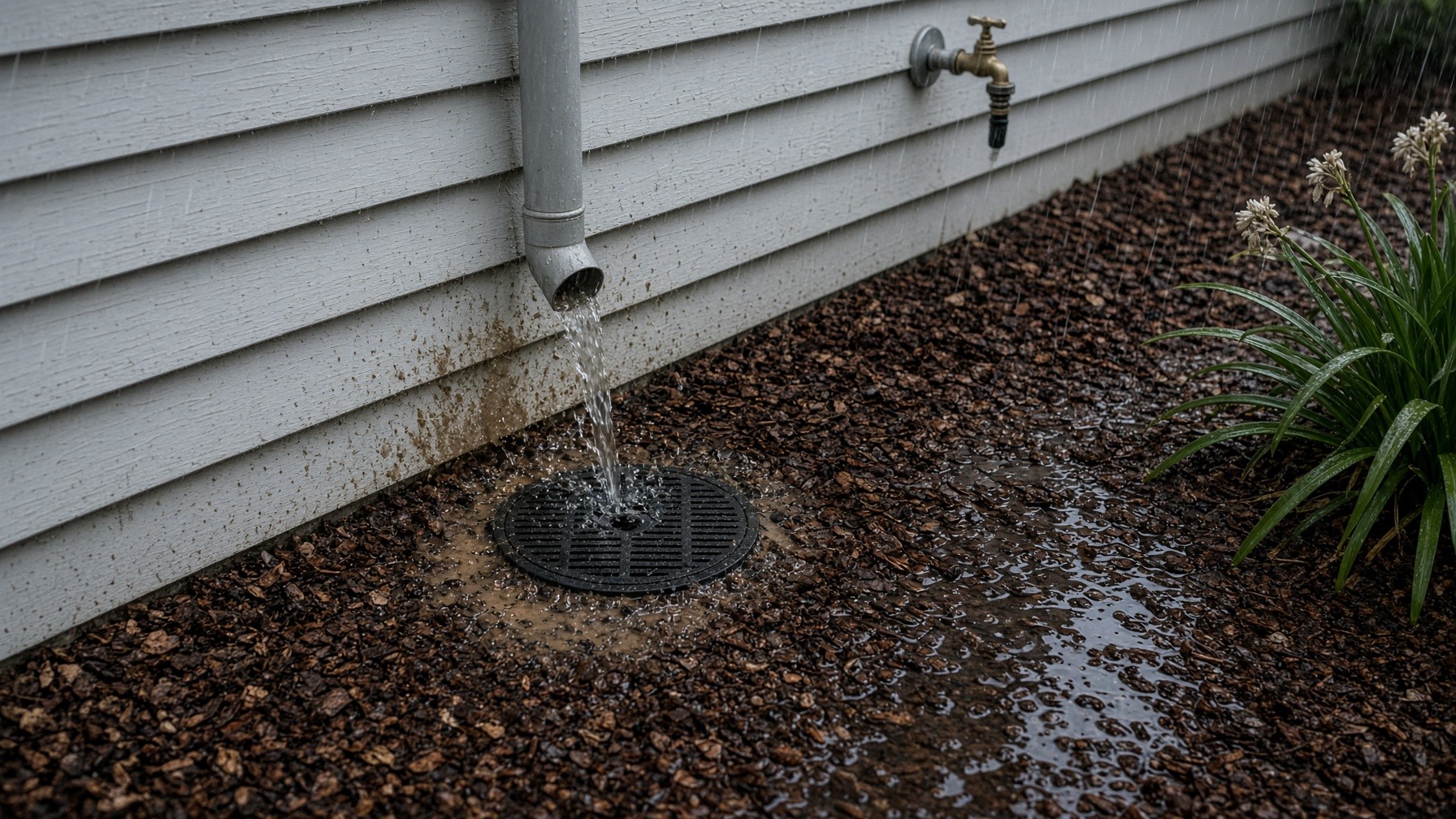
A downpipe that ends just above a gully grate, or one cut short so it splashes onto it, sends roof water into the waste drain every time it rains. Moving it to the stormwater system is drainlaying work, and the law is specific about who can do that.
When a check turns into a job
You’ve done what an owner can do once the grate is clear, the seal is topped up and the downpipes are accounted for. A gully that keeps losing its water, a cracked or lifted dish, a rim too low to fix with a tidy-up, waste water seeping up around the surround or a downpipe that needs moving are all trade jobs. So is any drain that runs slow even when the gully looks fine.
Book those through a registered tradesperson rather than a general handyman, because the law draws a clear line around drainlaying. Our registered plumbers who sort blocked drains and gully faults across Auckland start with the same checks you’ve just done, so the photos you took will save time.
Repairing, Raising, Moving or Replacing a Gully Trap: Who Can Do What
Once a gully needs more than a clean grate and a bucket of water, two separate laws apply. One says who is allowed to do the work. The other says whether the work needs a building consent. Owners often assume the second answers the first, and it doesn’t.
Drainlaying is restricted work
Section 10 of the Plumbers, Gasfitters, and Drainlayers Act 2006 says a person must not do any drainlaying, or assist in doing any drainlaying, unless they’re authorised to do so. The people it authorises are a registered person working under a current practising licence, or a person working under a provisional licence, within any limits the regulations set.
For a gully trap, that puts the dish, its connections and the drain below it on the other side of the line from an owner. Cleaning debris off the grate, topping up the water seal and keeping the surround clear are maintenance. Cutting in a new dish, relaying the outlet pipe, re-sealing a connection, moving a gully or shifting a downpipe into the stormwater drain are drainlaying. You can check a tradesperson’s registration on the Plumbers, Gasfitters and Drainlayers Board’s public register before they start.
When a gully job needs a building consent
Part 2 of Schedule 1 of the Building Act 2004 lists sanitary plumbing and drainlaying that doesn’t need a building consent. Its heading matters: the exemptions apply to work carried out by a person authorised under the Plumbers, Gasfitters, and Drainlayers Act. An owner doing it themselves isn’t covered. The clauses that come up on gully trap jobs are these:
- Clause 32, repair, maintenance and replacement: Repair and maintenance of sanitary plumbing and drainage using comparable products is exempt, and so is replacement with a comparable product or assembly in the same position. It doesn’t cover repair or replacement (other than maintenance) of something that has failed the Building Code’s durability provisions.
- Clause 33, drainage access points: Opening and reinstating a purpose-made access point within a drainage system that isn’t part of a network utility operator’s system.
- Clause 34, minor alteration to drains: Alteration to drains for a dwelling if it’s minor in nature, and the Act’s own example is “shifting a gully trap”. It does not include making any new connection to a service provided by a network utility operator.
So a registered drainlayer replacing a cracked gully dish with a comparable one in the same spot, or moving a gully a short distance to clear a new deck, is likely to sit inside the exemptions. A new connection to Watercare’s sewer, a change that adds fixtures, or a repair where the existing drain has failed for durability reasons needs a closer look. The Act was read as at 08 October 2026 for this guide.
Compliance note: Whether a particular gully trap or drain job needs a building consent depends on the work and the site. Ask the registered drainlayer doing the job to confirm it in writing, and check with Auckland Council if the work involves a new connection to the public sewer, a change to the number of fixtures, or a drain that has failed. Exempt work must still comply with the Building Code.
Ask for the record of work
The Plumbers, Gasfitters, and Drainlayers Act defines prescribed sanitary plumbing and drainlaying as work for which the registered person must provide a record of work under section 27A. When a drainlayer finishes restricted work on your gully or drain, ask for that record and keep it with the house papers. It’s the document that shows who did the work, and it’s what a buyer’s solicitor or a future tradesperson will want to see. Ask before the job starts whether your job is prescribed work, and what paperwork you’ll get at the end.
What a tradesperson will look at
When we’re called to a gully fault, we start with the checks above.
Has Watercare confirmed its side is clear? Is the water seal holding? Is the rim at the right height against the ground around it, and is the overflow relief gully still lower than the lowest fixture inside? Is a downpipe or garden bed sending rain into it? Is the dish cracked or the connection open?
The answers sort the job into one of three kinds.
Some are maintenance: clearing a blockage on the private side and leaving the gully as it was. Some are a repair or raise: a new riser, a re-sealed connection, a replacement dish in the same position. And some are an alteration: moving the gully, separating a downpipe from the waste drain, or dealing with a section of drain that has failed. The third kind is the one where the consent question above needs a proper answer before work starts.
What it costs
We don’t publish a single price for gully trap work, because the jobs range from clearing a blockage to relaying part of a drain, and the price turns on where the fault is, how deep the drain runs, what’s built over it and whether paving has to come up. What we can promise is how the price is set. Every job gets a fixed quote before any work starts, our quotes are free and no-obligation, and we reply to every enquiry within one working day. Send us your photos through our quote request form and we’ll tell you what the job looks like. Every plumber we send is registered with the Plumbers, Gasfitters and Drainlayers Board.
Gully Traps in Rental Properties: What Landlords Need to Know
An overflowing gully at a rental is the same drain problem with two extra questions attached: who pays, and how quickly it has to be fixed. Tenancy Services answers both in general terms, and the Watercare call order still applies.
Same first call, different person making it
Your tenant is often the one who spots the overflow. Agree in advance that they tell you or your property manager straight away, and that whoever takes the call rings Watercare on 09 442 2222 (press 1) before booking a plumber. Watercare’s FAQs also make the general point that landlords are responsible for fixing leaks on their property, and ask tenants to raise them quickly because the tenant pays for the water.
Urgent repairs and who can book them
Tenancy Services’ page on damage and repairs says that if the state of disrepair is likely to cause injury to people or property, a tenant can have the repair done and ask the landlord to pay for it. The landlord must pay the tenant back for urgent repair work as long as the tenant made reasonable attempts to let the landlord know first. Waste water coming up near the back door, or into the subfloor of a weatherboard rental in Henderson or Mangere, is the kind of fault where that rule can come into play.
The practical step is to make yourself easy to reach. A landlord who answers the phone and books Watercare and a registered tradesperson the same day keeps control of who does the work and what it costs.
When a blockage is caused by what went down the drain
Tenancy Services says a tenant isn’t responsible for fair wear and tear but is responsible for intentional or careless damage. For careless damage by tenants or their guests, the tenant’s liability is capped at four weeks’ rent or the landlord’s insurance excess, whichever is lower, and landlords can’t ask for or accept more than that limit. Whether a particular blockage counts as careless damage depends on the facts and is a question for Tenancy Services or the Tribunal, not something to decide on the back step. Keep the tradesperson’s report of what they found in the drain, because it’s the evidence either way.
Our guide to who fixes what in an Auckland rental, and how fast covers the wider repair rules.
Healthy Homes compliance note: Tenancy Services’ moisture ingress and drainage standard requires rental properties to have efficient drainage for the removal of storm water, surface water and ground water, including gutters, downpipes and drains for the removal of water from the roof. If a downpipe at your rental runs into a gully trap, talk to a registered drainlayer about connecting it to the stormwater system. Whether the property meets the standard is a question for Tenancy Services, not for us.
Add the gully to your inspection routine
A gully trap takes thirty seconds on a routine inspection: grate in place and clear, bowl holding water, rim still above the paving or garden, nothing stacked or built over it. Photograph it each time. A record that the gully was clear and holding water at the last inspection makes any later conversation about a blockage much simpler.
Before You Pick Up the Phone
Next time it rains hard, stand at the back door for a minute and watch the gully. If water is running towards the grate, or the bowl fills and stays full after the rain stops, you’ve learned more than a call-out would tell you. Take a photo, ring Watercare if anything is coming up, and if the fault is on your side, ring Superior Property Services on 0800 199 888 for a registered plumber and a fixed quote.
➡ Request a free no-obligation quote from Superior Property Services
➡ Get a registered plumber to look at a blocked or smelly gully trap
➡ Make an enquiry — we respond within 1 working day
What is a gully trap?
A gully trap is the grated basin outside a house that receives waste water from the kitchen, bathroom and laundry before it enters the underground drain and the sewer. It holds a water seal that blocks sewer smells, and it sits outside so that if the drain blocks, waste water overflows in the yard rather than inside. Toilets connect to the drain directly.
Who do I call when my gully trap overflows in Auckland?
Call Watercare first. Its FAQs ask people with a blocked drain on their property to contact it before a plumber, on 09 442 2222, press 1. Watercare checks whether its network is the problem. If its side is clear, the blockage is in your private drain and you need a registered plumber or drainlayer.
Is a blocked gully trap my responsibility or Watercare's?
The gully trap and the private drain are yours. Watercare is responsible for its pipes and manholes on its side of the point of supply. For gravity wastewater, that is the joint with its pipe or manhole if the public pipe is inside your boundary, or where your pipe leaves the boundary if it is outside. Manholes on private land are still Watercare's.
Why does my gully trap smell?
Usually the water seal has dried out or dropped. The standing water in the bowl blocks sewer gases, and the Building Code's Acceptable Solution requires at least one waste pipe to run into each gully so the seal does not evaporate. Pour a bucket of clean water in. If the smell returns or the bowl empties again quickly, have a registered tradesperson check the dish and its connections.
How high should a gully trap be above the ground?
Acceptable Solution G13/AS2 (Amendment 10, November 2023) puts the overflow level of the gully dish at least 25 mm above paved surfaces and at least 75 mm above unpaved surfaces, so rainwater runs past rather than in. Some council factsheets give 100 mm for unpaved ground, so a gully a little higher than 75 mm does no harm.
Can I fix or replace a gully trap myself?
You can clear debris from the grate, top up the water seal and keep the surround clear. Replacing the dish, re-sealing connections, relaying the outlet or moving the gully is drainlaying, and section 10 of the Plumbers, Gasfitters, and Drainlayers Act 2006 says only authorised people such as registered, licensed drainlayers may do it.
Do I need a building consent to move a gully trap?
Often not, when a registered drainlayer does it. Building Act Schedule 1 clause 34 exempts minor alterations to drains for a dwelling and gives shifting a gully trap as its example, but not a new connection to a network utility operator's service. The exemptions in Part 2 only cover work by people authorised under the Plumbers, Gasfitters, and Drainlayers Act, so confirm with your drainlayer or Auckland Council.
Can a downpipe go into a gully trap?
It should not. Watercare says downpipes should connect to the stormwater network, not the wastewater network, because stormwater in the wastewater pipes can overload them and cause overflows. A downpipe running into a gully is one of the common reasons gullies flood in heavy rain. Moving it to the stormwater drain is a job for a registered drainlayer.
Can I build a deck over a gully trap?
Yes, if access is kept. Acceptable Solution G13/AS2 asks for at least 600 mm of clear access space above the gully dish, and BRANZ notes that a deck may be built over a gully trap only where that access is provided. A lift-out hatch over the gully is the usual answer. Check the gully stays lower than the lowest fixture inside.
Who pays when a gully trap overflows at a rental property?
The landlord is generally responsible for repairs, and Tenancy Services says a tenant can have urgent repairs done and be paid back if they tried to tell the landlord first. A tenant is liable for careless damage up to four weeks' rent or the insurance excess, whichever is lower. Whether a blockage counts as careless damage depends on the facts.
Related guides
- Fixing or swapping out a toilet that rocks, runs or leaks
- Working out where a leak is before you pay to dig
- What to repair after the water’s gone and the house is dry
References
- Watercare, Faults and outages FAQs
- Watercare, Who is responsible for pipes?
- Watercare, How to prevent blockages and overflows
- MBIE, Acceptable Solutions and Verification Methods for Building Code Clause G13 Foul Water (G13/AS2, Second Edition, Amendment 10)
- BRANZ, Gully traps
- Tauranga City Council, Everything you need to know about gully traps
- Building Act 2004, Schedule 1, Part 2 (clauses 32 to 34)
- Plumbers, Gasfitters, and Drainlayers Act 2006, section 10 and section 4
- Plumbers, Gasfitters and Drainlayers Board, Search the register
- Tenancy Services, Damage and repairs
- Tenancy Services, Moisture ingress and drainage standard