
Toilet Replacement Cost NZ – 2026 Auckland Guide
Last updated:
Quick answer: Toilet replacement in NZ costs $400–$1,500 for a like-for-like swap of a standard close-coupled toilet, $1,100–$2,200 for premium back-to-wall designs, and $2,500–$8,000+ for wall-hung or smart toilets — with most Auckland homeowners paying $700–$1,300 all-in for a straightforward replacement, including the new toilet, plumber labour, old toilet removal, and any minor pipework adjustment around the pan.
The cistern’s running. Or the base is weeping. Or the seat’s cracked and the porcelain underneath is showing rust marks. Maybe the flush button stopped working last month and you’ve been jiggling the handle ever since. Whatever’s brought you here, you’re at the point of working out whether you spend $80 on a new fill valve or $1,200 on a new toilet altogether.
The honest answer depends on what’s actually wrong, what type of toilet you have, and whether your house was built before or after 1990 (yes — that matters more than most homeowners realise). A like-for-like toilet swap in an Auckland villa with S-trap drainage is a completely different job from a wall-hung in-wall cistern install in a new Long Bay subdivision.
This guide breaks the numbers down properly. We coordinate plumbing replacements across Auckland as part of our property maintenance services — single-job, no-renovation work for homeowners who need one thing fixed properly without committing to a full bathroom overhaul. So the costs here reflect what real Auckland jobs actually run, not what an installer might price an upsell at.
You’ll find: the realistic cost by toilet type, the S-trap vs P-trap mistake that costs homeowners thousands, how WELS and the Building Code apply to a simple replacement, the repair-vs-replace decision framework, and when this is an SPS job versus when you should be talking to Superior Renovations instead.
Toilet Replacement Cost by Type
Free cost calculator
How much will your project cost?
Get an instant Auckland price range for your project — no details required to see it.
Toilet pricing in New Zealand splits four ways by design type, and each design carries different install complexity. The toilet itself is only part of the cost — the plumber’s labour, old toilet removal, and any pipework adjustment around the pan footprint make up the rest.
Close-coupled toilet: $400–$1,500 supplied and installed
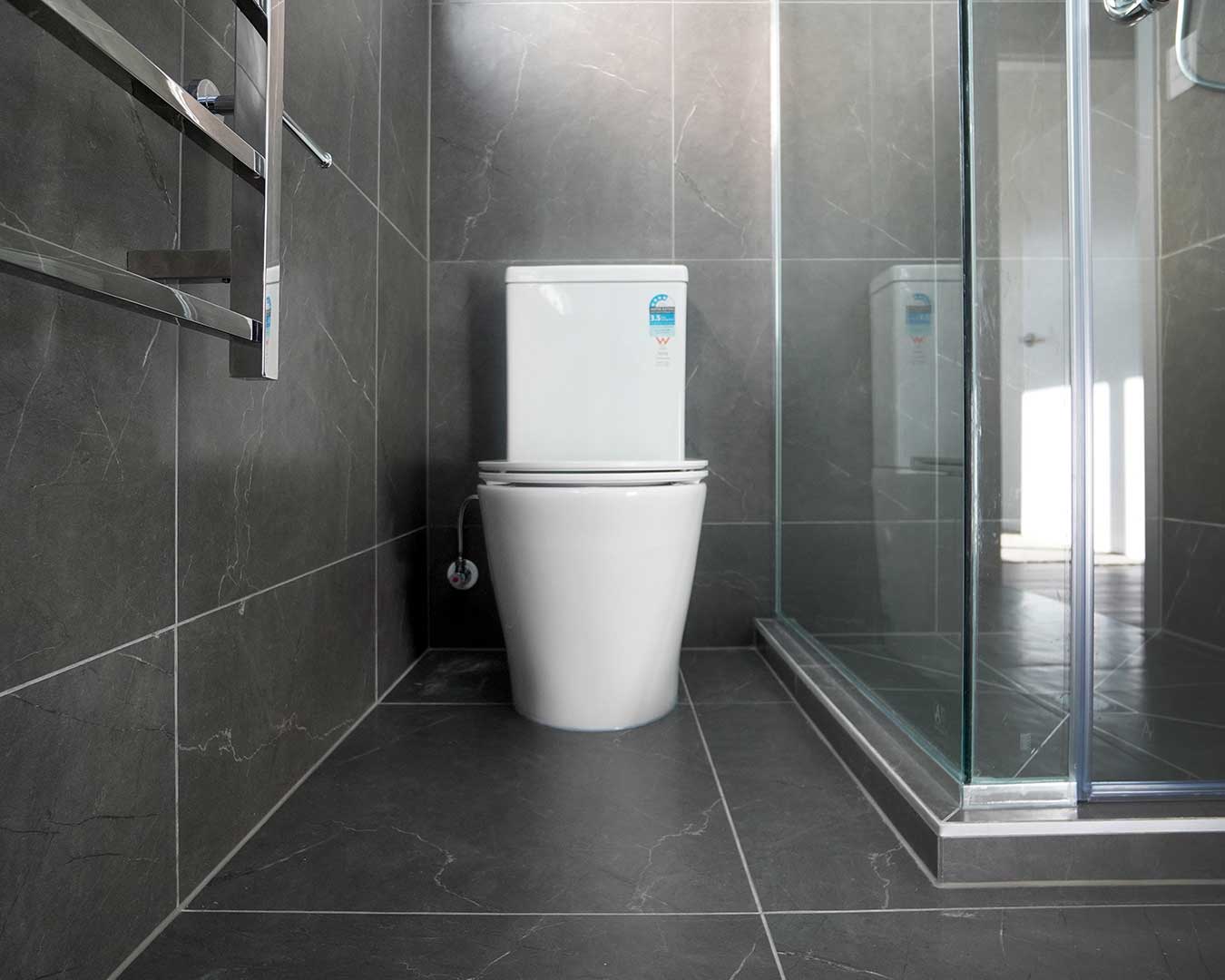
The default toilet design in New Zealand homes — the cistern sits directly on top of the pan in one connected unit. About 90% of Auckland homes have a close-coupled toilet currently installed, and replacing one with another is the easiest job in the toilet replacement world.
The toilet itself runs $250–$900 retail at Mico, Plumbing World, Mitre 10 or Bunnings. Entry-level Englefield close-coupled toilets sit around the $300–$450 mark; mid-range Caroma and better-spec Englefield models land at $500–$700; premium close-coupled options from Toto, Kohler or Methven push toward $1,000–$1,500.
Labour for a like-for-like close-coupled replacement is typically 2–4 hours of plumber time (around $300–$500 in Auckland), plus around $50–$80 for old toilet disposal if the plumber takes it away. Total all-in: $700–$1,300 for a standard job, $1,500–$2,200 if you’re going premium.
Back-to-wall toilet: $700–$2,000 supplied and installed
The modern Auckland favourite for new bathroom installs. The cistern sits inside a slim casing that sits flush against the wall, hiding pipework and giving a cleaner look than a close-coupled unit. The pan still touches the floor, so it’s a comparable install to close-coupled.
The toilet itself runs $500–$1,800. Englefield, Caroma and Newtech all do credible back-to-wall designs in the $600–$1,200 range. Premium back-to-wall units from Toto or Kohler sit at $1,500–$2,200.
Installation is similar to close-coupled: 3–4 hours labour, $350–$550, though if the existing toilet is a close-coupled with a different waste position, expect minor pipework adjustment that adds 1–2 hours. Total all-in: $1,100–$2,200 for most back-to-wall replacements.
Wall-hung toilet: $1,500–$3,500 supplied and installed
The cistern is built into the wall cavity (usually a Geberit or Caroma in-wall frame), the pan hangs off a structural bracket, and nothing touches the floor. Visually striking. Functionally complex. Install cost is roughly double a close-coupled because the wall has to be opened up and the in-wall frame structurally fixed.
The pan and in-wall cistern frame combined run $800–$2,200. Geberit Sigma frames and Caroma Invisi systems are the two dominant brands in Auckland. Premium wall-hung pans from Toto and Kohler push the combined cost to $2,000–$3,000 before install.
Install is 6–10 hours of trade time including the gib work to open the wall, the structural bracket fixing, the pipework routing, and the gib repair afterwards. Labour and trades typically run $700–$1,500. Total all-in: $1,500–$3,500 for a like-for-like wall-hung replacement, $4,000+ if you’re converting from a floor-mount toilet to a wall-hung.
Smart toilet: $2,500–$8,000+ supplied and installed
Heated seat, bidet wash, automatic flush, soft-close, integrated air drying, deodorising. Smart toilets are common in higher-end Auckland renovations but rare as a standalone replacement. The toilet itself starts at $2,000 for entry-level Caroma or Englefield smart units and runs to $7,000+ for top-spec Toto Washlet or Kohler Numi systems.
Installation is more involved because smart toilets need a power outlet within reach — a job for a registered electrician if there’s no existing socket in the right place. Add $300–$800 for electrical work on top of the plumbing install. Total all-in: $2,500–$8,000+ depending on the unit and how much electrical work is needed.
| Toilet Type | All-In Cost Range | Install Time |
|---|---|---|
| Close-coupled (standard) | $400–$1,500 | 2–4 hours |
| Back-to-wall | $700–$2,000 | 3–5 hours |
| Wall-hung | $1,500–$3,500 | 6–10 hours |
| Smart toilet | $2,500–$8,000+ | 4–8 hours (plus electrician) |
💡 Property tip: Don’t buy the toilet before the plumber has seen the job. We see Auckland homeowners turn up at Mico with a credit card, choose a toilet they like, then discover at install time that the waste outlet doesn’t line up or the set-out distance is wrong by 40mm. Get the plumber to confirm S-trap/P-trap and set-out dimensions first, then go shopping.
S-Trap vs P-Trap — The Auckland Decision Most Homeowners Get Wrong
This is the section that saves people the most money. Every toilet has either an S-trap or a P-trap, and which one you need depends on where the waste pipe exits — down through the floor (S-trap) or out through the wall (P-trap). Get this wrong and you’re paying for trade work to either redirect the drainage or modify the floor, on top of the toilet replacement itself.
What S-Trap and P-Trap Actually Mean
S-trap toilets have a waste outlet that drops vertically through the floor. Look at your existing toilet — if you can’t see the waste pipe at all from the back, and the pan is sitting flat on the floor with no visible connection at the back wall, you almost certainly have S-trap.
P-trap toilets have a waste outlet that exits horizontally through the back wall. If you can see a visible connection running from the back of the toilet through to the wall, with the waste pipe going horizontal, that’s P-trap.
The terms come from the shape of the trap (the bend in the pipe that holds water to block sewer gas) — S-shape for vertical, P-shape for horizontal. Every toilet sold in New Zealand is built for one or the other, with the trap angle pre-cast into the porcelain. They’re not interchangeable.
Auckland Home Age Pattern
There’s a strong pattern across Auckland based on when the house was built:
Pre-1990 homes (most Auckland villas, bungalows and original suburb stock): S-trap is standard. The waste plumbing runs under the floor and drops into a vertical stack. Mt Eden, Ponsonby, Grey Lynn, Devonport, Glen Eden, Henderson, Papatoetoe, Mount Roskill and the rest of Auckland’s character and earlier-built stock are almost all S-trap.
Post-2000 subdivisions: P-trap is the default. Modern building methods and concrete slab construction make horizontal back-wall drainage easier. Stonefields, Hobsonville Point, Long Bay, Karaka, Flat Bush, Albany Heights and most newer subdivisions are P-trap throughout.
1990–2000 homes: mixed. Could go either way depending on the build and the renovation history.
What Happens If You Buy the Wrong Trap Type
Two scenarios, both expensive:
Bought S-trap, need P-trap: The waste outlet drops to the floor instead of going to the wall. You’d need to cut the floor open, install vertical drainage to connect to the existing wall outlet, and patch the floor afterwards. Add $1,500–$3,000 to the job.
Bought P-trap, need S-trap: The waste outlet exits to the wall instead of dropping. You’d need to add horizontal pipework, possibly relocate the toilet position by 100–200mm to suit the new outlet, and modify the existing stack. Add $1,200–$2,800.
Conversion adapters exist but they’re usually a code-compliance grey area and not a substitute for matching the right trap to the right drainage. The fix is to identify what you have, then buy the right toilet.
Set-Out Distance — The Second Hidden Catch
The set-out is the distance from the back wall to the centre of the waste pipe. Standard set-outs in New Zealand are 140mm, 180mm and 220mm. Buy a toilet with a 220mm set-out for a 140mm waste position and the toilet pan won’t reach — you’re back to floor cutting and pipe relocation.
Always measure the set-out before you buy. A tape measure and 30 seconds is cheaper than $2,000 of remedial pipework.
💡 Property tip: If you’re not sure whether your toilet is S-trap or P-trap, take a photo from the back showing the pipework (or absence of it) and ask any plumbing supplier. Mico and Plumbing World deal with this question daily and will tell you exactly what you need before you buy. Better still, have the plumber doing the install confirm it in writing as part of the quote.
NZ Compliance — WELS, the Building Code, and What’s Actually Required
Like-for-like toilet replacement in New Zealand is generally exempt from building consent — meaning you don’t need council sign-off to swap one toilet for another in the same spot. But there are real compliance rules around water efficiency that affect what you can install, and most Auckland homeowners only find out about them after they’ve bought the wrong toilet.
WELS — The Water Efficiency Rating Every NZ Toilet Has
WELS (Water Efficiency Labelling Scheme) is a mandatory rating system for all new toilets sold in New Zealand. Each toilet is rated from 1 star to 6 stars based on water consumption per flush. There is no legal minimum star rating for toilets in NZ — the WELS label is a mandatory point-of-sale information standard, not a performance minimum. On the WELS scale, a standard 6/3L dual-flush rates 3 stars, and a 4.5/3L dual-flush rates 4 stars.
Building Code clause G12 governs water supplies where consented plumbing work is involved; the WELS label itself is a consumer information standard under the Fair Trading Act. The good news: virtually every toilet sold at Mico, Plumbing World, Mitre 10 and Bunnings in New Zealand meets at least the 3-star minimum. Older toilets (the 11-litre single-flush units common in 1980s and 1990s installs) are not WELS compliant and shouldn’t be installed today.
Better-spec toilets achieve 4-star or 4.5-star ratings (3.5/2.5L dual-flush, or 3/2L dual-flush respectively), which saves around 8,000–12,000 litres per year for a household of four. Watercare publishes water efficiency guidance on their website — for the typical Auckland household, upgrading from a 3-star to a 4.5-star toilet saves enough water to notice on the bill.
Schedule 1 — Why Like-for-Like Replacement Is Consent-Exempt
Under Schedule 1 of the Building Act 2004, replacing an existing sanitary fixture (toilet, basin, sink, or shower) in the same location with a new one of the same type is generally exempt from building consent. This is the legal basis for why your plumber can swap a close-coupled toilet for another close-coupled toilet without you needing to lodge a consent.
Consent is required if: you’re adding a new toilet where one didn’t previously exist, changing the toilet position significantly (more than minor relocation), modifying drainage or stack pipework beyond minor adjustment, or making changes that affect the water supply network beyond the existing connection point. For Auckland-specific questions, Auckland Council’s consent helpline is the authority. MBIE publishes the Schedule 1 exemption list at building.govt.nz.
Restricted Sanitary Plumbing — Why You Need a Licensed Plumber
Plumbing connections to a toilet are restricted sanitary plumbing under the Plumbers, Gasfitters and Drainlayers Act 2006. You can legally fit your own toilet seat. You cannot legally make or break the water supply or drainage connections — that has to be done by a Certifying or Registered Plumber. Ask the plumber for written confirmation of the work — and where a building consent is involved, a producer statement (PS3) forms part of the council record.
If you’re tempted to DIY the plumbing connections, two things to know: home insurance will not cover water damage from unlicensed work, and a future LIM report on the property may flag uncertified plumbing work as a compliance defect that affects the sale.
Auckland Water and Toilet Component Lifespan
The components that fail on Auckland toilets are usually the fill valve (the float-activated mechanism that refills the cistern after a flush) and the flush valve (the rubber seal between the cistern and the bowl). Both are rubber-based and degrade over time from constant water contact and chlorine exposure.
Typical fill valve life in Auckland: 6–12 years. Flush valve life: 8–15 years. Cheaper toilets at the entry level often use lower-grade components that fail at the shorter end of those ranges. Better-spec brands like Toto and Caroma use higher-grade internal mechanisms that genuinely last longer — one of the reasons we recommend mid-range or better when the budget allows.
💡 Property tip: If the toilet itself is fine but the flush mechanism is failing, replace just the fill valve and flush valve — typically $80–$200 in parts plus 1–2 hours of plumber labour. We see Auckland homeowners replace whole toilets for what’s actually a $150 fill valve problem.
How much will your project cost?
Instant Auckland price range — no details needed.
Repair vs Replace — The Decision Framework
The most common mistake we see is homeowners jumping to full replacement when the actual problem could be fixed for under $200. The opposite mistake, repairing toilets that are genuinely past saving, also happens, usually as a sequence of $150 fixes that add up over 18 months. Here’s the framework we use when a homeowner asks us to look at a problem toilet.
Repair Almost Always Wins When…
The cistern keeps running after flushing. Failed fill valve. $80–$150 in parts, 1–2 hours labour. Total $230–$330. A new toilet costs four to six times that for the same outcome.
Weak or partial flush. Usually a failed flush valve or worn-out flush button mechanism. $50–$150 in parts, 1–2 hours labour. Total $200–$300.
Leak between the cistern and pan. The donut seal (cistern-to-pan seal) has perished. $30–$60 part, 1 hour labour. Total $130–$180.
Wobbly toilet seat or broken hinge. Replace the seat. $40–$200 for the seat itself, 15 minutes of labour or DIY. No plumber required.
Cracked toilet seat. Same as above — replace the seat, not the toilet.
Replace Makes More Sense When…
Cracked porcelain on the bowl or cistern. Cracks let water seep, get worse over time, and can’t be reliably patched. Replace the affected component — sometimes just the cistern if the pan is fine, sometimes the whole toilet.
Persistent leak at the base (pan-to-floor connection) that returns after wax ring replacement. The toilet’s seal area or the floor flange is compromised. At that point, fix the flange properly and install a new toilet rather than continuing to chase the leak.
Three or more repairs in 18 months. If you’ve replaced the fill valve, then the flush valve, then the donut seal in the same toilet over a year and a half, the internal components are at end-of-life and the rest will follow. Bulk replacement of all the wear parts is sometimes worth doing in one job — but at that point a new toilet costs roughly the same and gives you 15 more years of reliability.
The toilet is single-flush (pre-WELS) and uses 9+ litres per flush. The water savings from a 4.5/3L dual-flush replacement pay back the upgrade cost in 4–6 years for a typical Auckland family. Worth doing on principle alone.
Aesthetic match for a bathroom refresh. If you’ve just installed a new vanity and new tapware, an old toilet looks visibly out of place. The replacement is justified on visual terms even if the toilet still works.
The 3-Strike Rule
Our internal rule of thumb: if a toilet has needed three separate repair visits in 18 months, recommend replacement on the next call-out. The probability of further repairs being needed is high, and the cumulative cost has usually crossed the replacement-cost line.
💡 Property tip: Before you commit to replacement, ask the plumber to identify exactly what’s failing and quote both options — repair vs replace. A good plumber will tell you honestly when a $150 repair is the right answer, even though they earn more on a $1,000 replacement.
When to Call Superior Property Services vs Superior Renovations
Both companies sit under the Superior Construction Group — same trade network, same standards, different service models. Knowing which one to call saves you money and gets you the right team for the job.
Superior Property Services — Single-Job and Maintenance Work
Call us when the job is one specific thing that doesn’t justify a full renovation engagement. Toilet replacement on its own, replacing all the toilets in a multi-bathroom home as a single project, between-tenancy turnover on a home you live in, or pre-sale tidy-up before listing — these are SPS jobs, the same single-job way we handle a hot water cylinder replacement.
What you get: one project manager, one quote that includes our Auckland plumbing team and any minor trade work needed (gib repair around the pan footprint, paint touch-ups, old toilet disposal), and a 1-working-day response commitment. We coordinate the trades. You get one invoice.
Typical job scope for SPS: $400–$5,000 total. Anything bigger usually starts looking like a renovation.
Superior Renovations — Bathroom-Scale Work
Call Superior Renovations when the toilet is part of a bigger bathroom project. New vanity plus toilet plus tiling, full bathroom rip-out, ensuite addition, walk-in shower with new floor waste, or any change that involves moving the toilet position significantly — these are renovation jobs.
What you get: full design, consent management (where required), tile selection, full project management for multi-trade sequencing. Different scale, different process, different price point — bathroom renovations typically run $20,000–$65,000.
The Decision Test
Ask yourself: “Am I doing one specific thing, or am I redoing a bathroom?” If it’s one thing, even a fairly involved one like a wall-hung toilet upgrade, that’s still us. If it’s bathroom-scale work where the toilet is just one element of a wider scope, that’s Superior Renovations.
If you’re unsure, ring us anyway on 0800 199 888. We’ll triage the job honestly and refer you to Superior Renovations if that’s the better fit — they’re the same trade network and the same standards. You don’t lose anything by starting with the wrong number.
Auckland Toilet Replacement — What Most Homeowners Pay
Pulling it all together: the realistic total cost ranges Auckland homeowners pay in 2026, by job scope.
| Job Scope | All-In Cost Range | Typical Auckland Example |
|---|---|---|
| Fill valve or flush valve repair | $200–$330 | Running cistern, weak flush |
| Standard close-coupled replacement | $700–$1,300 | Like-for-like swap in a 1990s home |
| Premium close-coupled replacement | $1,500–$2,200 | Toto or Kohler upgrade |
| Back-to-wall toilet replacement | $1,100–$2,200 | Mid-range modern look |
| Wall-hung toilet replacement | $1,500–$3,500 | Like-for-like wall-hung swap |
| Smart toilet upgrade | $2,500–$8,000+ | Toto Washlet or Kohler Numi |
| Multi-toilet replacement (3 toilets) | $1,800–$3,800 | Whole-house close-coupled refresh |
These are all-in figures — toilet, plumber labour, old toilet removal, and any minor pipework or gib repair around the pan. If the existing waste position is wrong for your new toilet, add $1,200–$3,000 for drainage rework. If you’re converting from floor-mount to wall-hung, add $1,500–$2,500 for the in-wall frame and structural fixing.
Cost to Add a New or Second Toilet
Adding a toilet where there wasn’t one before (a second toilet in a spare room, a powder room under the stairs, or a new WC as part of a bathroom addition) is a bigger job than a straight replacement, because it needs new drainage, a new water supply run, and, unlike a like-for-like swap, a building consent. You’re not just installing a pan; you’re extending the waste and supply plumbing to a new point.
Realistic all-in cost to add a second toilet in Auckland: $3,500–$9,000+. The range is wide because it depends almost entirely on how far the new toilet sits from existing drainage. A new WC backing onto an existing bathroom wall (short pipe runs) sits at the lower end. A toilet on the far side of the house, or upstairs over a living area, means longer waste and vent runs, floor or wall opening, and more trade time, pushing toward the top of the range.
Because adding a toilet extends the drainage and water supply beyond the existing connection points, it isn’t consent-exempt under Schedule 1 — you’ll need a building consent from Auckland Council, and the drainage work has to be signed off by a Certifying Drainlayer. Factor consent fees and inspection time into the budget, and scope the job with a plumber and drainlayer before committing.
➡ Request a free no-obligation quote from Superior Property Services
➡ Learn more about our property maintenance services in Auckland
➡ Make an enquiry — we respond within 1 working day
Toilet Replacement Cost NZ — Frequently Asked Questions
How much does it cost to replace a toilet in Auckland?
A like-for-like standard close-coupled toilet replacement in Auckland typically costs $700–$1,300 all-in, including the toilet, plumber labour, old toilet removal, and any minor pipework adjustment. Premium close-coupled or back-to-wall replacements run $1,500–$2,200. Wall-hung toilets start at $1,500 and run to $3,500. Smart toilets with bidet and heated seat features sit at $2,500–$8,000+ depending on the model and any electrical work needed. Most Auckland homeowners are in the $700–$1,500 range for a standard replacement.
Can I just replace the toilet myself in NZ?
You can legally fit your own toilet seat. You cannot legally connect or disconnect the water supply or drainage — that's restricted sanitary plumbing under the Plumbers, Gasfitters and Drainlayers Act 2006 and must be done by a Certifying or Registered Plumber. Ask the plumber for written confirmation of the work. Unlicensed plumbing work isn't covered by home insurance for any resulting water damage, and may be flagged on a future LIM report as uncertified work. Save the DIY for the toilet seat; leave the plumbing connections to the plumber.
What's the difference between S-trap and P-trap toilets?
S-trap toilets have a waste outlet that drops vertically through the floor. P-trap toilets have a waste outlet that exits horizontally through the back wall. Auckland homes built before 1990 (most villas, bungalows and original suburb stock) are almost all S-trap. Post-2000 subdivisions are typically P-trap throughout. The two are not interchangeable — buying the wrong trap type means $1,200–$3,000 of additional drainage work to make it fit. Identify what you have before you buy, or have the plumber confirm it in writing.
Do I need a building consent to replace a toilet?
No — like-for-like toilet replacement in the same position is exempt from building consent under Schedule 1 of the Building Act 2004. You don't need to lodge anything with Auckland Council to swap one toilet for another in the same spot. Consent is required if you're adding a new toilet where one didn't exist, significantly relocating the toilet position, modifying drainage beyond minor adjustment, or making changes to the water supply network. Where a consent is involved, the plumber's producer statement (PS3) forms part of the council record; for exempt like-for-like swaps, ask for written confirmation of the work.
What is WELS and do I need to worry about it?
WELS is the Water Efficiency Labelling Scheme — a mandatory star rating from 1 to 6 on every toilet sold in New Zealand. There is no legal minimum star rating — WELS is a mandatory point-of-sale label rather than a performance requirement. A 4.5 litre full / 3 litre half dual-flush rates 4 stars. Virtually every toilet sold at Mico, Plumbing World, Mitre 10 and Bunnings meets at least the 3-star minimum. Choosing a 4-star or 4.5-star toilet saves 8,000–12,000 litres of water per year for a typical four-person household.
How long does a toilet replacement take?
A standard like-for-like close-coupled toilet replacement takes 2–4 hours of plumber time on site. Back-to-wall replacements take 3–5 hours. Wall-hung replacements involving in-wall cistern work and gib repair take 6–10 hours of trade time, sometimes split across two days because the gib stopping needs to dry. Smart toilet installations may also need an electrician for power, which can add half a day. Most single-toilet jobs are completed in a single day on site.
Is a wall-hung toilet worth the extra cost?
Wall-hung toilets cost roughly double a like-for-like close-coupled replacement because the in-wall cistern frame requires structural fixing and gib work. The visual benefit is significant — clean wall lines, easier floor cleaning, contemporary look. The functional benefit is modest: same flush performance as a good close-coupled. Worth it for bathroom renovations where the look matters, or accessibility situations where floor cleaning is a priority. Less compelling for a straightforward like-for-like replacement in a standard bathroom.
Why does my Auckland toilet's flush mechanism keep failing?
The fill valve and flush valve are rubber-based components that degrade from constant water contact and chlorine exposure. Typical Auckland lifespan is 6–12 years for fill valves and 8–15 years for flush valves. Entry-level toilets often use lower-grade internal components that fail at the shorter end of those ranges. Better-spec brands like Toto and Caroma use higher-grade mechanisms that genuinely last longer. If you've replaced the fill valve and the flush valve in the same toilet within 18 months, the toilet itself is approaching end-of-life and full replacement is often the better answer.
Can I keep my existing toilet seat with a new toilet?
Usually no. Toilet seats are matched to specific pan shapes and sizes, and the fixing positions on the new toilet rarely match the old seat. Most new toilets come with their own matching seat included or available as a paired option. If you have a high-spec aftermarket seat (soft-close, bidet, heated) and want to keep it, check the fixing hole positions on both the seat and the proposed new toilet before you buy. For most standard seats, factor in $40–$200 for a new matching seat with the new toilet.
What's the cheapest decent toilet I can buy in NZ?
Englefield is the most common entry-level brand at Mico, Plumbing World and Mitre 10, with credible close-coupled units in the $280–$450 range. They meet the 3-star WELS minimum and use serviceable internal components. For about $100–$200 more you get a mid-range Caroma or better-spec Englefield unit ($500–$700) with longer-lasting fill and flush valves. We generally recommend the mid-range option for the cost-per-year-of-service it delivers — entry-level toilets can need component replacements at 6–8 years where mid-range run to 12–15 years.
When should I repair my toilet instead of replacing it?
Repair almost always wins for a running cistern (failed fill valve, $200–$330 fix), weak flush (failed flush valve, $200–$300 fix), or a leak between the cistern and pan (perished donut seal, $130–$180 fix). Replacement makes sense when the porcelain itself is cracked, when there's a persistent base leak that returns after wax ring replacement, when the toilet is pre-WELS single-flush using 9+ litres per flush, or when you've needed three separate repairs in 18 months. Our rule of thumb: three repair visits in 18 months means the next call-out should be a replacement.
Should I call Superior Property Services or Superior Renovations for a toilet upgrade?
Call Superior Property Services for single-job work: one toilet replacement, multi-toilet replacements as a single project, between-tenancy turnover work, or pre-sale tidy-ups. Job scope typically $400–$5,000. Call Superior Renovations for bathroom-scale work: full rip-out, new vanity plus toilet plus tiling, ensuite addition, or any project where the toilet is one element of a wider renovation. Bathroom renovations typically run $20,000–$65,000. If you're not sure, call 0800 199 888 — we'll triage the job honestly and hand off to Superior Renovations if it's the better fit.
How much does it cost to add a second toilet in Auckland?
Adding a new or second toilet where none existed typically costs $3,500–$9,000+ all-in in Auckland, well above a like-for-like replacement. The cost is driven mostly by how far the new toilet sits from existing drainage and water supply: a WC backing onto an existing bathroom wall is cheapest, while a toilet on the far side of the house or upstairs needs longer waste and vent runs. Unlike a straight swap, adding a toilet is not consent-exempt under Schedule 1, so you'll need a building consent and a Certifying Drainlayer to sign off the drainage.
Can I replace just the toilet cistern instead of the whole toilet?
Yes. If the pan is sound and only the cistern is cracked, leaking or outdated, a plumber can replace the cistern alone, provided a matching cistern is available for your pan model. Cistern replacement typically runs $250–$600 all-in including parts and labour, far less than a full toilet. For close-coupled toilets the cistern and pan are often sold as a matched set, so on older or discontinued models a matching cistern can be hard to source, in which case replacing the whole toilet is the practical option.
References
- Building Performance (MBIE) — Building work that doesn’t need a building consent (Schedule 1)
- Building Performance (MBIE) — G12 Water Supplies (water efficiency)
- Plumbers, Gasfitters and Drainlayers Board — Licensing and restricted work