
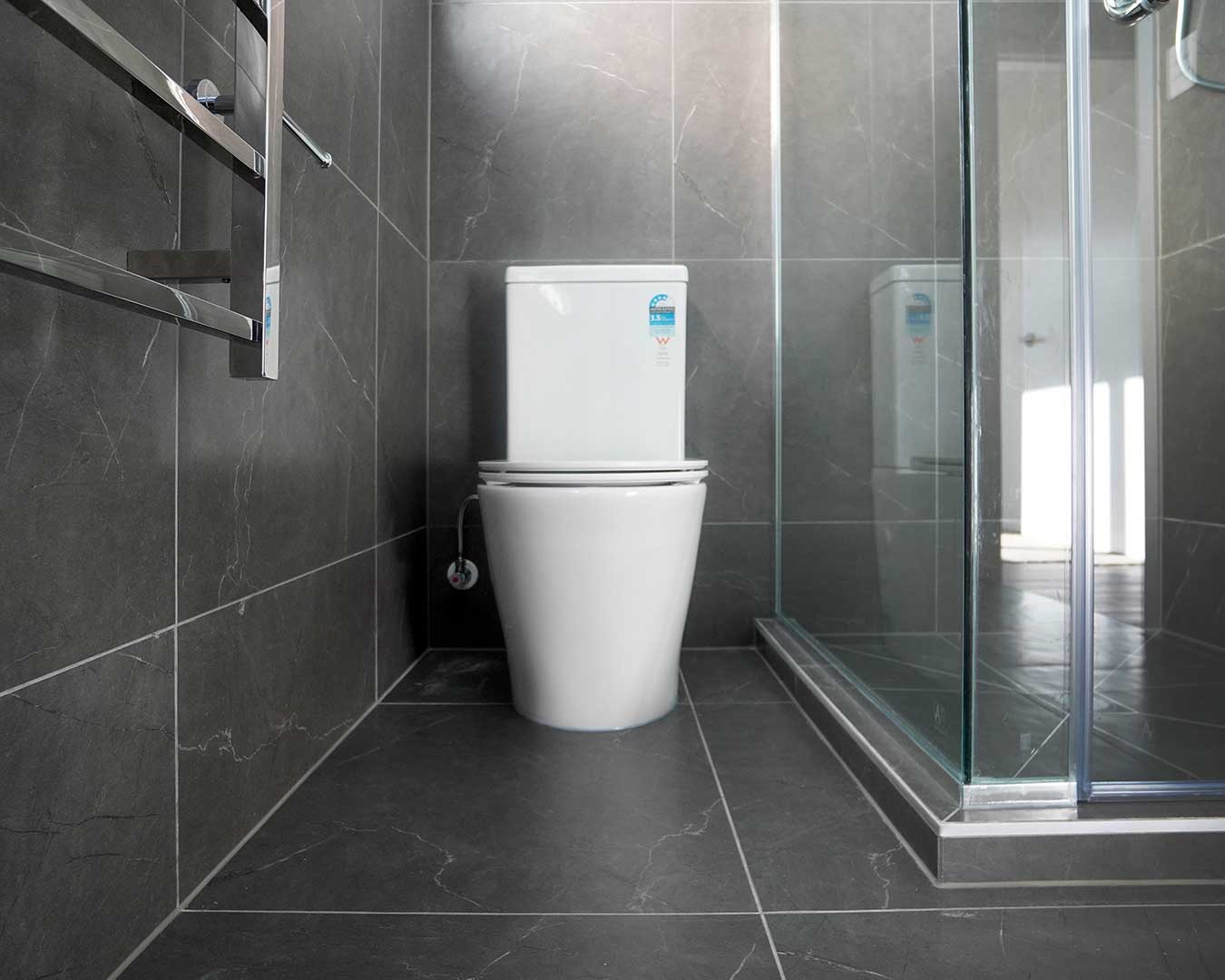
Toilet Replacement Cost NZ – 2026 Auckland Guide
Last updated:
Quick answer: Toilet replacement cost in NZ for a like-for-like swap in the same position runs $400 to $1,500 all-in in Auckland. Adding a toilet where none existed is a consented project, not a replacement.
The cistern won’t stop running, the base is weeping onto the floor, or the porcelain has a hairline crack you can’t unsee. Before you spend money on a new toilet, it’s worth knowing whether a cistern part would sort it for a fraction of the price, and what actually moves the cost when the whole toilet has to go.
Free cost calculator
How much will your project cost?
Answer a few questions and we’ll email you an Auckland price range.
The price splits into three parts: the toilet suite you choose, the licensed plumber who disconnects the old pan and connects the new one, and anything that has to change around it. Keep the new toilet in the same spot, on the same waste outlet, and you stay at the cheap end. Move it, add one, or change the type of pan, and the job grows.
Who does the work is not optional either. Under the Plumbers, Gasfitters and Drainlayers Board’s rules, a homeowner can replace a ball cock (the float valve that refills the cistern) but cannot unfix or fix a toilet pan, its waste pipe or its water supply. That shapes both the repair options and the bill.
Toilet Replacement Cost by Type of Toilet
Two numbers decide a toilet quote: what the suite costs, and how much plumbing has to change to fit it. The suite is the most variable line. Superior Renovations’ 2026 Auckland cost guide puts a straight replacement in the same spot at $400 to $1,500 all-in, made up of $250 to $1,000 for the suite and $500 to $1,000 for a licensed plumber, plus small fittings and disposal. Our own house repair cost guide puts a full toilet replacement at $600 to $1,200 supply and install, inside that range.

What the toilet suite itself costs
These are suite prices only, before the plumber, from Superior Renovations’ published 2026 guide. The plumbing work sits on top.
| Toilet type | Suite price (Superior Renovations’ 2026 guide) | What it means for the install |
|---|---|---|
| Close-coupled (two-piece) | $250–$1,000+ | The simplest swap; parts are stocked at every plumbing merchant |
| One-piece | $400–$1,000 | Similar install to close-coupled; no join line to clean |
| Back-to-wall | $250–$2,000 | The pan has to suit where your waste and water already come in |
| Wall-faced | $500–$4,500 | Cistern built into a wall cavity or behind a unit; more complex fit |
| Wall-hung | $300–$5,000 | Needs a frame inside a built-out wall; usually planned as part of a renovation |
| Smart (heated seat, wash) | $800–$7,000 | Needs a power point within reach, which often means an electrician as well |
What the plumber charges
Auckland plumbers typically charge $120 to $180 an hour plus a call-out fee of $80 to $150 for standard hours, per our breakdown of what Auckland trades charge for common house repairs. A same-position swap is a short job, which is why the plumbing labour on a standard replacement sits in the $500 to $1,000 band above. Removing the old toilet is usually folded into the plumber’s quote; taking it to a transfer station adds roughly $20 to $60, by Superior Renovations’ figures.
What pushes a quote past the top of the range is rarely the suite. It is the work around it: a waste outlet in the wrong place for the new pan, a water inlet that needs moving, a damaged floor flange under the old toilet, or a power point for a smart seat.
What happens on the day of a toilet swap
A same-position replacement follows a predictable order, and knowing it helps you spot where extra cost can creep in.
- Water off and cistern emptied. The plumber shuts the stop valve that feeds the toilet, flushes the cistern dry and sponges out what’s left.
- Old toilet off. The water supply is disconnected, the pan is unfixed from the floor and pulled off its waste connector, and the old suite comes out.
- The hidden check. With the pan gone, the plumber can see the floor under it, the waste outlet and the connector. This is where a quote can change: soft or water-damaged flooring under a long-leaking toilet, or an outlet that doesn’t suit the new pan.
- New toilet in. A new pan connector goes on, the pan is set level and fixed down, the cistern is fitted and the supply reconnected.
- Tested. Several full and half flushes, checking the connector, the supply and the base for weeping before the job is signed off.
If the floor under the old pan turns out to be damaged, that’s a separate repair, and it’s better found now than after the new toilet is sealed down. Ask the plumber to show you what they find.
Why a wall-hung or smart toilet costs more than its price tag
A wall-hung pan only looks simple. The cistern and frame live inside the wall, so swapping a floor-standing toilet for a wall-hung one means opening and rebuilding that wall, then re-lining and finishing it. That is bathroom-renovation work in all but name, and it is the point where a toilet job usually stops being a single maintenance visit.
Smart toilets bring a different extra: electricity. Heated seats and warm-water wash functions need mains power, and there is rarely a socket where the cistern sits. Electrical work in a bathroom falls under the wiring rules in AS/NZS 3000, so plan for an electrician’s visit as well as the plumber’s.
💡 Property tip: Ask for the quote to list the suite, the plumbing labour and the fittings as separate lines. A single lump sum hides whether the price is driven by the toilet or by work the plumber expects to find once the old pan is off.
S-Trap, P-Trap and Set-Out: Check These Before You Buy
Most replacement surprises come from one mismatch: a new pan that doesn’t line up with the drain already in the floor or wall. Two measurements prevent it.
What S-trap and P-trap mean
The trap is the bend moulded into the pan that holds water and blocks sewer gas. On an S-trap toilet the waste leaves straight down through the floor. On a P-trap toilet it leaves horizontally through the wall behind. The shape is cast into the porcelain, so one type is not a drop-in substitute for the other.
You can usually tell which you have by looking behind the pan. If the pan sits flat on the floor and no waste pipe runs back to the wall, the outlet goes down: S-trap. If a pipe connector runs from the back of the pan into the wall, it is P-trap. In older Auckland homes with suspended timber floors the waste often runs under the floor, but age is only a hint. Look before you shop.
Set-out: the measurement nobody mentions
The set-out is the distance from the finished wall to the centre of the waste outlet. Every pan is made to suit a range of set-outs, printed on its specification sheet. Buy one that doesn’t cover your measurement and it either won’t reach the outlet or won’t sit back against the wall, and fixing that means changing the drain rather than the toilet.
If the outlet doesn’t match
When the toilet you want doesn’t suit the existing outlet, there are two routes: choose a pan made for the outlet you have, or change the plumbing to suit the pan. The first keeps the job a straight swap. The second turns it into an alteration to the sanitary plumbing, which costs more and, depending on what changes, may raise the consent question covered below.
💡 Property tip: Send the plumber two photos before they quote: one from the side showing where the waste leaves the pan, and one showing the gap between the back of the pan and the wall. Awkward outlets and non-standard set-outs are the usual reason a “fixed” price changes on the day.
Toilet Replacement in NZ: Consent, Licensed Plumbers and Water Labels
A like-for-like toilet replacement doesn’t need a building consent, but it does need a licensed plumber, and the new toilet has to carry a water efficiency label when it’s sold. Here’s where each rule comes from.
When a toilet replacement needs a building consent
Schedule 1 of the Building Act 2004 lists building work that doesn’t need a consent. Three of its sanitary plumbing clauses cover toilets:
- Clause 32 exempts replacing sanitary plumbing and drainage with a comparable product in the same position. A like-for-like toilet swap fits here. The exemption does not cover replacing something that failed the Building Code’s durability provisions, for example through a failure of the external moisture requirements.
- Clause 35 exempts altering existing sanitary plumbing, provided the total number of sanitary fixtures in the building is not increased and no specified system is modified or affected.
- Clause 34 exempts minor alterations to drains for a dwelling, such as shifting a gully trap, but not a new connection to the public network.
Read together, a straight swap is exempt, and some changes to the existing plumbing can be too. Adding a toilet where there wasn’t one increases the number of fixtures, so clause 35 no longer applies and it needs a consent. Exempt work still has to meet the Building Code.
Compliance note: Whether a particular job is exempt depends on the exact work. If you’re moving a toilet, changing drainage or adding a fixture, confirm the consent position with Auckland Council or a licensed building practitioner before work starts.
Who can legally replace a toilet
Sanitary plumbing is restricted work. The Plumbers, Gasfitters and Drainlayers Board’s consumer advice says a homeowner can install appliances such as dishwashers and washing machines and can replace or repair taps, ball cocks and plugs. A homeowner cannot do any work fixing or unfixing a pipe, plumbing fixture or appliance, including a trap, waste or soil pipe, or any pipe that supplies water.
For a toilet, that splits cleanly. Replacing the ball cock (the float-operated fill valve inside the cistern) is on the homeowner’s list. Taking the pan off the waste pipe and connecting a new one is not. The Board lists who can do that work: a certifying plumber, a plumber working under a nominated certifying plumber, a restricted plumber, or a trainee or exempted person supervised by a certifying plumber. Ask to see the plumber’s licence before work starts, and check it on the Board’s public register if you’re unsure.
WELS water efficiency labels on toilets
The Consumer Information Standards (Water Efficiency) Regulations 2017 require lavatory equipment sold in New Zealand to carry a water efficiency rating label, with the star rating worked out under the joint standard AS/NZS 6400:2016. The label is information at the point of sale, not a minimum performance standard: a toilet that flushes more than a one-star rating allows is labelled zero stars rather than banned. The Commerce Commission enforces the labelling.
Compare the stars on toilets you’re considering. More stars means less water per flush, which matters on a metered Auckland water bill.
💡 Property tip: When the job’s finished, ask the plumber what documentation they’ll leave you for the work and keep it with your house records. If a buyer, insurer or council later asks who did the plumbing, you’ll have the answer.
How much will your project cost?
Answer a few questions and we’ll email you an Auckland price range.
Repair or Replace Your Toilet?
Plenty of “I need a new toilet” calls turn out to be a cistern part. The repair is far cheaper, so rule it out first. Our house repair cost guide puts a toilet cistern repair at $180 to $400, against $600 to $1,200 for a full replacement.
When a repair is the right call
- The cistern keeps running or refilling. Usually the ball cock (fill valve) or the flush valve seal. A running toilet can waste up to 200 litres a day on a metered Auckland account, our plumbing team notes, so don’t leave it.
- A weak or partial flush. Often a worn flush valve or button mechanism inside the cistern.
- A leak between the cistern and the pan. Usually the seal between the two, which a plumber can replace without changing the toilet.
- A broken or loose seat. A new seat is a straight swap, not plumbing work.
A quiet running toilet is easy to miss. Put a few drops of food colouring in the cistern and wait without flushing. Colour in the bowl means the flush valve is leaking. If you suspect water is going somewhere you can’t see, our guide to tracing a leak that’s quietly lifting your water bill covers the next checks.
When replacing the toilet makes more sense
- Cracked porcelain on the pan or cistern. A crack can’t be reliably patched and tends to spread.
- A leak at the base that keeps coming back after the seal has been redone, which points to a problem with the pan or the floor connection.
- No compatible parts. On an old or discontinued model a matching cistern or internal mechanism can be hard to source, and replacing the toilet becomes the practical fix.
- A bathroom refresh, where an old toilet would sit out of place next to a new vanity and tapware.
Cistern only, or the whole toilet?
If the pan is sound and only the cistern is cracked, leaking or worn out, a plumber can replace the cistern alone, provided a matching one is available for your pan. On close-coupled toilets the cistern and pan are often sold as a matched set, so on older models the whole toilet is frequently the only option. Ask the plumber to check part availability before you decide.
💡 Property tip: Ask the plumber to quote both options, repair and replace, on the same visit. If the repair price is close to half the replacement and the toilet is old, the replacement usually wins on the next fault alone.
Adding a New Toilet, or a Bathroom-Scale Job?
Replacing a toilet and adding one are different jobs with different prices. Superior Renovations’ guide puts adding a brand-new toilet where none existed at $10,000 to $15,000 or more once design, consent and the extra trades are counted, with Auckland Council consent fees of about $1,500 to $3,000 for a single new toilet project. The reason is the clause 35 limit above: a new fixture increases the count, so the work needs drawings and a building consent, and the drainage has to be extended to a new point.
When to call Superior Property Services
Call us when the job is one thing done properly: a toilet replacement, a cistern repair, or several toilets in one house swapped as a single job. Our registered plumbers who handle toilet repairs and swaps give a fixed quote before any work starts and reply within one working day. If the floor around the pan needs patching once the old toilet is off, we can line that up in the same visit through our small bathroom alterations service.
When to call Superior Renovations
Call our sister company when the toilet is one part of a bigger bathroom: a full strip-out, new tiling and vanity, an ensuite, a wall-hung conversion, or adding a toilet where there wasn’t one. That’s a full bathroom renovation with design and consent handled, and it’s a different scale of project.
For landlords
A running or leaking toilet in a rental is a repair, not an upgrade, and the plumbing still has to be done by a licensed plumber. Where a repair or replacement sits among a landlord’s obligations, and how quickly urgent work should be done, is covered in our guide to who fixes what in an Auckland rental.
What to Do Next
Start with the cheapest question: is it the toilet, or a part inside the cistern? If it really is the toilet, measure the set-out, check which way the waste leaves, and keep the new one in the same position. Do that and you’re paying for a plumber’s short visit, not a project.
➡ Request a free no-obligation quote from Superior Property Services
➡ Book a plumber for a toilet repair or replacement in Auckland
➡ Make an enquiry — we respond within 1 working day
Toilet Replacement Cost NZ: Frequently Asked Questions
How much does it cost to replace a toilet in Auckland?
A like-for-like toilet replacement in the same position runs $400 to $1,500 all-in in Auckland, by Superior Renovations' 2026 guide: $250 to $1,000 for the suite and $500 to $1,000 for a licensed plumber, plus fittings and disposal. Our own house repair cost guide puts a full toilet replacement at $600 to $1,200 supply and install. Wall-hung and smart toilets cost more because of the work around them.
Can I replace a toilet myself in NZ?
Not the toilet itself. The Plumbers, Gasfitters and Drainlayers Board says homeowners can replace or repair taps, ball cocks and plugs, and install appliances such as dishwashers. Fixing or unfixing a plumbing fixture, its trap, waste or soil pipe, or its water supply is restricted work for a licensed plumber. So you can replace the ball cock inside the cistern or fit a new seat, but taking the pan off and connecting a new one needs a plumber.
Do I need a building consent to replace a toilet?
Not for a like-for-like swap. Clause 32 of Schedule 1 of the Building Act 2004 exempts replacing sanitary plumbing with a comparable product in the same position. Clause 35 also exempts altering existing sanitary plumbing as long as the number of fixtures in the building doesn't increase and no specified system is affected. Adding a new toilet increases the count, so it needs a consent. Confirm anything beyond a straight swap with Auckland Council.
How much does it cost to install a new toilet where there wasn't one?
Much more than a replacement. Superior Renovations' guide puts adding a brand-new toilet at $10,000 to $15,000 or more once design, consent and extra trades are counted, with Auckland Council consent fees of about $1,500 to $3,000 for a single new toilet project. A new fixture increases the number of sanitary fixtures, so the Schedule 1 exemptions stop applying and the work needs a building consent.
What is the difference between an S-trap and a P-trap toilet?
The trap is the water-holding bend cast into the pan. On an S-trap toilet the waste leaves straight down through the floor; on a P-trap it leaves horizontally through the wall behind. The two aren't interchangeable, so check which you have before buying: if no pipe runs from the back of the pan to the wall, it's almost certainly S-trap. Measure the set-out too, the distance from the wall to the centre of the outlet.
How much does a toilet cistern repair cost?
Our house repair cost guide puts a toilet cistern repair at $180 to $400 in Auckland, against $600 to $1,200 for a full replacement. Common repairs are a new ball cock (the fill valve), a flush valve seal, or the seal between cistern and pan. Auckland plumbers typically charge $120 to $180 an hour plus a call-out fee of $80 to $150, so a single-visit repair keeps the cost down.
What is WELS and does my new toilet need it?
WELS is the water efficiency rating label. Under the Consumer Information Standards (Water Efficiency) Regulations 2017, lavatory equipment sold in New Zealand must carry a label showing its star rating under AS/NZS 6400:2016. It is a point-of-sale label, not a minimum standard: a high-flush toilet is labelled zero stars rather than banned. More stars means less water per flush, which shows up on a metered Auckland bill.
Is a wall-hung toilet worth it as a replacement?
Usually only as part of a renovation. A wall-hung pan needs a frame and cistern inside a built-out wall, so converting from a floor-standing toilet means opening, rebuilding and re-lining the wall. Superior Renovations' guide prices wall-hung suites at $300 to $5,000 before that work. If the wall is being opened for a bathroom renovation anyway, the extra cost is smaller; as a standalone swap it rarely makes sense.
Can I replace just the cistern instead of the whole toilet?
Yes, if the pan is sound and a matching cistern is available for your model. A plumber can replace the cistern alone, which costs far less than a new toilet. Close-coupled toilets are often sold as a matched pan and cistern set, though, so on older or discontinued models a matching cistern can be hard to find, and replacing the whole toilet becomes the practical option.
How do I know if my toilet is leaking?
Put a few drops of food colouring in the cistern and leave it without flushing. If colour appears in the bowl, the flush valve seal is letting water through. A cistern that hisses or refills on its own points to the ball cock. Water on the floor around the base points to the pan seal or the floor connection. Our plumbing team notes a running toilet can waste up to 200 litres a day on a metered account.
Should I call Superior Property Services or Superior Renovations?
Call Superior Property Services for single jobs: a toilet replacement, a cistern repair, or several toilets swapped in one house. We give a fixed quote before work starts and reply within one working day. Call Superior Renovations when the toilet is part of a bigger bathroom: a full strip-out, new tiling and vanity, an ensuite, a wall-hung conversion or adding a new toilet. Not sure? Call us on 0800 199 888 and we'll point you the right way.
Related guides
- What Auckland plumbers, electricians and other trades charge for everyday repairs
- How to find a leak you can hear but can’t see
- What to do if your house still has Dux Quest plumbing
References
- Building Act 2004, Schedule 1 clauses 32, 34 and 35 (sanitary plumbing and drainage exemptions), version as at 8 October 2026
- Plumbers, Gasfitters and Drainlayers Board, Advice for consumers (DIY plumbing and who can do sanitary plumbing)
- Consumer Information Standards (Water Efficiency) Regulations 2017
- Commerce Commission, Water efficiency labels