
Dux Quest Pipes Auckland: Costs, Risks, Replumb 2026
Last updated:
Quick answer: Dux Quest is a 1970s-80s black or grey polybutylene plumbing pipe still installed in an estimated 20,000 to 40,000 NZ homes. It fails at joints and pipe runs, most insurers cover only the first leak, and a full Auckland replumb costs $7,000–$18,000 in 2026.
An estimated 20,000 to 40,000 New Zealand homes still have Dux Quest plumbing running through their ceilings and walls. The product was pulled from the market nearly four decades ago. The pipes are still failing, quietly, slowly, often inside walls, and your insurer almost certainly won’t cover the second leak.
If you’re a landlord with a 1970s or 80s rental, this is one of the biggest hidden risks on your balance sheet. One burst pipe in the ceiling of a Manurewa unit can write off the carpet, the gib, the ceiling, the insulation and a fortnight of rent in a single weekend. If it’s the second incident, you’re paying for all of it.
If you’re a property manager juggling 80 doors, you’ve probably already had that call. The 3am leak. The tenant standing in their living room with a bucket. The landlord asking why this wasn’t picked up at the last inspection.
And if you’re a homeowner who has just had a building report come back with “Dux Quest detected” on page 14, you’re now staring at a five-figure decision you didn’t budget for.
This is the guide we wish every Auckland landlord and homeowner had before they bought a 1978 build. We’ll cover how to identify Dux Quest properly, why it fails, how insurers actually treat it in 2026, what a full replumb costs this year, and the operational side most plumbers don’t talk about — scheduling around tenancies, coordinating trades, and the documentation your insurer and property manager need afterwards.
The Landlord and PM sections are flagged clearly so you can skip to what’s relevant. Homeowners can read the whole thing — the cost section applies to you too.
What Dux Quest Plumbing Actually Is — and Why It’s Still in Auckland Homes
Free cost calculator
How much will your project cost?
Get an instant Auckland price range for your project — no details required to see it.
Dux Quest is a black (sometimes grey) polybutylene plastic water pipe manufactured by the New Zealand company Dux Industries Limited. It was installed in residential properties from roughly 1978 to 1987, both in new builds and as a retrofit replacement for old galvanised steel pipes. At the time it was cheaper than copper, lighter to install, and didn’t corrode.
The product hit the market just before New Zealand had a unified Building Code. The current code only became fully effective on 1 January 1993, and it isn’t retrospective. So Dux Quest pipes installed before then aren’t illegal to leave in place — they just aren’t manufactured or sold anymore, and the original warranty expired decades ago.
Dux Quest vs “Dux Qest” — the spelling that trips everyone up
The product was actually branded “Dux Qest” — no “u”. The word “Qest” was the brand name. “Dux Quest” is the common misspelling that’s now embedded in every Google search, every insurance memo and every building report in the country. Search either spelling. They mean the same thing.
You’ll also see references to “Polytherm” and other early polybutylene products from the same era. They have similar failure characteristics. If a plumber tells you the pipe is “the same family of plastic as Dux Quest”, treat it the same way — same failure pattern, same insurance treatment.
How to identify Dux Quest in your Auckland property
Four physical signs will tell you, in order of how reliable they are:
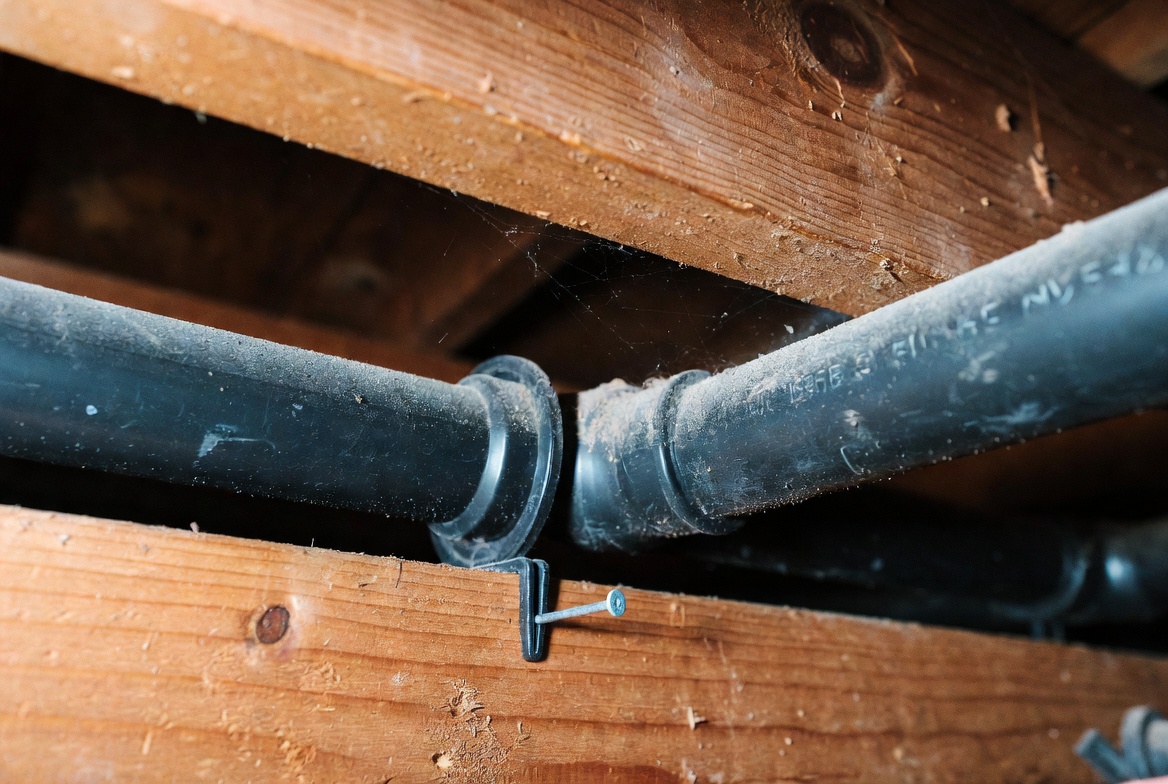
- Colour and material. Black plastic (sometimes grey) plastic pipe, roughly 15mm internal diameter, flexible but firm.
- White “Qest” branding printed at intervals along the pipe. The lettering fades over time and is often unreadable on pipes that have been in roof cavities for 40 summers — so absence of branding doesn’t mean it isn’t Dux Quest.
- Acetal plastic fittings. The joiners, elbows and tees are a distinctive cream or grey plastic, not metal. They look thick and bulky compared to modern fittings. Most failures start at these joints — the throat of the elbow cracks first.
- Build era and location of pipe runs. If the home was built or replumbed between 1978 and 1987, and the main pipe runs are in the ceiling cavity (which was standard for that era), Dux Quest is the default suspect.
If you’re checking your own property, the easiest places to look are the under-bench cupboards in the kitchen and laundry, under the bathroom vanity, and inside the linen cupboard where the hot water cylinder lives. If you find black plastic pipe in any of these locations and the home is the right era, assume Dux Quest until a licensed plumber tells you otherwise.
💡 Property tip: Take a torch and a photo into the ceiling manhole. Most Dux Quest in Auckland homes runs across the ceiling joists with plastic clips spacing it every 600mm or so. If the manhole access is in a Mt Wellington 1980s brick-and-tile, there’s a strong chance you’ll find black pipe within two minutes.
The Auckland suburbs where Dux Quest shows up most
Dux Quest landed in the Auckland market right in the middle of the late-1970s and 1980s housing boom. That means the suburbs developed or infilled during that decade are the ones carrying the highest concentration of affected properties today.
The suburbs we see it in most often:
- South Auckland: Manurewa, Papakura, Papatoetoe, Otahuhu, Manukau, Mangere — heavy state housing infill and private subdivisions through the late 70s and 80s.
- East Auckland: Howick, Pakuranga, Botany — major subdivision growth in the same window.
- West Auckland: Henderson, Te Atatu, Massey, Ranui — significant new-build activity through the same period.
- Central: Mt Wellington, Mt Albert, Glen Innes, Panmure — infill and replumbing of older homes through the 1980s. Many character villas in Mt Albert had their galvanised pipes swapped to Dux Quest in mid-decade renos.
- North Shore: Birkdale, Beach Haven and the Hibiscus Coast newer subdivisions of that era.
If your rental or home sits in any of these areas and predates 1990, Dux Quest is the working assumption until proven otherwise.
Healthy Homes compliance note: Dux Quest doesn’t appear by name in the Healthy Homes Standards, but the moisture ingress and drainage standard does. A slow Dux Quest leak in a wall cavity that causes ongoing damp, mould, or surface moisture can put you outside compliance even before the pipe bursts properly. The leak itself isn’t the only problem — the consequences are. Tenancy Services Healthy Homes guidance is here.
Why Dux Quest Plumbing Fails — and the Insurance Reality Landlords Need to Know
Dux Quest doesn’t fail because someone bumps the pipe or because the water pressure climbs. It fails because the material itself is breaking down — and that distinction matters when you talk to an insurer.
The chemistry of failure: chlorine, UV and heat in your ceiling
Three things are killing your Dux Quest pipes, in order of how badly:
1. Chlorine in the town water supply. Auckland water is chlorinated. The chlorine reacts with the polybutylene from the inside, slowly causing micro-fractures in the pipe wall. Decades into that process, the pipe wall is no longer the smooth flexible plastic it was — it’s brittle. A small flex, a small pressure change, and it splits.
2. UV exposure during installation. The original Dux Industries specification said the pipe should not be exposed to direct sunlight for more than 30 days before it was installed. Plenty of 1980s building sites left bundles of black pipe lying outside for months. Pipes that copped that level of UV are more brittle than the ones that didn’t.
3. Heat in the ceiling cavity. The standard practice in the late 70s and 80s was to run the main pipe across the ceiling joists. In an Auckland summer, an uninsulated roof space gets to 50-60°C. The pipes expand, contract, and over decades the stress accumulates. Most catastrophic Dux Quest failures we see are pipes in the ceiling, not pipes under the floor.
The failure mode is consistent. Either a hairline crack appears at the throat of an acetal elbow (the joint cracks first), or the pipe splits longitudinally (a thin line along the length of the pipe) and water sprays out. Sometimes it’s a pinhole that drips into the ceiling insulation for weeks before anyone notices. Sometimes it’s a full burst at 2am.
How insurers actually treat Dux Quest claims in 2026
This is where landlords get hurt. The standard New Zealand insurance position on Dux Quest, across most major insurers, is that the first leak is an accident and subsequent leaks are a known fault.
What that means in practice:
- First incident: usually covered. Insurer pays for the water damage, drying, and repairs to walls, floors, ceilings and contents.
- Second incident on the same property: claim usually declined. The insurer takes the position that you now know the property has Dux Quest, you’ve been warned, and any subsequent failure is a foreseeable consequence — not an accident.
- Some insurers go further: they will refuse to insure a property at all once Dux Quest has been identified, until it’s been replumbed and certified.
For a single-property homeowner that’s painful. For a landlord with three rentals in Papakura, all built in 1983, all still on Dux Quest — that’s a portfolio-level risk. One failure on each property in the same year, and you’re personally underwriting the second, third and fourth incidents.
“The insurance industry’s position is pretty consistent now, and Dux Quest is treated as a known fault rather than an unforeseen event. Once you’ve had one claim on a property, or once a pre-purchase inspection has identified it, you’re on borrowed time with cover. We tell every landlord client the same thing: budget for the replumb before the leak, not after.”
— Superior Property Services Team
What changes if you knew the property had Dux Quest when you bought it
This is the trap that’s caught more than a few Auckland buyers in the last two years.
If your pre-purchase building report identified Dux Quest, your insurer expects you to manage that risk proactively. If you bought the property anyway, didn’t replumb it, and a pipe later bursts, the insurer can decline the claim entirely, even the first one, on the grounds that you knew about the defect at the time of purchase and didn’t act.
That’s a real difference from the old “first leak only” position. It’s worth ringing your insurer directly and asking the question in writing: “My property contains Dux Quest pipes that were identified in the building report at purchase. What is your position on water damage claims from those pipes?” Their answer in writing is what you need on file.
If you’re a property manager, this is also the moment to push your landlord client. Pre-purchase reports that flag Dux Quest and then sit in a drawer are a slow-burning liability for everyone involved.
💡 Property tip: Patching the leaking section of Dux Quest while leaving the rest of the system in place is the worst option financially. The rest will fail. You’re paying for two reinstatement jobs (wall openings, painting, carpet drying) instead of one. The maths only works if you’re replumbing the lot.
Dux Quest for Landlords: Managing the Risk Across an Auckland Portfolio
This section is written specifically for landlords and property managers. Homeowners can skip to the cost section below.
If you own one rental, Dux Quest is a project. If you own three or more in the right era, Dux Quest is a portfolio strategy. The decisions are different, the cashflow is different, and the scheduling matters more than the technical work itself.
Catching Dux Quest during routine rental inspections
Most landlords don’t actively check for Dux Quest at their three-monthly inspections, and most property managers don’t either. The inspection checklist focuses on tenant condition, smoke alarms, Healthy Homes compliance items. Plumbing usually rates a single line: “no visible leaks, taps functioning.”
That’s a gap. If the property predates 1990, every routine inspection should include a 60-second check for Dux Quest:
- Open the kitchen sink cupboard. Black plastic pipe?
- Open the under-vanity cupboard in the bathroom. Black plastic pipe?
- Look at the hot water cylinder connections in the linen cupboard. Black plastic pipe with acetal fittings?
- If there’s safe ceiling access, a torch through the manhole takes another 30 seconds.
If any of those are yes, the property goes on a list. You don’t replumb tomorrow, but you stop being surprised when the call comes.
Between-tenancy replumbing — the only scheduling window that works
Trying to replumb an occupied rental is a nightmare. The water gets switched off for stretches, ceilings get opened, the tenant is displaced from kitchens and bathrooms for two or three days, and you end up paying for a hotel or rent abatement. The realistic window for a planned Dux Quest replumb is the gap between tenancies.
In a typical Auckland rental turnover, you have around 7-14 days between move-out and the new tenant signing. That’s the window. A standard three-bedroom Auckland house can be replumbed end-to-end in 3-5 working days, with reinstatement (wall patching, ceiling repair, painting touch-ups, carpet cleaning) adding another 2-4 days depending on access.
This is where landlords routinely lose money: booking a plumber, then realising on day three that the walls need re-gibbing, then calling around for a plasterer, then waiting another week for a painter. The turnover that should have been 10 days becomes a month. The new tenant moves out before they move in.
The way to avoid that is to scope the full job (plumbing, wall reinstatement, painting, carpet cleaning) before the previous tenant has even handed back the keys. Get one company to coordinate all of it, or get every trade booked into the same calendar week before work starts.
Multi-property risk: what to do if you own three or more 1970s-80s rentals
If you have multiple Auckland rentals from the affected era, replumbing one a year is a manageable cashflow strategy. Replumbing all of them at once isn’t realistic for most portfolio sizes, and waiting for them all to fail isn’t a strategy at all.
The way we usually structure this with multi-property landlord clients:
- Audit the portfolio first. Two days of inspections across all properties tells you which ones definitely have Dux Quest, which ones have already had partial replumbs, and which ones are clean.
- Triage by risk. Properties with pipes in the ceiling are higher-risk than properties with all pipes under the floor (cooler, less stress). Properties that have already had a leak, even one, are at the top of the list.
- Schedule replumbs across the next 12-24 months, aligned with planned tenancy turnovers. Don’t try to push tenants out for it. Wait for the natural window.
- Get a single trade network managing the whole programme so the documentation, warranties and reinstatement standards are consistent across the portfolio. Different plumbers across different properties is how landlords lose track of what’s been done.
Where Dux Quest blurs into Healthy Homes compliance
The Healthy Homes Standards don’t mention Dux Quest by name, but two of the five standards intersect with the leak risk in ways most landlords don’t realise.
Moisture ingress and drainage: properties must have efficient drainage of stormwater, surface water and ground water, and an enclosed subfloor space requires a ground moisture barrier. A slow Dux Quest leak under the floor that’s saturating the subfloor isn’t just a plumbing problem — it’s a Healthy Homes problem the moment the tenant flags damp inside the house.
Draught stopping: all unreasonable gaps and holes in the building envelope must be sealed. Wall cavities that have been opened up to access leaking pipes and then poorly patched can fail this standard.
For landlord clients carrying portfolios, the conversation we have most often is: “You’re going to spend the money on Dux Quest eventually. Do it before the moisture ingress causes a Healthy Homes complaint and the tenant takes it to the Tribunal.”
Healthy Homes compliance note: Auckland landlords are required to provide a signed Healthy Homes compliance statement with any new or renewed tenancy agreement. If a Dux Quest leak has compromised insulation or ventilation, or caused moisture issues, the property may no longer meet the standards that statement describes. Tenancy Services says a landlord who doesn’t meet the healthy homes standards is in breach of the Residential Tenancies Act 1986 and may face financial penalties of up to $7,200. Standards summary on tenancy.govt.nz.
What a Full Auckland Replumb Actually Costs in 2026
The honest answer is that it depends — but the range is narrower than most online quotes admit. For a standard three-bedroom Auckland house in 2026, expect a full Dux Quest replumb to land between $7,000 and $18,000, with $9,000-$13,000 being the typical mid-range outcome.
The wide range isn’t padding. It’s because three factors swing the price more than anything else: house size, access to the pipework, and the scope of reinstatement (wall patching, painting, carpet making-good) that has to happen afterwards.
2026 cost ranges by Auckland property type
| Property type | Typical 2026 replumb cost | Notes |
|---|---|---|
| 2-bedroom unit or townhouse | $5,000 – $8,500 | Smaller scope; often easier ceiling access in single-storey units |
| Standard 3-bedroom single-storey home | $7,000 – $13,000 | Most common Auckland scenario; mid-range outcome around $9,500–$11,000 |
| 4-bedroom single-storey home | $10,000 – $16,000 | More fixtures, longer pipe runs, additional bathroom usually adds $1,500–$2,500 |
| Two-storey 4-bedroom home | $13,000 – $22,000 | Upper-floor access adds complexity; chasing pipes between floors is the biggest cost driver |
| Older concrete slab home | $12,000 – $25,000+ | Pipes routed above slab and through walls/ceilings rather than chased into the slab; reinstatement of walls and ceilings is the dominant cost |
| Typical Auckland 3-bed rental | $9,000 – $13,000 | Inclusive of reinstatement; planned between tenancies; PEX-A replacement piping |
What actually drives the variation
If two plumbers quote you wildly different numbers on the same house, the difference is almost always in these five things:
- Access. A house with a generous subfloor where a plumber can crawl through and run new pipe alongside the old is much cheaper than a slab-on-grade home where every pipe run has to come through walls and ceilings. Single-biggest factor.
- Number of bathrooms. Two bathrooms = more fixtures, longer pipe runs, more vanity and shower connections. Each additional bathroom typically adds $1,500-$2,500.
- Two-storey vs single-storey. Running pipework between floors usually means opening up walls in stairwells or chasing through gib in upstairs rooms. Two-storey is rarely under $13,000.
- Reinstatement scope. A quote for just the plumbing leaves you with holes in walls, ceiling cavities open, and patches of bare gib. A quote that includes reinstatement covers patching, plastering, painting and any carpet making-good. The difference between “plumbing only” and “fully reinstated and painted” is typically $2,000-$5,000.
- Replacement pipe. PEX-A is the modern standard (flexible, fewer joints, long warranty). Some plumbers still offer PEX-B or modern polybutene options. The pipe material itself is a small part of the cost — labour and reinstatement dwarf it.
The hidden cost most quotes don’t mention: coordinating the trades
A full replumb isn’t a plumbing job. It’s a plumbing job plus a building job plus a painting job plus a flooring job, all in the same week.
Here’s what’s actually happening behind the scenes on a standard Auckland three-bedroom replumb:
- Plumber arrives, isolates water, runs new PEX-A through the ceiling and walls, makes connections to all fixtures, pressure tests.
- Wall and ceiling openings now need patching with new gib, taped, stopped, sanded — that’s a plasterer or a builder, not a plumber.
- Patched areas need to be repainted, often the whole wall or whole ceiling to make the colour match — that’s a painter.
- If any flooring was lifted (carpet, vinyl, occasionally tile), it needs to be re-laid or replaced — that’s a flooring tradie.
- The Healthy Homes compliance status might need to be re-checked, especially if insulation was disturbed during ceiling work.
If you’re coordinating all those trades yourself, you’re paying for the gaps between them. Plumber finishes Tuesday, plasterer can’t get there until Friday, painter the following Wednesday, flooring two weeks after that. The property sits empty, you sit waiting, and the bills come in separately.
How the Superior Property Services one-call model changes the maths
Superior Property Services is part of the wider Superior Construction Group network — which means we run all of those trades through one schedule. A standard Auckland Dux Quest replumb through our property maintenance team looks like this:
- Day 1-3: Licensed plumber runs the new pipework, pressure tests and certifies.
- Day 3-4: Our builder team patches the openings, re-gibs, plasters and stops.
- Day 5-6: Superior Painters touches up the patched areas (and the surrounding walls or ceilings if needed to match).
- Day 6-7: Carpets cleaned, vinyl re-laid where needed, fixtures back in place.
One project manager, one quote, one invoice, one warranty. For a landlord turning over a Manurewa rental, that’s the difference between a 10-day turnaround and a 30-day turnaround. For a homeowner, it’s the difference between living in a building site for three weeks and three days.
That model is the reason “one call for all your property maintenance” isn’t a tagline for us — it’s how the operations actually work. Our property maintenance team coordinates all of it from a single point of contact.
💡 Property tip: When you’re comparing quotes, ask each plumber two specific questions: “Is reinstatement included — wall patching, painting, and any carpet making-good?” and “Who manages the scheduling between trades?” The cheaper quote is almost always the one that’s left those costs out.
Consent, Compliance and the Right Tradespeople for the Job
Replumbing a house sounds like it should need a building consent. In most cases, it doesn’t — but there are conditions, and the work has to be done by the right people for any of this to apply.
Do you need a building consent? (Schedule 1, Exemption 35)
Under Schedule 1 of the Building Act 2004, Exemption 35 specifically covers “alteration to existing sanitary plumbing (excluding water heaters)” without a building consent — as long as three conditions are met:
- The total number of sanitary fixtures in the building isn’t increased by the alteration. (Replacing pipe doesn’t add fixtures, so a like-for-like replumb is fine.)
- The alteration doesn’t modify or affect any “specified system” under the Building Act — for example, a fire suppression system or a backflow prevention device. Standard residential replumbs almost never touch these.
- The work is done by an “authorised person” — a registered plumber, gasfitter or drainlayer under the Plumbers, Gasfitters, and Drainlayers Act 2006.
For a standard Dux Quest replumb in an Auckland home (like-for-like pipe replacement, no new fixtures, all done by a licensed plumber), Exemption 35 applies and no Auckland Council building consent is needed.
Two scenarios where consent does kick in:
- If the replumb is part of a larger renovation that adds or moves fixtures (new ensuite, extra toilet, second kitchen), the wider project needs consent and the plumbing change goes through that consent.
- If the hot water cylinder is being replaced at the same time, that’s a separate matter: water heaters are explicitly excluded from Exemption 35 and have their own rules (see our hot water cylinder replacement cost guide).
Who’s legally allowed to do the work
Restricted plumbing work in New Zealand can only be carried out by a person registered under the Plumbers, Gasfitters, and Drainlayers Act 2006. Anyone running new water supply pipework through your home needs to be a registered and currently-licensed plumber. There’s no DIY exemption for replumbing. Every Dux Quest replumb we handle is carried out by our Auckland plumbing and drainage service, with the PGDB paperwork provided on completion.
That matters for two reasons:
- If your insurance ever does cover a Dux Quest claim, the insurer will ask who did the original replumb. A non-registered plumber’s work is unlikely to be accepted.
- When you sell the property and the buyer’s solicitor asks for the replumb certification, an unlicensed job has no paper trail.
Always ask for the plumber’s PGDB licence number, and check it on the Plumbers, Gasfitters and Drainlayers Board register. It takes 30 seconds.
For property managers — the documentation your landlord client will need
After the replumb is complete, the documentation that should sit on file for your landlord client:
- A signed Record of Work from the licensed plumber (a PGDB requirement for restricted plumbing work), confirming the sanitary plumbing complies with Building Code clause G12.
- A line-item invoice showing the pipework, fittings, and any fixtures replaced.
- The new pipe material warranty (PEX-A from reputable manufacturers usually carries a 25-year manufacturer’s guarantee).
- Before-and-after photos of the work, especially anything in ceiling cavities and behind walls.
- A note in the property’s maintenance log specifying the date the property was confirmed Dux-Quest-free.
That last document is the one most landlords forget — and it’s the one insurers and future buyers will ask for. A dated note confirming the property was fully replumbed and the previous Dux Quest system removed in its entirety is the record that changes the property’s insurance position and its sale value.
Healthy Homes compliance note: If your replumb involved opening ceilings or walls where insulation sits, the insulation needs to be reinstated to the same R-value or higher to keep the property compliant with the Healthy Homes insulation standard (R-2.9 ceiling, R-1.3 underfloor for most Auckland rentals). A reputable property maintenance contractor will confirm this in writing before signing off the job.
Sort the Dux Quest Risk Before It Sorts You
If your Auckland rental or home was built between 1978 and 1987, and you haven’t actively checked for Dux Quest plumbing, the working assumption is that it’s there. The insurance position has hardened. The cost of a full replumb has climbed roughly in line with construction inflation. And the cost of doing nothing, one burst pipe over a Manurewa or Henderson winter, can easily exceed the cost of the replumb itself.
For landlords with multiple 1970s-80s properties, the answer is a portfolio plan: audit first, triage by risk, schedule into the tenancy turnover windows over the next 12-24 months. For property managers, it’s having one trade network you can call who manages plumber, builder, painter and flooring under one schedule. For homeowners staring at a pre-purchase report that says “Dux Quest detected”, the answer is: get a real quote, get the insurance position in writing, and do the work once — not in patches.
Superior Property Services handles Dux Quest replumbs across Auckland through the wider Superior Construction Group trade network. One call, one project manager, all trades coordinated, response within 1 working day.
➡ Request a free no-obligation quote from Superior Property Services
➡ Learn more about our property maintenance services in Auckland
➡ Make an enquiry — we respond within 1 working day
Frequently Asked Questions About Dux Quest Plumbing in Auckland
Is Dux Quest plumbing illegal in New Zealand?
No, Dux Quest plumbing isn't illegal to have in your home. The product was withdrawn from the market in the late 1980s and pre-dates the current Building Code, which became fully effective on 1 January 1993. The Building Code isn't retrospective, so existing Dux Quest installations remain lawful. That said, the product is uninsurable as an ongoing risk with most New Zealand insurers, and most building inspectors will flag it as a major defect in pre-purchase reports.
How can I tell if my house has Dux Quest pipes?
Look for black (or grey) plastic pipe under sinks, behind vanities, around the hot water cylinder, and in the ceiling cavity. The pipe often has 'Qest' printed in white lettering — though this fades over time. The joiners and elbows are a distinctive cream or grey plastic, not metal. If the house was built or replumbed between 1978 and 1987 in Auckland and the pipe runs are in the ceiling, assume Dux Quest until a licensed plumber confirms otherwise.
How much does it cost to replumb a house in NZ in 2026?
A full Dux Quest replumb in Auckland in 2026 typically costs between $7,000 and $18,000 for a standard single-storey home, including reinstatement. Larger four-bedroom homes and two-storey homes can reach $13,000–$22,000. The single biggest cost drivers are access, number of bathrooms, two-storey complexity, and whether reinstatement (wall patching, painting, carpet making-good) is included in the quote.
Will my insurance cover damage from Dux Quest leaks?
Most New Zealand insurers will cover the first leak incident, treating it as an accidental event. Subsequent leaks on the same property are usually declined as a 'known fault.' Some insurers refuse cover entirely once Dux Quest has been identified. If your pre-purchase building report flagged Dux Quest and you bought the property anyway, your insurer may decline even the first claim on the basis that you knew about the risk and didn't act. Always ask your insurer for their position in writing.
Do I need building consent to replumb my house?
Generally no — Schedule 1, Exemption 35 of the Building Act 2004 allows alteration to existing sanitary plumbing without a building consent, provided the number of sanitary fixtures isn't increased, no 'specified system' is modified, and the work is done by an authorised person under the Plumbers, Gasfitters and Drainlayers Act 2006. A standard like-for-like Dux Quest replumb in an Auckland home almost always qualifies. Consent does kick in if you're adding or moving fixtures, or replacing the hot water cylinder at the same time.
How long does a full house replumb take?
A standard three-bedroom Auckland house can be replumbed in 3–5 working days, plus another 2–4 days for reinstatement work (wall patching, painting, carpet making-good). Two-storey homes and four-bedroom properties typically take 7–10 working days end-to-end. The realistic landlord window is the gap between tenancies, usually 7–14 days, which is why scheduling around the natural turnover cycle saves money and avoids tenant disruption.
What is Dux Quest replaced with in 2026?
The current Auckland standard for a Dux Quest replumb is PEX-A pipework with brass fittings. PEX-A is a cross-linked polyethylene that handles chlorinated water, UV exposure and temperature change without the polybutylene failure issues. Reputable PEX-A from established manufacturers typically carries a 25-year manufacturer's guarantee. Modern polybutene products with brass fittings (such as Secura Polybutene) are also used by some plumbers and carry similar warranties.
Can I just replace the section of pipe that's leaking?
You can, but it's almost never the financially smart choice. The rest of the Dux Quest system is in the same condition and will fail too, usually within a few years. Patching one section means paying for two reinstatement jobs (wall openings, painting, possible carpet damage) instead of one. Most Auckland plumbers and property maintenance companies will recommend full replacement once Dux Quest is confirmed, and most insurers won't continue covering a property where only the failed section has been replaced.
Does Dux Quest affect my house value or my ability to sell?
Yes. Pre-purchase building inspections routinely identify Dux Quest as a major defect, and buyers either negotiate the price down to reflect a replumb (currently $7,000–$18,000 in Auckland) or make their offer conditional on the vendor replumbing before settlement. Some lenders are now reluctant to mortgage homes where Dux Quest has been identified and not addressed. A documented full replumb with the plumber's Record of Work on file removes this issue entirely and is a strong selling point.
Do I have to disclose Dux Quest to a tenant?
There's no specific Dux Quest disclosure requirement under the Residential Tenancies Act. But if you know the property has Dux Quest, and a foreseeable leak then causes loss of property or amenity for the tenant, the tenant can apply to the Tenancy Tribunal. The Healthy Homes Standards also require that the property meet the moisture ingress and drainage standard. A property with active or recurring leaks from a known-defective plumbing system won't pass that test. The safer position is proactive replumbing rather than reactive disclosure.
Is Dux Quest replacement a tax-deductible repair or a capital improvement?
The Inland Revenue position is generally that replacing a defective plumbing system with a like-for-like modern equivalent is a repair and maintenance expense, fully deductible against rental income in the year it's incurred. If the replumb is part of a larger renovation that improves or adds to the property (new bathroom layout, additional fixtures), it can fall into capital expenditure and need to be depreciated. Always confirm the treatment with your accountant before the work — the line between deductible repair and capital improvement is fact-specific.
Can you get house insurance with Dux Quest plumbing in NZ?
It is getting harder. Many New Zealand insurers will still cover a home with Dux Quest, but some now decline new policies or renewals once the piping has been identified, and others exclude leaks from the known-defective system. If you are buying, ask the insurer for their position in writing before you go unconditional. A documented full replumb, with the plumber's Record of Work on file, restores normal cover and removes the issue when you come to sell.
References
- Building Performance (MBIE) — Alteration to existing sanitary plumbing (Schedule 1, exemption 35)
- Plumbers, Gasfitters and Drainlayers Board — licence register
- Tenancy Services — Healthy Homes Standards