
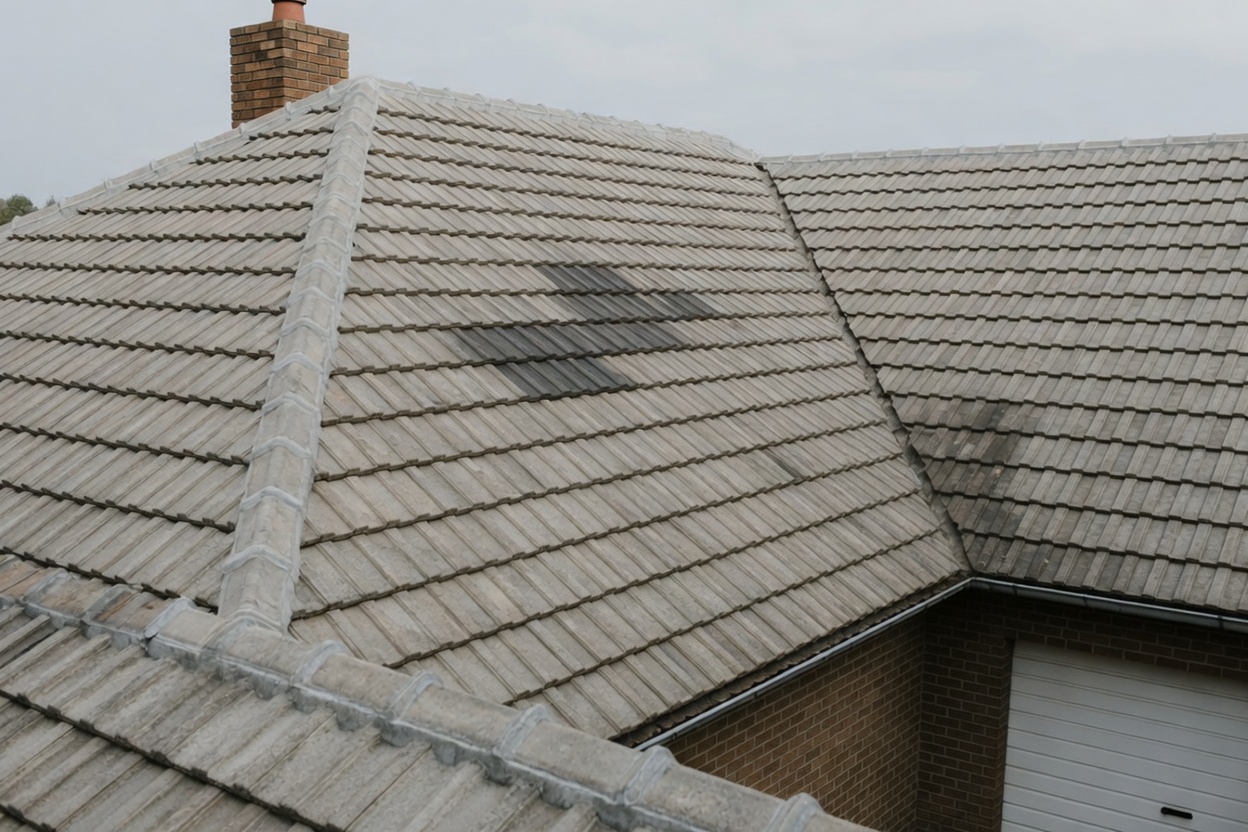
Concrete Tile Roof Maintenance: The Auckland Homeowner’s Guide
Last updated:
Quick answer: Concrete tile roof maintenance means treating moss and lichen, replacing cracked or slipped tiles, clearing gutters and valleys, and re-pointing ridge caps — done every year or two, it lets a concrete tile roof reach its full 50–60 year lifespan instead of failing early.
Half the brick-and-tile houses in Auckland have a concrete tile roof. Drive through Pakuranga, Howick, Massey or the East Coast Bays and you’re looking at street after street of them — most laid in the 1960s through the 1990s, most still going. That’s the good news. Concrete tiles are tough, and BRANZ puts their working life at 50 to 60 years before replacement is on the table.
The catch is that “50 to 60 years” assumes the roof gets looked after. Left alone, a concrete tile roof doesn’t last that long. Moss creeps under the tiles and holds water against them. The mortar holding the ridge caps cracks and lets wind and rain in. One slipped tile turns into a leak, the leak soaks the sarking, and suddenly a $300 job is a $6,000 one.
So how do you actually keep a concrete tile roof healthy — and how do you tell the difference between a roof that needs a bit of maintenance and one that’s genuinely had it? That’s what this guide covers. We do this work across Auckland every week, so we’ll be straight with you about what matters, what it costs, and when spending money on maintenance stops making sense.
Free cost calculator
Get a ballpark for your property job
Get an instant Auckland price range for your project — no details required to see it.
What Concrete Tile Roof Maintenance Actually Involves
Maintaining a concrete tile roof comes down to five jobs: clearing debris, treating biological growth, checking and replacing damaged tiles, keeping valleys and flashings sound, and re-pointing the ridge line when the mortar goes. None of it is glamorous. All of it is cheaper than the alternative.
Here’s the thing most homeowners don’t realise: a concrete tile roof rarely fails all at once. It fails in small, ignorable ways — a bit of moss here, a hairline crack there, a gutter that overflows in heavy rain. Each one seems minor. Together, over a few years, they’re what takes a roof from “good for another 20 years” to “needs replacing”.
Clearing debris, gutters and valleys
Leaves, moss clumps and general muck collect in the valleys (where two roof planes meet) and in the gutters. When they block up, water backs up under the tiles instead of running off. In Auckland’s wetter suburbs and anywhere with overhanging trees — think the older tree-lined streets of Mt Eden, Remuera or Titirangi — this is the single most common cause of tile-roof leaks we see.
Valleys matter more than gutters here. A blocked gutter overflows outward, which is annoying but visible. A blocked valley pushes water sideways under the tiles, where you won’t see it until it’s dripping through a ceiling.
💡 Property tip: Check your valleys and gutters after every autumn leaf-drop and after any big Auckland storm. Two ten-minute checks a year prevent the majority of tile-roof leaks.
Treating moss and lichen
Auckland’s warm, damp, humid climate is a paradise for moss and lichen, and concrete tiles — being slightly porous — hold onto it. It’s not just cosmetic. Moss traps moisture against the tile surface, which speeds up the breakdown of the tile’s coating and, over winter, can lift and crack tiles as it grows into the gaps.
Treatment is a chemical moss and mould wash, applied and left to work, rather than blasted off. This is where a lot of well-meaning homeowners go wrong: they hit the roof with a high-pressure water blaster. On concrete tiles that’s a mistake — the pressure strips the surface coating and drives water up under the tiles. Soft wash, not blast.
Replacing cracked and slipped tiles
Individual concrete tiles crack — from foot traffic, from a branch, from frost, or just from age. Others slip out of position when the nib or the fixing fails. A single cracked or slipped tile is a straightforward replacement, and it’s exactly the kind of small job that’s worth sorting immediately rather than waiting.
One honest warning: matching old concrete tiles can be tricky. Profiles change, colours fade, and some 1970s tile ranges are long out of production. We keep a stock of common Auckland profiles, but on an older roof, don’t expect a brand-new tile to blend in perfectly. Function first, appearance second.
This is a good moment to mention who we are. Superior Property Services handles exactly this kind of work — the small, awkward maintenance job that a big re-roofing outfit won’t bother turning up for. One call, and we sort it, usually within a working day. You can see the full scope on our concrete tile roof maintenance page.
That covers the day-to-day. But the job that most defines whether a tile roof survives its full lifespan is the one homeowners understand least — the ridge line. That’s next.
The Auckland-Specific Problems That Wreck Tile Roofs Early
Two things end concrete tile roofs before their time in Auckland: failed ridge pointing and our coastal, high-moss climate. Get on top of both and a tile roof will comfortably outlast its owner’s mortgage.
Failed ridge and hip pointing
The ridge caps — the tiles running along the very top and down the hips of the roof — are bedded and pointed with mortar. That mortar is the weak point of the whole system. Traditional mortar pointing typically starts cracking and crumbling from around 20 to 25 years, well before the tiles themselves are anywhere near done.
When the pointing goes, wind lifts the loose mortar out, the ridge caps loosen, and water gets straight into the roof space at the highest point — where it does the most damage. On a lot of Auckland roofs from the 1980s and 90s, the tiles are fine but the pointing is shot. That’s a re-pointing job, not a re-roof, and the difference in cost is enormous.
Modern flexible pointing compounds last far longer than the old sand-and-cement mortar. If your roof is due for re-pointing, it’s worth doing it properly with a flexible compound rather than patching the old mortar.
— Superior Property Services Team
Coastal exposure and salt
Auckland is a coastal city, and a huge number of homes sit within a few kilometres of the sea. Salt air is harder on roofs than most people think. For tile roofs in coastal suburbs — the Bays, Devonport, St Heliers, the whole eastern and North Shore coastline — the surface coating breaks down faster and moss takes hold more aggressively.
It doesn’t mean coastal tile roofs fail — plenty last their full life — but they need their maintenance intervals tightened. Where an inland Papakura roof might be fine on a two-yearly wash, a Bucklands Beach roof 400 metres from the water wants doing every year.
💡 Property tip: The closer you are to the coast, the shorter your maintenance interval. Within about 500 metres of the sea, treat moss and check tiles annually rather than every second year.
Surface coating breakdown
Concrete tiles come with a factory-applied surface coating that gives them their colour and helps shed water. That coating fades and wears — typically becoming noticeable from around 15 to 20 years. A faded, chalky roof isn’t necessarily a failed roof; the concrete underneath is still structurally sound, and the surface can often be cleaned and recoated rather than replaced.
Recoating is its own decision and sits closer to painting than maintenance — if that’s the road you’re going down, our team can point you to the right option for your roof, including whether a specialist roof coating or a full re-roof makes more sense for your situation. For general upkeep, though, cleaning and tile repair is the core of it. More on the repair-or-replace call in the next section.
Repair or Replace? The Honest Decision Framework
The single most useful thing to understand about a concrete tile roof is that the tiles and the fixings age at completely different rates. The tiles can be sound at 50 years while the pointing, the underlay and the flashings have failed twice over. That’s why “repair or replace” isn’t one question — it’s several.
When maintenance is the right call
If your tiles are largely intact, the leaks trace back to blocked valleys, failed pointing or a handful of cracked tiles, and the roof is under about 40 years old — you’re firmly in maintenance territory, and re-roofing would be spending tens of thousands to fix a few thousand dollars’ worth of problems.
Picture a typical situation. A homeowner in Howick calls us about a stain spreading across a bedroom ceiling. They’ve had two roofers quote a full re-roof at north of $30,000. We get up there and find the tiles are fine — it’s a cracked valley and about a metre of failed ridge pointing letting water in. Sorted for a fraction of the cost, roof good for another 15 to 20 years. That scenario plays out constantly.
When replacement genuinely makes sense
Replacement moves into the frame when the problems are structural and widespread, not isolated. If the roofing underlay (the sarking or building paper beneath the tiles) has perished, if a large proportion of tiles are cracked or delaminating, or if the roof has been leaking unaddressed for years and the framing is affected — patching stops being economic.
The other honest trigger is the patchwork problem. Once you’re replacing tiles across the roof and can’t match them, and you’re re-pointing and re-flashing at the same time, the cost of doing it all piecemeal starts to approach the cost of a proper re-roof — and a re-roof resets the clock and often the insurance position too. At that point it’s a genuine numbers conversation, not an obvious call either way.
Rough cost bands
Honest figures matter here, so these are indicative Auckland market ranges to plan around; your actual price always comes from a quote on your specific roof.
| Job | What it covers | Indicative cost (Auckland) |
|---|---|---|
| Moss & lichen soft wash | Full roof treatment, typical 3-bedroom home | From around $300 to $900 |
| Cracked / slipped tile replacement | Per-tile or small batch | Around $80 to $200 per tile (less per tile in bulk) |
| Ridge re-pointing | Full ridge & hip line, flexible compound | Around $1,500 to $3,000 (roughly $35 to $70 per metre) |
| Full concrete tile re-roof | Complete replacement, ~200m² home | $40,000+ (indicative NZ range — confirm per quote) |
The gap between the first three rows and the last one is the whole argument for maintenance. If you’d like real numbers for your specific roof, that’s what a quote is for — request one here and we’ll give you honest figures, not a scare.
There’s one more group this decision hits differently: landlords. If your concrete tile roof is on a rental, a leak isn’t just a repair bill — it’s a compliance problem. That’s next.
If Your Tile Roof Is on a Rental: The Healthy Homes Angle
A leaking roof on a rental property isn’t only a maintenance issue — it can put you offside with the Healthy Homes moisture ingress standard. This section is for landlords and investment owners; if you’re an owner-occupier, skip to the wrap-up.
Under the Healthy Homes Standards, rental properties must have efficient drainage and guttering, and the property must not have obvious sources of moisture getting in. A concrete tile roof with failed pointing or cracked tiles letting water into the ceiling space is exactly the kind of moisture ingress that fails that test — and a damp ceiling cavity feeds the mould problems that tenants (rightly) complain about.
Healthy Homes compliance note: The moisture ingress standard requires efficient drainage and guttering and no unreasonable moisture entry. A leaking tile roof can breach this. See the moisture ingress standard on Tenancy Services for the specific requirements.
For landlords in the high-rental suburbs where tile roofs are everywhere — Manurewa, Papakura, Māngere, Henderson — this is worth getting ahead of. A roof maintenance check before a tenancy turnover is far cheaper than an emergency repair mid-tenancy plus a Tenancy Tribunal headache. We work with a lot of Auckland landlords and property managers on exactly this, and because we’re one call for all trades, a roof check can happen alongside the rest of your between-tenancy work. Our landlord maintenance services cover the lot.
A concrete tile roof is one of the best assets an Auckland home has — but only if it’s maintained. Treat the moss, clear the valleys, keep an eye on the ridge line, and replace cracked tiles as they happen, and there’s no reason a sound tile roof shouldn’t see out its full 50 to 60 years. Ignore it, and you’ll be paying for a re-roof a decade or two early.
If you’re not sure what state yours is in, don’t guess from the ground. Get someone up there who’ll tell you the truth about whether it’s a maintenance job or something bigger.
➡ Request a free no-obligation quote from Superior Property Services
➡ Learn more about our concrete tile roof maintenance in Auckland
➡ Make an enquiry — we respond within 1 working day
How often should a concrete tile roof be maintained in Auckland?
For most Auckland homes, treat moss and check tiles, valleys and gutters every one to two years. Within about 500 metres of the coast, do it annually because salt air and higher moss loads shorten the safe interval. A full inspection is worth doing yearly once the roof passes 25 years old, as BRANZ recommends professional checks on older roofs.
How long does a concrete tile roof last in New Zealand?
BRANZ puts the working life of clay and concrete tile roofs at 50 to 60 years before replacement is needed, provided they are maintained. The tiles themselves are structurally sound for decades, but the ridge pointing typically needs redoing from 20 to 25 years and the surface coating fades from 15 to 20 years. Maintenance is what gets a roof to the top of that range rather than failing early.
Can you pressure wash a concrete tile roof?
High-pressure water blasting is not recommended on concrete tiles. The pressure strips the tile's surface coating and drives water up under the tiles, causing more harm than the moss it removes. A soft chemical moss and mould wash, applied and left to work, is the correct method. It clears biological growth without damaging the tile surface or forcing water into the roof space.
Why is my concrete tile roof leaking if the tiles look fine?
Most tile-roof leaks in Auckland are not caused by the tiles at all. The usual culprits are blocked valleys pushing water sideways under the tiles, failed ridge pointing letting water in at the top of the roof, or perished flashings. All three are maintenance repairs, not re-roofing jobs, and all three are far cheaper to fix than the water damage they cause if left.
What is ridge re-pointing and do I need it?
Ridge re-pointing replaces the mortar that beds and seals the ridge and hip tiles along the top of the roof. The original sand-and-cement mortar typically cracks and crumbles from around 20 to 25 years, well before the tiles wear out. If your roof is that age and you can see gaps or loose mortar along the ridge line, re-pointing is likely needed. Modern flexible pointing compounds last much longer than the old mortar.
How much does concrete tile roof maintenance cost in Auckland?
Maintenance jobs like moss treatment, tile replacement and ridge re-pointing run to a few hundred or low thousands of dollars, depending on roof size and access. A full concrete tile re-roof on a typical home starts around $40,000. That gap is the reason maintenance pays off. For accurate figures on your specific roof, request a quote from Superior Property Services rather than relying on generic estimates.
Should I repair or replace my concrete tile roof?
Repair if the tiles are largely sound and the problems are isolated: cracked tiles, blocked valleys, or failed pointing. Replace if the underlay has perished, a large proportion of tiles are cracked or delaminating, or the roof has been leaking long enough to affect the framing. Because tiles and fixings age at different rates, a roof can look old but only need maintenance. Get it inspected before deciding.
Does a leaking rental roof breach Healthy Homes standards?
It can. The Healthy Homes moisture ingress and drainage standard requires efficient guttering and drainage and no unreasonable moisture getting into the property. A concrete tile roof leaking into the ceiling space is a moisture source that can breach this standard and lead to the mould problems tenants complain about. Landlords should sort roof leaks promptly. The specific requirements are on the Tenancy Services website.
Can you match old concrete roof tiles?
Sometimes, but not always perfectly. Tile profiles change over the decades and some older ranges are out of production, so an exact match on a 1970s or 80s roof is not guaranteed. Colours also fade, so even a correct-profile new tile can look different against weathered ones. We keep common Auckland profiles in stock. The priority on a repair is a watertight, structurally sound roof, with appearance a close second.
How do I know if my roof is decramastic or concrete tile?
Concrete tiles are heavy, thick and made of moulded concrete, usually with a curved or ribbed profile. Decramastic tiles are pressed steel with a stone-chip coating and are much lighter and thinner. This matters because they need different maintenance and repair approaches. If you are not sure which you have, a quick inspection settles it, and it changes the advice on whether cleaning, recoating or replacement is the right path.
References
- BRANZ — Good Repair Guide: Clay and concrete roof tiles (BK180)
- Tenancy Services — Healthy Homes moisture ingress and drainage standard