
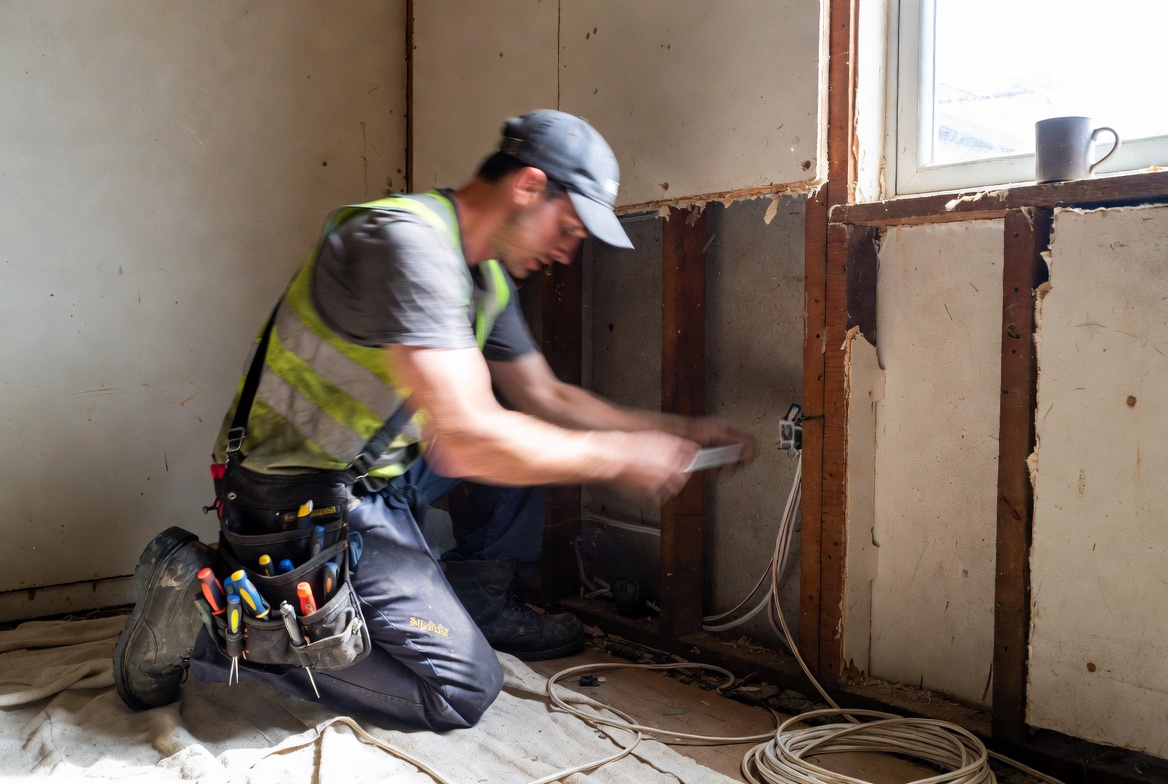
How Much to Rewire a House in NZ 2026 | Cost Guide
Quick answer: A standard three-bedroom timber home in NZ costs around $8,000 to $15,000 to rewire in 2026, with a switchboard upgrade typically adding $800 to $2,000. Four-bedroom or two-storey homes run $16,000 to $25,000 or more — and Auckland villas with original pre-1990 wiring sit at the upper end.
Free Cost Calculators
Try our free property cost calculators
Compare indicative prices for common Auckland property jobs in under a minute — no obligation.
A pre-1990 Auckland villa with original wiring is one of the most expensive problems most landlords don’t realise they own. Insurance companies do. Cover is being quietly refused — or quietly cancelled — on homes still running TRS or VIR rubber-sheathed cabling. If you’ve inherited one of these places, bought one cheap, or you’re renting one out and crossing your fingers, a full rewire isn’t a renovation upgrade. It’s a risk-removal job that someone is going to make you do eventually. The insurer, the council, or a tenant who’s had enough of the trips.
For a standard three-bedroom timber home in Auckland, a full rewire in 2026 costs $8,000 to $15,000. Four-bedroom houses, two-storey builds, and character villas with tricky access push past $16,000 to $25,000+. A modern switchboard with RCDs adds $800 to $2,000. None of those numbers include the part nobody quotes upfront: putting the walls back together once the electrician is done.
That’s the gap this guide closes. Whether you’re a homeowner trying to scope a job or a landlord working out whether to rewire between tenancies, the cost is only one piece. The signs you actually need it, the consents and certificates involved, AS/NZS 3000:2023 compliance, and the gib and paint reinstatement nobody mentions upfront — those are the things that determine the real number.
We do this every week at Superior Property Services. One call, all trades — electrician, gib stopper, painter — coordinated under one project manager instead of three separate arrangements. That matters most for landlords running between-tenancy timing and homeowners who can’t take time off work to chase tradies for site visits. Here’s everything you actually need to know.

What a Full House Rewire Actually Costs in NZ in 2026
Most online cost guides quote a range and leave it at that. The trouble is, rewire pricing is driven by four things that aren’t always visible from the outside — and one of them isn’t even electrical work. Get clear on these before you ring around for quotes.
Rewire cost by house size — 2026 NZ pricing
Across our trade network and the wider NZ electrical market, these are the realistic 2026 ranges for a full rewire. Auckland prices sit at the upper end of each band because of labour rates, access challenges in character suburbs, and the extra time involved in older housing stock.
| House size | Typical NZ rewire cost (2026) | Typical duration |
|---|---|---|
| 2-bedroom unit or small home | $8,000 – $11,000 | 3 – 5 working days |
| 3-bedroom timber home | $10,000 – $15,000 | 5 – 8 working days |
| 4-bedroom or two-storey home | $16,000 – $25,000 | 8 – 12 working days |
| Large villa or character home (5+ bed) | $25,000 – $40,000+ | 12 – 20 working days |
| Switchboard upgrade (add-on) | +$800 – $2,000 | +0.5 – 1 day |
The big variable nobody talks about: reinstatement. Rewiring an existing home means opening walls and ceilings to chase the new cabling through. That damage has to be patched, sanded, and repainted before the place is liveable again. Most pure-play electrician quotes don’t include this. On a three-bedroom Auckland villa with lath-and-plaster walls, gib repair and repainting can add $3,000 to $8,000 on top of the electrical quote. On a tidy 1970s brick-and-tile with gib walls and accessible ceiling space, the reinstatement bill can be far smaller.
What’s actually in the price
A proper full rewire quote should cover: stripping out the old cabling, running new TPS or similar cable through the walls, floor, and ceiling, installing modern outlets and switches, upgrading the switchboard to one with RCDs (or RCBOs), and issuing the EWRB-compliant paperwork at the end. If a quote doesn’t itemise the switchboard work, ask. If it doesn’t mention the Certificate of Compliance, ask harder.
Why Auckland pricing sits at the top of the range
Three reasons Auckland landlords and homeowners pay more. One: hourly rates here track at the upper end — $95 to $140 plus GST for domestic sparkies, with the busier suburbs (Remuera, Ponsonby, Mt Albert, Devonport) often quoting at the top. Two: character villas in Mt Eden, Grey Lynn, Ponsonby, and the older parts of Mt Albert have plaster walls, restricted subfloor access, and no roof crawl space — every metre of cable costs more to run. Three: demand for between-tenancy turnaround work pushes lead times out, and rush jobs always cost more than scheduled ones.
💡 Property tip: When you get rewire quotes, ask each electrician to either include reinstatement (gib repair + paint) or to give you a written estimate of the damage their work will create. Comparing electrical-only quotes side by side, without that line item, is how landlords get blindsided by a $5,000 paint and plaster bill they didn’t budget for.
For homeowners and landlords trying to coordinate that whole stack — electrical, gib, paint, sometimes tiles in wet areas — Superior Property Services manages the lot under one project, which is the SCG network advantage we’ll come back to in Section 4.
How to Tell If Your House Actually Needs Rewiring
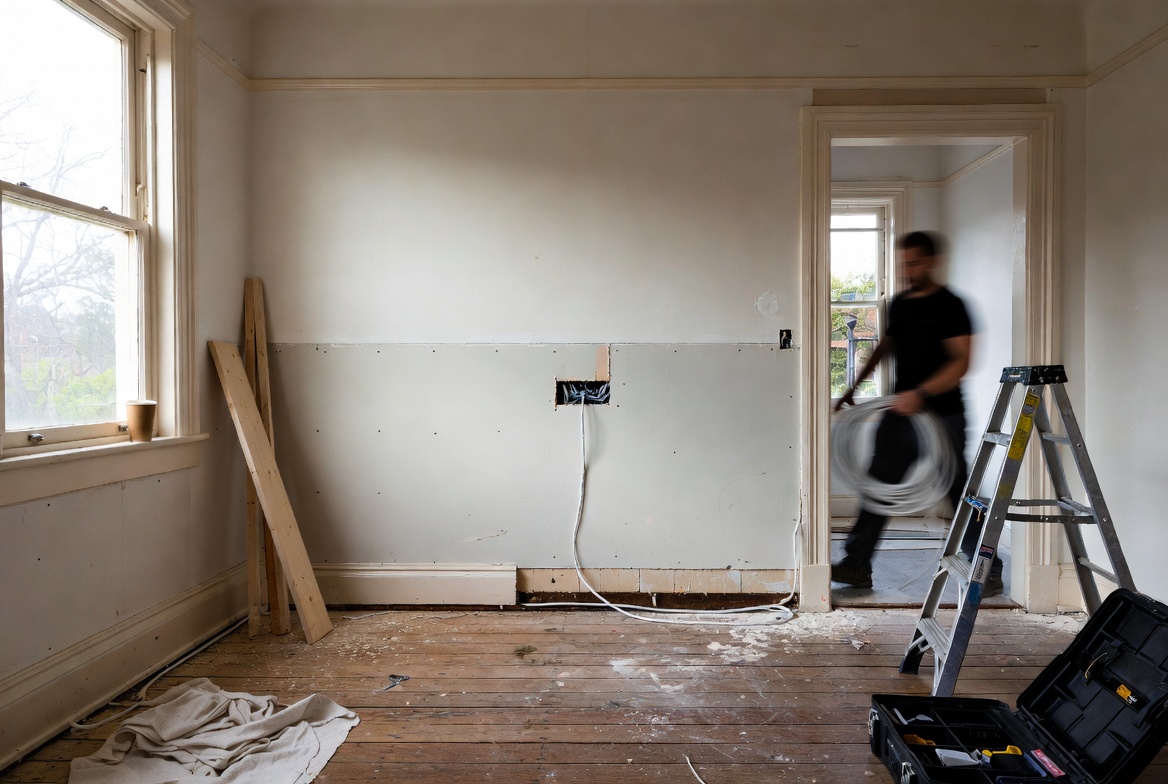
Not every old house needs a full rewire. Some need a switchboard upgrade and a few new circuits. Others need the lot. Here’s how to tell the difference before you spend on quotes.
The age clue — what cabling era is your house?
The fastest signal is the era of the cabling, which usually maps to when the house was built or last fully rewired. Pre-1960s homes often still have VIR (Vulcanised Indian Rubber) or TRS (Tough Rubber Sheath) cable — rubber-insulated wiring that becomes brittle and flammable as it ages. This is the stuff insurers refuse cover for. 1960s to mid-1990s homes commonly have early TPS (Thermoplastic Sheath) cable — generally safer than rubber but often missing earthing and certainly missing the RCD protection that modern AS/NZS 3000:2023 requires on every power circuit. Pre-2003 homes typically have no RCD protection at all, because RCDs only became mandatory on socket-outlet circuits after that.
If you can get a torch into the meter box or the ceiling space and you see cable that looks like rubbery black tubing rather than modern PVC-sheathed cable, get an electrician to confirm. If it’s TRS or VIR, you’re not deciding whether to rewire. You’re deciding when.
Switchboard signs that point to a rewire
Look at the switchboard itself. Ceramic fuses with porcelain bases and rewireable fuse wire mean you’re running an electrical system designed for 1950s appliance loads. No RCDs (those test buttons) mean no earth-leakage protection — a serious safety gap and a non-starter for landlords under modern compliance expectations. An undersized board with no spare circuits usually means any new appliance has to share an already-overloaded line.
Operational warning signs
Plenty of homes look fine until they don’t. Watch for circuit breakers tripping repeatedly without an obvious cause, lights flickering when an appliance kicks in, outlets that feel warm to the touch or look discoloured, a burning smell near switches or sockets, and two-pin outlets without an earth pin. Any of these, individually, mean “get an electrician out.” Several at once mean “stop using affected circuits and get them out today.”
💡 Property tip: If you’ve just bought an older Auckland home and the LIM didn’t include a recent electrical inspection, book an EWRB-registered electrician for a switchboard and visible-cabling inspection in the first month. It costs $200 to $400 and tells you whether you’re sitting on a $1,500 switchboard job or a $20,000 rewire. We’ve seen plenty of buyers find out the hard way after moving in.
The insurance angle — what insurers refuse cover for
This is where the financial pressure really lands. Most major NZ insurers will refuse new cover or cancel renewal cover on homes with TRS or VIR wiring still in service. Some will exclude electrical-fire claims. Standard home insurance does not cover the cost of replacing old wiring just because it’s old — but if a fire is traced to that wiring, you may find you weren’t covered for the damage either. Always check the small print, and disclose old cabling to your insurer rather than hoping they don’t notice. For landlords, the implications are bigger again — we’ll come back to that.
Healthy Homes compliance note: The Healthy Homes Standards don’t directly require RCDs or a full rewire, but smoke alarm compliance under the Residential Tenancies Act does. Long-life photoelectric or hard-wired smoke alarms must be installed within 3 metres of every bedroom door and on every level — in force for all rental properties since 1 July 2016. From 1 November 2024, new builds and major renovations must have interconnected hard-wired alarms across all bedrooms and living spaces. If you’re already opening the ceiling for a rewire, sorting both at once is the obvious play.
Consent, Certification, and What’s Legally Required
This is where most homeowners get nervous and most landlords get caught short. The rules around electrical work in NZ are tighter than people expect — and the paperwork an electrician must give you is more than a formality. It’s your legal protection if something goes wrong years later.
AS/NZS 3000:2023 — the standard everything must meet
Every electrical installation in NZ has to comply with the current edition of the Wiring Rules — AS/NZS 3000:2023. That standard requires RCD protection on all socket-outlet circuits (30mA trip, within 30 milliseconds), proper earthing, and modern circuit protection. If your house is being rewired, the whole installation has to be brought up to that standard. You don’t get to keep some old circuits because they “still work.”
EWRB registration — check before you hire
All electrical work classified as Prescribed Electrical Work (PEW) — which includes any fixed wiring, switchboard upgrades, or full rewires — must be done by an electrician currently registered with the Electrical Workers Registration Board (EWRB). This is the single check every landlord and homeowner should do before signing a quote. Search the EWRB online register, confirm the practising licence is current, and keep a copy of the registration number with your job paperwork. It takes two minutes. If the person on your driveway doesn’t have a current EWRB licence, no electrical work they do is legal — and no insurer will pay out on a claim related to it.
Certificate of Compliance (CoC), Electrical Safety Certificate (ESC), and Record of Inspection (RoI)
Under Regulation 65 of the Electricity (Safety) Regulations 2010, a Certificate of Compliance (CoC) must be issued for all general-risk and high-risk Prescribed Electrical Work. For a full rewire, you should also receive an Electrical Safety Certificate (ESC) when the installation is reconnected to power. High-risk PEW also requires a Record of Inspection (RoI) from a licensed electrical inspector before the work can be signed off.
The electrician must issue these within 20 working days of completion (sooner is normal), and you should keep all three on file for at least 7 years. Insurers ask for them after fires. Buyers ask for them at sale. Tenancy Services and the Tribunal ask for them in disputes. The paperwork is the difference between “we did it properly” and “prove it.”
— Superior Property Services Team
Where building consent comes in
This is the part the pure-play electrician guides miss. A pure electrical rewire is Prescribed Electrical Work and doesn’t usually need a building consent on its own. But reopening walls and ceilings often does — especially if there’s any structural alteration, if the property is older than 1991 and has fibrous plaster ceilings, or if you’re combining the rewire with bathroom or kitchen alterations. Auckland Council guidance changes here regularly, and the practical answer is to confirm with your electrician and a Licensed Building Practitioner (LBP) before work starts. If consent is needed, it’s needed before any wall comes down — not after.
💡 Property tip: If you’re rewiring as part of a wider renovation — new bathroom, kitchen, or floor plan changes — the building consent and electrical certification have to be coordinated. Get one project manager handling both. Trying to coordinate an electrician, an LBP, and a council inspector across three separate phone numbers is how timelines blow out and paperwork gets lost.
Healthy Homes compliance note: If you’re a landlord rewiring a rental, this is the moment to confirm every Healthy Homes Standard is also being met — heating in the main living area, insulation in the ceiling and underfloor, kitchen and bathroom extractor fans (50 L/s and 25 L/s respectively, vented outside), draught-stopping, and moisture barriers where required. See the full requirements at tenancy.govt.nz. Doing them together saves a second mobilisation and a second round of reinstatement.
The Landlord Lens — Tenancy Risk, Between-Tenancy Timing, and Coordination
If you’re a landlord or property manager reading this, the cost numbers are only half the equation. The other half is operational — when do you do the work, how do you do it without burning a tenancy, and how do you stop the project ballooning across three separate trades and three separate timelines.
Why landlords with TRS or VIR wiring are exposed
The exposure is real and stacking. Insurance: cover refused or cancelled if old rubber wiring is in service. Tenant safety: a tenant injured by an electrical fault has a clear claim, and the Tenancy Tribunal takes a dim view of landlords who knew the property had pre-1990 wiring and did nothing. Resale: buyers and their lawyers now routinely request electrical certificates before settlement, and an old switchboard can knock thousands off a sale price. Tenancy Tribunal: if a tenant raises an electrical safety concern through FastTrack Resolution and you can’t produce certificates, you’re already on the back foot.
It’s not a question of whether old wiring eventually becomes a tenancy risk. It’s a question of whether it becomes a risk before you’ve sorted it, or after.
Between-tenancy is your only realistic window
A full rewire on an occupied rental is, in practical terms, almost impossible. Power has to be off in stages, walls have to be opened, dust and debris are everywhere, and the tenant has to vacate rooms one at a time. We’ve done it before for landlords with no other option, but it’s slow and the tenant relationship rarely survives it. Between-tenancy is the window.
If you’ve got a tenant moving out — or you’ve just had one move out — that’s your moment. The typical Auckland rental turnover window is 5 to 14 days, and a small-to-mid rewire fits inside that comfortably if it’s planned properly. The trick is having all the trades lined up before the keys come back. A landlord ringing around for quotes after the tenant has already moved out has lost the window.
The trade coordination problem most landlords hit
Here’s the thing. A rewire isn’t an electrician’s job. It’s an electrician, a gib stopper, a painter, and sometimes a tiler — coordinated across about a fortnight. Most landlords trying to manage this themselves end up booking three or four separate trades, each with their own schedule, each with their own quote, and each waiting for the previous one to finish before they can start.
If the painter shows up before the gib has cured properly, the paint cracks. If the electrician hits a piece of cabling the plumber should have rerouted, the timeline goes back two days. If the tiler can’t get on site because the gib stopper is running late, the whole turnover slips. This is what kills rental turnaround budgets — not the cost of the rewire itself.
That’s the gap Superior Property Services fills for landlords. One point of contact, one project manager, one coordinated schedule across the full SCG trade network. Electrician, gib stopper, painter, plumber if needed — all booked and sequenced together. We don’t sub out the coordination back to the landlord, which is what most pure-play trades do.
Healthy Homes electrical safety adjacency
When the ceiling is open for a rewire, the practical thing is to do the smoke alarm work at the same time. The Tenancy Services smoke alarm guide sets out the standard: long-life photoelectric alarms (minimum 8-year battery) or hard-wired alarms, within 3 metres of every bedroom door, on every level. From 1 November 2024 new builds and major renovations must have interconnected hard-wired alarms across bedrooms and living spaces — and if you’re doing a full rewire, “major renovation” probably applies. Confirm with your electrician. Doing the smoke alarms separately, six months later, doubles the disruption and roughly doubles the labour cost.
Healthy Homes compliance note: Landlords sometimes ask whether RCDs are required under Healthy Homes. They’re not — but they’re required under AS/NZS 3000:2023, which any rewire has to meet. The Standards don’t excuse you from the Wiring Rules. If you’d rather sort the lot in one go — heating, insulation, ventilation, smoke alarms, electrical — between-tenancy is the only sensible window, and a coordinated trade network is the only sensible way to do it.
For Auckland property managers
If you’re managing a portfolio, the rewire conversation usually starts with a maintenance request that you didn’t expect — a tenant reporting flickering lights, a tripping circuit that keeps coming back, or an old switchboard your last electrician flagged “informally.” The cost of letting that drift through 18 months of patch-up calls almost always exceeds the cost of one properly-scoped rewire between tenancies. We work with property managers across Auckland on B2B trade network partnerships built specifically for this kind of work — one supplier, one process, one set of paperwork.
One of our property manager clients in Manurewa flagged a portfolio rental last winter where the switchboard still had ceramic fuses and two of the bedrooms had two-pin outlets. The tenant hadn’t complained — yet — but the next routine inspection was going to surface it. We rewired between tenancies in nine days, including ceiling insulation top-up and three new extractor fans. Total cost to the landlord, including reinstatement: $18,400. Cost of finding out the hard way? Hard to put a number on it, but it would have started with an insurance claim being declined.
When to Rewire, When to Patch, and What to Do Next
Not every old wiring story ends in a full rewire. If your switchboard is the main problem, a board upgrade and a few new circuits ($2,500 to $5,000) might be enough for now. If you’re planning a kitchen or bathroom renovation in the next year or two, doing the rewire as part of that wider project usually makes more sense than splitting it into two jobs. And if the cabling is modern TPS in good condition but you just want more outlets and RCD protection, you don’t need to rewire the whole house — you need targeted work and a switchboard upgrade.
The full-rewire decision usually lands when three things stack up: pre-1990 cabling (TRS, VIR, or older), a switchboard that’s past it, and either an insurance flag or a renovation that’s already going to open the walls. If any two of those apply to you, the rewire conversation is worth having now — not later, not after settlement, not after the next tenant moves in.
For Auckland homeowners trying to figure out whether they need it, the cheapest first step is a switchboard and visible-cabling inspection from an EWRB-registered electrician. $200 to $400, and you’ll know. For landlords and property managers, the smarter first step is to scope it against the next tenancy turnover and build the budget around that window rather than waiting for a tenant complaint to force the timing.
If you’d like a proper scoped quote — electrical work plus reinstatement, with the paperwork and coordination handled — we run this exact type of project for homeowners, landlords, and property managers across Auckland every week.
➡ Request a free no-obligation quote from Superior Property Services
➡ Learn more about our landlord property services in Auckland
➡ Make an enquiry — we respond within 1 working day
Frequently Asked Questions
How much does it cost to rewire a 3-bedroom house in NZ in 2026?
A standard three-bedroom timber home in NZ costs $10,000 to $15,000 to rewire in 2026, with most Auckland properties sitting in the $11,000 to $14,000 range. A switchboard upgrade with RCDs typically adds $800 to $2,000. Reinstatement (gib repair and repainting) adds another $3,000 to $8,000 on top, which most pure-electrical quotes don't include. Always ask whether reinstatement is in the quote or separate.
How much does it cost to rewire a 4-bedroom house in NZ?
A four-bedroom or two-storey home in NZ costs $16,000 to $25,000+ to rewire in 2026, depending on age, accessibility, and condition. Character villas with plaster walls, restricted subfloor access, or no roof crawl space push past $30,000. Switchboard upgrades and reinstatement are usually additional. Auckland prices typically sit at the upper end of these ranges due to higher labour rates and older housing stock.
How long does a full house rewire take in NZ?
A full house rewire typically takes 3 to 12 working days depending on size: 3-5 days for a 2-bedroom unit, 5-8 days for a 3-bedroom home, and 8-12 days for a 4-bedroom or two-storey house. Add another 3-7 days for gib repair, sanding, and repainting before the property is liveable again. Between-tenancy turnover windows of 10-14 days fit most small-to-mid rewires comfortably if trades are coordinated upfront.
How do I know if my house needs rewiring?
Common signs include frequent circuit breaker trips, flickering lights, warm or discoloured outlets, a burning smell near switches, two-pin (unearthed) outlets, ceramic fuses on the switchboard, no RCD protection, and visible rubber or cloth-sheathed cabling. Pre-1990 NZ homes often have TRS or VIR wiring that insurers now refuse to cover. If you see any of these, book an EWRB-registered electrician for a switchboard and cabling inspection ($200-$400).
Do I need building consent to rewire a house in NZ?
A pure electrical rewire is classified as Prescribed Electrical Work and doesn't usually require building consent on its own — but it must be done by an EWRB-registered electrician and certified with a Certificate of Compliance under Regulation 65 of the Electricity (Safety) Regulations 2010. Building consent may be required if the rewire involves wall removal, structural alteration, or is combined with a bathroom or kitchen renovation. Confirm with your electrician and council before work starts.
Is rewiring covered by insurance?
Standard home insurance does not cover the cost of replacing wiring just because it's old. However, if wiring is damaged by an insured event (fire, earthquake, storm), the rewiring may be covered as part of the repair. The bigger issue is that many NZ insurers will refuse or cancel cover on homes with pre-1990 TRS or VIR rubber-sheathed wiring still in service. Always disclose old cabling to your insurer rather than risk a refused claim.
Can I rewire a house myself in NZ?
No. Under the Electricity Act 1992, homeowners and landlords cannot perform fixed wiring or any Prescribed Electrical Work in their own properties — only EWRB-registered electricians can. Replacing a light bulb is fine. Replacing a power point, switchboard, or any fixed wiring is not. Any uncertified electrical work voids insurance cover and creates a serious safety and legal liability if anything goes wrong.
Do landlords have to rewire old rental properties in NZ?
The Residential Tenancies Act and Healthy Homes Standards don't specifically mandate a rewire on old rental properties, but landlords must provide premises that are safe and meet electrical safety requirements. If the property has pre-1990 TRS or VIR wiring, insurers may refuse cover and the Tenancy Tribunal has consistently held landlords responsible for known electrical safety risks. In practice, most older Auckland rentals need rewiring within the next 5-10 years — between-tenancy is the only realistic window.
What's the difference between a partial and full house rewire?
A partial rewire replaces specific circuits or sections of cabling, typically the kitchen, bathroom, or older wings of the house, while leaving sound modern circuits in place. A full rewire replaces every cable, outlet, and switch in the home and includes a new switchboard. Partial rewires cost $2,500 to $7,000 and suit homes with mostly modern TPS cabling. Full rewires are necessary when most or all cabling is pre-1990 or fails inspection.
What is TRS, VIR, and TPS cabling and why does it matter?
VIR (Vulcanised Indian Rubber) and TRS (Tough Rubber Sheath) are rubber-insulated cables used in pre-1960s NZ homes. The rubber becomes brittle and flammable with age, creating fire risk and prompting insurance refusal. TPS (Thermoplastic Sheath) is the PVC-sheathed cable used from the 1960s onwards — generally safer, but pre-2003 TPS installations often lack RCD protection and earthing required under AS/NZS 3000:2023. Identifying which is in your walls is the first step in scoping a rewire.
Do I need a switchboard upgrade as part of a rewire?
Almost always yes, if the rewire is being done to meet current AS/NZS 3000:2023 standards. Modern switchboards include RCDs (or RCBOs) providing 30mA earth-leakage protection on all socket-outlet circuits and properly rated MCBs. A switchboard upgrade adds $800 to $2,000 to a rewire and is rarely worth skipping — old ceramic-fuse boards can't be brought up to the current standard, and most insurers and buyers now expect to see a modern board on any post-rewire property.
How do I find a registered electrician for a rewire in Auckland?
Check the EWRB online register at ewrb.govt.nz to confirm any electrician's practising licence is current before you sign a quote. Ask for three references from rewires they've done in the last 12 months, and ask to see a sample Certificate of Compliance from a recent job. For landlords and property managers wanting coordinated trades (electrical plus gib and paint reinstatement), Superior Property Services manages the full job under one project manager across the Auckland region — request a quote at superiorpropertyservices.co.nz.
Need Property Maintenance Help in Auckland?
Get a free no-obligation quote from Superior Property Services.
We respond within 1 working day.
Or call us: 0800 199 888
www.superiorpropertyservices.co.nz